Snow Bunting

Snow Bunting

Plectrophenax nivalis

Silhouette: Lauren McLean · PhyloPic

LCLeast ConcernNTVUENCR
Daily sighting probability <5% · Rare
at Toronto

In 3 days <5%

449 Verified sightings at Toronto
3,892 In all 15 parks From 2019 to 2026
November Best month
☀️ Diurnal When it's spotted

About the Snow Bunting

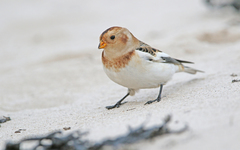
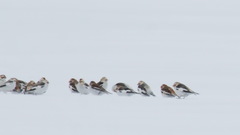
The snow bunting (Plectrophenax nivalis) is a passerine bird in the family Calcariidae. It is an Arctic specialist, with a circumpolar Arctic breeding range throughout the northern hemisphere. There are small isolated populations on a few high mountain tops south of the Arctic region, including the Cairngorms in central Scotland and the Saint Elias Mountains on the southern Alaska-Yukon border, as well as the Cape Breton Highlands. The snow bunting is the most northerly recorded passerine in the world.

The snow bunting was formally described by the Swedish naturalist Carl Linnaeus in 1758 in the tenth edition of his Systema Naturae. He placed it with the buntings in the genus Emberiza and coined the binomial name Emberiza nivalis. He specified the locality as Lapland. It is now placed in the genus Plectrophenax, described in 1882 by the Norwegian born zoologist Leonhard Stejneger with the snow bunting as the type species. The genus name Plectrophenax is from Ancient Greek plektron, "cock's spur", and phenax "imposter", and the specific nivalis is Latin for "snow-white".

The snow bunting was formerly classified in the family Emberizidae, which included American sparrows... Wikipedia →

Sounds

Call0:19

Norway · 2026

© Mats Rellmar · XC1173234 · CC BY-NC-SA 4.0

Alarm call0:53

Norway · 2026

© bert de bruin · XC1143780 · CC BY-NC-SA 4.0

Flight call0:15

France · 2025

© Lucien Hueber · XC1060935 · CC BY-NC-SA 4.0

Global Distribution

Parks Where Found

# Park Country Daily sighting probability
1 Svalbard 🇳🇴 Norway
~80%
2 Vatnajokull National Park 🇮🇸 Iceland
~60%
3 Wrangell-St. Elias National Park 🇺🇸 United States
~10%
4 Wood Buffalo National Park 🇨🇦 Canada
~10%
5 Wadden Sea National Park 🇩🇪 Germany
~10%
6 Cairngorms National Park 🇬🇧 United Kingdom
~10%
7 Kluane National Park 🇨🇦 Canada
<5%
8 Merritt Island National Wildlife Refuge 🇺🇸 United States
<5%
9 Acadia National Park 🇺🇸 United States
<5%
10 Kenai Fjords National Park 🇺🇸 United States
<5%
11 Point Pelee National Park 🇨🇦 Canada
<5%
12 Redwood National Park 🇺🇸 United States
<5%
13 Pacific Rim National Park Reserve 🇨🇦 Canada
<5%
14 Shenandoah National Park 🇺🇸 United States
<5%
15 Great Bear Rainforest 🇨🇦 Canada
<5%

Cities Where Found

# City Country Daily sighting probability
1 Boston 🇺🇸 United States
<5%
2 Chicago 🇺🇸 United States
<5%
3 Helsinki 🇫🇮 Finland
<5%
4 Toronto 🇨🇦 Canada
<5%
5 Montreal 🇨🇦 Canada
<5%
6 Copenhagen 🇩🇰 Denmark
<5%
7 Porto 🇵🇹 Portugal
<5%
8 San Francisco 🇺🇸 United States
<5%
9 Edmonton 🇨🇦 Canada
<5%
10 Liverpool 🇬🇧 United Kingdom
<5%

Before you go

What are the chances of seeing a Snow Bunting in Toronto?

Rare

Under 5% of wildlife watchers report a Snow Bunting sighting in Toronto on a given day, based on 449 verified sightings from GBIF citizen-science data. It is the 186th most-seen of the 288 birds we can rate there. Over three days the chance rises to under 5%, if each day is a fresh chance.

When is the best time to see a Snow Bunting in Toronto?

November

In that month about 10% of wildlife watchers report a Snow Bunting in Toronto on a given day, against under 5% in December to October, the lowest months.

What time of day is best to see a Snow Bunting?

Between 1 and 4 pm

Across all the parks we cover, that three-hour window holds the most Snow Bunting sightings with a recorded time, and about 9 in 10 of them come between 6 am and 6 pm: it is a daytime animal.

Is Toronto the best place to see a Snow Bunting?

Among the best

Of the 15 cities where we can rate Snow Bunting sightings, Toronto ranks 4th at under 5%, level with the leaders once rounded. The best odds are in Boston (United States, under 5%), Chicago (United States, under 5%) and Helsinki (Finland, under 5%).

Where does the Snow Bunting sighting chance come from?

GBIF citizen-science records

It is estimated from how often the Snow Bunting is recorded against all the birds logged in Toronto (449 verified sightings), calibrated against known sighting rates. Figures are rounded to the nearest 10% because citizen-science data supports honest approximations, not decimals, and months with records from fewer than five people show "—". How it works.

← Back to Toronto