Stoat

Stoat

Mustela erminea

Silhouette: Margot Michaud · PhyloPic

LCLeast ConcernNTVUENCR
Daily sighting probability <5% · Rare
at Toronto

In 3 days ~10% in a week ~20%

7 Verified sightings at Toronto
109 In all 13 parks From 2019 to 2026
October Best month
☀️ Diurnal When it's spotted

About the Stoat

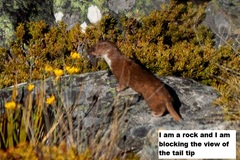
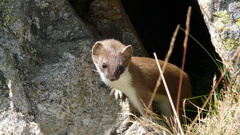
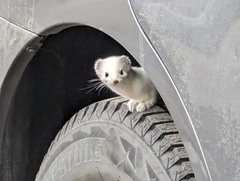
The stoat (Mustela erminea), also known as the Eurasian ermine or ermine, is a species of mustelid native to Eurasia and the northern regions of North America. Because of its wide circumpolar distribution, it is listed as Least Concern on the IUCN Red List. The name ermine is used especially in its pure white winter coat of the stoat or its fur. Ermine fur was used in the 15th century by Catholic monarchs, who sometimes used it as the mozzetta cape. It has long been used on the ceremonial robes of members of the United Kingdom House of Lords. It was also used in capes on images such as the Infant Jesus of Prague.

The stoat was introduced into New Zealand in the late 19th century to control rabbits. However, they have had a devastating effect on native bird populations; as such, the species was nominated as one of the world's top 100 "worst invaders".

The root word for "stoat" is likely either the Dutch word stout ("bold") or the Gothic word 𐍃𐍄𐌰𐌿𐍄𐌰𐌽 (stautan, "to push"). According to John Guillim, in his Display of Heraldrie, the word "ermine" is likely derived from Armenia, the nation where it was thought the species originated, though other authors have linked it... Wikipedia →

Sounds

Recording0:28

New Zealand · 2024

© jjaeg · iNaturalist · CC BY-NC 4.0

Recording0:07

United Kingdom · 2024

© Malcolm MacGarvin · iNaturalist · CC BY-NC 4.0

Global Distribution

Parks Where Found

# Park Country Daily sighting probability
1 Vanoise National Park 🇫🇷 France
~30%
2 Aoraki Mount Cook National Park 🇳🇿 New Zealand
~20%
3 Egmont National Park 🇳🇿 New Zealand
~20%
4 Mercantour National Park 🇫🇷 France
~20%
5 Ecrins National Park 🇫🇷 France
~20%
6 Point Pelee National Park 🇨🇦 Canada
~10%
7 Gros Morne National Park 🇨🇦 Canada
~10%
8 Fiordland National Park 🇳🇿 New Zealand
~10%
9 Great Bear Rainforest 🇨🇦 Canada
~10%
10 Banff National Park 🇨🇦 Canada
~10%
11 Glacier National Park 🇺🇸 United States
~10%
12 Pyrénées National Park 🇫🇷 France
~10%
13 Rocky Mountain National Park 🇺🇸 United States
<5%

Cities Where Found

# City Country Daily sighting probability
1 Helsinki 🇫🇮 Finland
~10%
2 Anchorage 🇺🇸 United States
~10%
3 Edmonton 🇨🇦 Canada
<5%
4 Boston 🇺🇸 United States
<5%
5 Vancouver 🇨🇦 Canada
<5%
6 Toronto 🇨🇦 Canada
<5%

Zoos & Centres Where Found

# Zoo / Centre Country
1 Flamingo Land Resort 🇬🇧 United Kingdom In captivity
2 British Wildlife Centre 🇬🇧 United Kingdom In captivity
3 AQUA Akvarium & Dyrepark 🇩🇰 Denmark In captivity
4 Reykjavík Park and Zoo 🇮🇸 Iceland In captivity

Before you go

What are the chances of seeing a Stoat in Toronto?

Rare

Under 5% of wildlife watchers report a Stoat sighting in Toronto on a given day, based on 7 verified sightings from GBIF citizen-science data. It is the 22nd most-seen of the 23 mammals we can rate there. Over three days the chance rises to about 10%, and over a week to about 20%, if each day is a fresh chance.

When is the best time to see a Stoat in Toronto?

Any time of year

In every month with enough records, under 5% of wildlife watchers report a Stoat in Toronto on a given day, so our monthly data shows no clear season.

What time of day is best to see a Stoat?

Between 2 and 5 pm

Across all the parks we cover, that three-hour window holds the most Stoat sightings with a recorded time, and about 9 in 10 of them come between 6 am and 6 pm: it is a daytime animal.

Is Toronto the best place to see a Stoat?

6th of 6

Of the 6 cities where we can rate Stoat sightings, Toronto ranks 6th at under 5%. The best odds are in Helsinki (Finland, about 10%), Anchorage (United States, about 10%) and Edmonton (Canada, under 5%).

Where does the Stoat sighting chance come from?

GBIF citizen-science records

It is estimated from how often the Stoat is recorded against all the mammals logged in Toronto (7 verified sightings), calibrated against known sighting rates. Figures are rounded to the nearest 10% because citizen-science data supports honest approximations, not decimals, and months with records from fewer than five people show "—". How it works.

← Back to Toronto