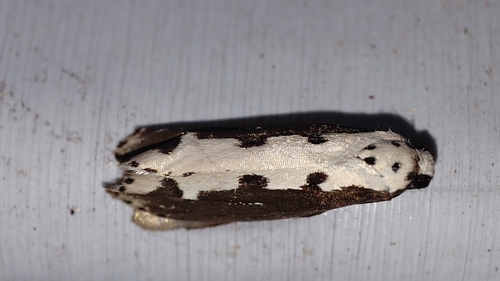
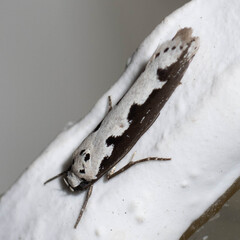
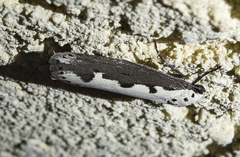
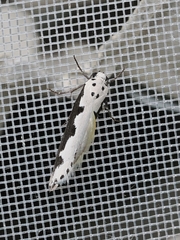





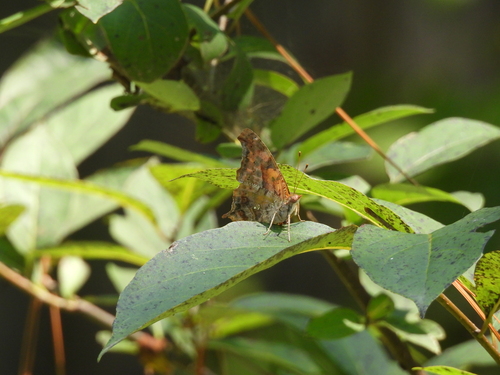
Viper's Bugloss Moth

Viper's Bugloss Moth

Ethmia bipunctella

Daily sighting probability <5% · Rare
at Toronto

In 3 days ~10%

6 Verified sightings at Toronto
69 In all 6 parks From 2019 to 2026
July Best month
🌙 Nocturnal When it's spotted

About the Viper's Bugloss Moth

The E. bipunctella invalidly described in 1936 by H. Rebel in L. Osthelder is actually E. distigmatella. Ethmia bipunctella is a diurnal moth from the family Depressariidae. It can be found in Central and Southern Europe, North Africa, Asia and the northeastern part of North America. E. iranella was formerly included here as a subspecies.

The wingspan of the moth ranges from 19–28 millimetres (0.75–1.10 in). The flight time ranges from May to September. The moth is bivoltine, having two generations per year. The most important host plant is the viper's bugloss, but also Anchusa officinalis and plants from the genus Symphytum. Pupae are attached to dead wood. Wikipedia →

Global Distribution

Parks Where Found

# Park Country Daily sighting probability
1 Monfragüe National Park 🇪🇸 Spain
~10%
2 Sierra Nevada National Park 🇪🇸 Spain
~10%
3 Doñana National Park 🇪🇸 Spain
~10%
4 Sierra de Guadarrama National Park 🇪🇸 Spain
~10%
5 Bavarian Forest National Park 🇩🇪 Germany
~10%
6 Pyrénées National Park 🇫🇷 France
<5%

Cities Where Found

# City Country Daily sighting probability
1 Madrid 🇪🇸 Spain
~20%
2 Porto 🇵🇹 Portugal
~10%
3 Copenhagen 🇩🇰 Denmark
<5%
4 Helsinki 🇫🇮 Finland
<5%
5 Barcelona 🇪🇸 Spain
<5%
6 Lisbon 🇵🇹 Portugal
<5%
7 Prague 🇨🇿 Czechia
<5%
8 Vienna 🇦🇹 Austria
<5%
9 Toronto 🇨🇦 Canada
<5%

Before you go

What are the chances of seeing a Viper's Bugloss Moth in Toronto?

Rare

Under 5% of wildlife watchers report a Viper's Bugloss Moth sighting in Toronto on a given day, based on 6 verified sightings from GBIF citizen-science data. It is the 1410th most-seen of the 1689 insects we can rate there. Over three days the chance rises to about 10%, if each day is a fresh chance.

When is the best time to see a Viper's Bugloss Moth in Toronto?

Any time of year

In every month with enough records, under 5% of wildlife watchers report a Viper's Bugloss Moth in Toronto on a given day, so our monthly data shows no clear season.

What time of day is best to see a Viper's Bugloss Moth?

Between 10 pm and 1 am

Across all the parks we cover, that three-hour window holds the most Viper's Bugloss Moth sightings with a recorded time, and about 7 in 10 of them come between 6 pm and 6 am: it is mostly seen at night.

Is Toronto the best place to see a Viper's Bugloss Moth?

9th of 9

Of the 9 cities where we can rate Viper's Bugloss Moth sightings, Toronto ranks 9th at under 5%. The best odds are in Madrid (Spain, about 20%), Porto (Portugal, about 10%) and Copenhagen (Denmark, under 5%).

Which relatives of the Viper's Bugloss Moth live in Toronto?

Same order: Lepidoptera

The closest relatives of the Viper's Bugloss Moth that you can see in Toronto (order Lepidoptera, Butterflies and Moths) are Monarch (about 40%), Common Blue (about 30%) and Red Admiral (about 30%), with each one's daily chance of a sighting.

Where does the Viper's Bugloss Moth sighting chance come from?

GBIF citizen-science records

It is estimated from how often the Viper's Bugloss Moth is recorded against all the insects logged in Toronto (6 verified sightings), calibrated against known sighting rates. Figures are rounded to the nearest 10% because citizen-science data supports honest approximations, not decimals, and months with records from fewer than five people show "—". How it works.

← Back to Toronto