Grape Phylloxera

Grape Phylloxera

Daktulosphaira vitifoliae

Daily sighting probability <5% · Rare
at Vienna

In 3 days ~10% in a week ~20%

7 Verified sightings at Vienna
5 In 1 park From 2019 to 2026
October Best month
☀️ Diurnal When it's spotted

About the Grape Phylloxera

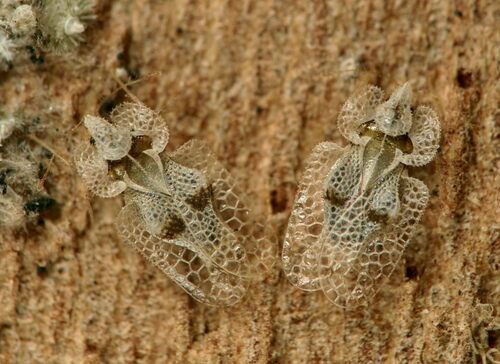
Grape phylloxera is an insect pest of grapevines worldwide, originally native to eastern North America. Grape phylloxera (Daktulosphaira vitifoliae Fitch 1855) belongs to the family Phylloxeridae, within the order Hemiptera, bugs); originally described in France as Phylloxera vastatrix; it is equated to the previously described Daktulosphaera vitifoliae and Phylloxera vitifoliae. The insect is commonly just called phylloxera (from Ancient Greek: φύλλον, leaf, and ξηρός, dry).

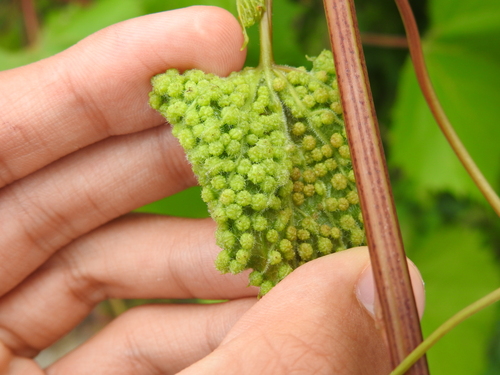
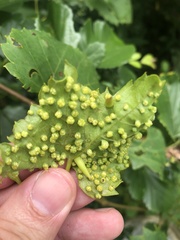
These almost microscopic, pale yellow, sap-sucking insects, related to aphids, feed on the roots and leaves of grapevines (depending on the phylloxera genetic strain). On Vitis vinifera, the resulting deformations on roots ("nodosities" and "tuberosities") and secondary fungal infections can girdle roots, gradually cutting off the flow of nutrients and water to the vine. Nymphs also form protective galls on the undersides of grapevine leaves of some Vitis species and overwinter under the bark or on the vine roots; these leaf galls are typically only found on the leaves of American vines.

American vine species (such as Vitis labrusca) have evolved to have several natural defenses against phylloxera. The roots of the American vines exude a sticky sap that repels the nymph form by clogging its mouth when it tries to feed from the vine. If the nymph is successful in creating a feeding wound on the root, American vines respond by forming a protective layer of tissue to cover the wound and protect it from secondary bacterial or fungal infections.

Currently, no cure for phylloxera is known, and unlike other grape diseases such as powdery or downy mildew, no chemical control or response is available. The only successful means of controlling phylloxera has been the grafting of phylloxera-resistant American rootstock (usually hybrid varieties created from the Vitis berlandieri, V. riparia, and V. ruprestris species) to more susceptible European V. vinifera vines. Wikipedia →
Global Distribution

Parks Where Found

# Park Country Daily sighting probability
1 Cévennes National Park 🇫🇷 France
<5%

More parks will be added in future updates.

Cities Where Found

# City Country Daily sighting probability
1 Kharkiv 🇺🇦 Ukraine
~10%
2 Detroit 🇺🇸 United States
~10%
3 Montreal 🇨🇦 Canada
~10%
4 Minneapolis [Saint Paul] 🇺🇸 United States
~10%
5 Chicago 🇺🇸 United States
<5%
6 Toronto 🇨🇦 Canada
<5%
7 Boston 🇺🇸 United States
<5%
8 Kyiv 🇺🇦 Ukraine
<5%
9 Washington 🇺🇸 United States
<5%
10 Porto 🇵🇹 Portugal
<5%

Before you go

What are the chances of seeing a Grape Phylloxera in Vienna?

Rare

Under 5% of wildlife watchers report a Grape Phylloxera sighting in Vienna on a given day, based on 7 verified sightings from GBIF citizen-science data. It is the 1090th most-seen of the 1406 insects we can rate there. Over three days the chance rises to about 10%, and over a week to about 20%, if each day is a fresh chance.

When is the best time to see a Grape Phylloxera in Vienna?

October

In that month about 10% of wildlife watchers report a Grape Phylloxera in Vienna on a given day, against under 5% in November to September, the lowest months.

What time of day is best to see a Grape Phylloxera?

Between 8 and 11 am

Across all the parks we cover, that three-hour window holds the most Grape Phylloxera sightings with a recorded time, and nearly all of them come between 6 am and 6 pm: it is a daytime animal.

Is Vienna the best place to see a Grape Phylloxera?

12th of 14

Of the 14 cities where we can rate Grape Phylloxera sightings, Vienna ranks 12th at under 5%. The best odds are in Kharkiv (Ukraine, about 10%), Detroit (United States, about 10%) and Montreal (Canada, about 10%).

Where does the Grape Phylloxera sighting chance come from?

GBIF citizen-science records

It is estimated from how often the Grape Phylloxera is recorded against all the insects logged in Vienna (7 verified sightings), calibrated against known sighting rates. Figures are rounded to the nearest 10% because citizen-science data supports honest approximations, not decimals, and months with records from fewer than five people show "—". How it works.

← Back to Vienna