Grapevine Beetle

Grapevine Beetle

Pelidnota punctata

Daily sighting probability ~10% · With luck
at Washington

In 3 days ~20% in a week ~30%

134 Verified sightings at Washington
54 In all 2 parks From 2019 to 2026
July Best month
🌙 Nocturnal When it's spotted

About the Grapevine Beetle

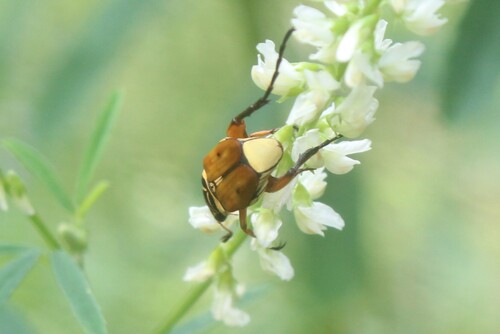
Pelidnota punctata, the grapevine beetle, spotted June beetle or spotted pelidnota, is a species of beetle in the family Scarabaeidae (Scarab beetles), subfamily Rutelinae. Grapevine beetles are common in the north and central United States and eastern Canada, but do relatively little damage to their host plants. The beetles fly at a fast speed, usually in a curving flight.

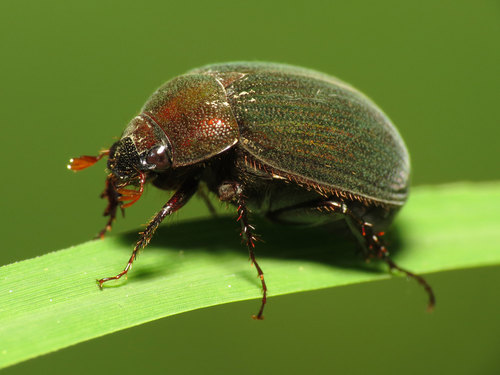
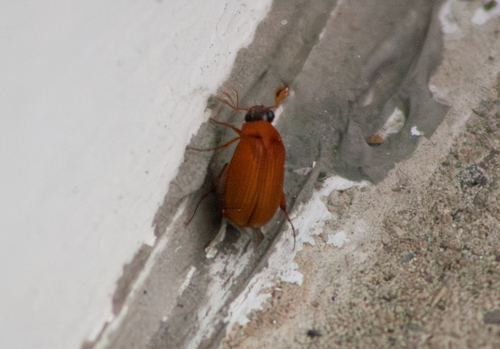
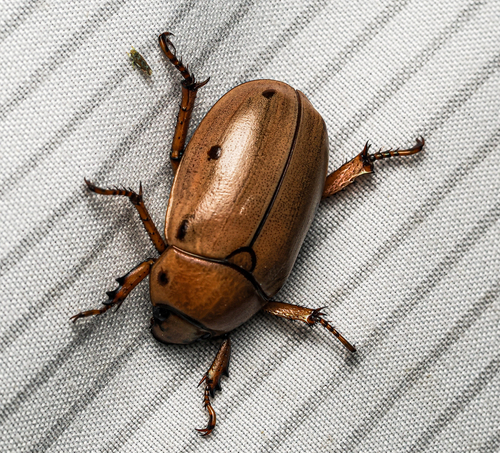
The adult beetle is approximately 2.5 centimetres (1 inch) long, but can reach 3 cm (1.2 in) occasionally. Its pattern is off-yellow or auburn red, with four black spots running down each side. Fine black lines divide the edges of its elytra. There are regional variants of Pelidnota punctata: a common southern form lacks the darker legs, while the northern form has darker legs. Adults in the northern parts of its range will have darker and more spots, while those in the southern regions may not have them at all. The grapevine beetle is a variable species, whose taxonomy was confused by a single authority (Thomas Casey) who split the species into 11 different taxa in 1915, only to have these names relegated to synonymy by subsequent workers.

This species lives throughout the eastern part of... Wikipedia →
Global Distribution

Parks Where Found

# Park Country Daily sighting probability
1 Great Smoky Mountains National Park 🇺🇸 United States
~10%
2 Shenandoah National Park 🇺🇸 United States
~10%

Cities Where Found

# City Country Daily sighting probability
1 Detroit 🇺🇸 United States
~20%
2 Philadelphia 🇺🇸 United States
~10%
3 Minneapolis [Saint Paul] 🇺🇸 United States
~10%
4 Montreal 🇨🇦 Canada
~10%
5 Chicago 🇺🇸 United States
~10%
6 Baltimore 🇺🇸 United States
~10%
7 Orlando 🇺🇸 United States
~10%
8 Toronto 🇨🇦 Canada
~10%
9 Boston 🇺🇸 United States
~10%
10 New York City 🇺🇸 United States
~10%

Before you go

What are the chances of seeing a Grapevine Beetle in Washington?

With luck

About 10% of wildlife watchers report a Grapevine Beetle sighting in Washington on a given day, based on 134 verified sightings from GBIF citizen-science data. It is the 216th most-seen of the 1807 insects we can rate there. Over three days the chance rises to about 20%, and over a week to about 30%, if each day is a fresh chance.

When is the best time to see a Grapevine Beetle in Washington?

June and July

In those months about 10% of wildlife watchers report a Grapevine Beetle in Washington on a given day, against under 5% in August to May, the lowest months.

What time of day is best to see a Grapevine Beetle?

Between 8 and 11 pm

Across all the parks we cover, that three-hour window holds the most Grapevine Beetle sightings with a recorded time, and about 8 in 10 of them come between 6 pm and 6 am: it is mostly seen at night.

Is Washington the best place to see a Grapevine Beetle?

12th of 15

Of the 15 cities where we can rate Grapevine Beetle sightings, Washington ranks 12th at about 10%. The best odds are in Detroit (United States, about 20%), Philadelphia (United States, about 10%) and Minneapolis [Saint Paul] (United States, about 10%).

Which relatives of the Grapevine Beetle live in Washington?

Same family: Scarabaeidae

The closest relatives of the Grapevine Beetle that you can see in Washington (family Scarabaeidae, Scarabs) are Common Green June Beetle (about 10%), Oriental Beetle (about 10%) and Japanese Beetle (about 10%), with each one's daily chance of a sighting.

Where does the Grapevine Beetle sighting chance come from?

GBIF citizen-science records

It is estimated from how often the Grapevine Beetle is recorded against all the insects logged in Washington (134 verified sightings), calibrated against known sighting rates. Figures are rounded to the nearest 10% because citizen-science data supports honest approximations, not decimals, and months with records from fewer than five people show "—". How it works.

← Back to Washington