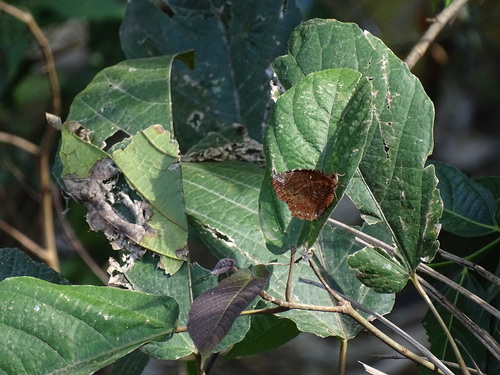
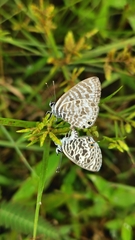
Zebra Blue
Daily sighting probability ~10% · With luck
at Xiamen City

In 3 days ~30% in a week ~50%

6 Verified sightings at Xiamen City
38 In all 6 parks From 2019 to 2026
October Best month
☀️ Diurnal When it's spotted

About the Zebra Blue

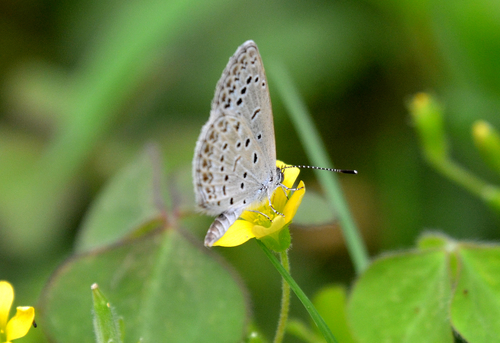
Leptotes plinius, the zebra blue or plumbago blue, is a species of blue butterfly (Lycaenidae) found in Sri Lanka, India to Australia. The species was first described by Johan Christian Fabricius in 1793. This form closely resembles, in both sexes, on the upperside of Tarucus theophrastus, but the character and disposition of the markings on the underside are completely different.

Male upperside: dark violet with, in certain lights, a rich blue suffusion. Forewing: no discocellular black spot so conspicuous as in T. theophrastus; terminal margin with a narrow edging of fuscous black, widest at the apex, gradually decreasing to the tornus, followed by an inconspicuous anteciliary jet-black line. Hindwing: costal margin slightly but broadly shaded with fuscous, which is continued as a slender anteciliary black line to the tornus. Underside: white. Forewing: with the following brownish-black markings: an irregular edging along the costa to near the apex from which extends downwards a subbasal band, broadened across the cell and below it; an irregular band that extends along the discocellulars and below them to interspace 1 where it ends in a point; an upper discal curved... Wikipedia →

Global Distribution

Parks Where Found

# Park Country Daily sighting probability
1 Doi Inthanon National Park 🇹🇭 Thailand
~10%
2 Lamington National Park 🇦🇺 Australia
~10%
3 Springbrook National Park 🇦🇺 Australia
~10%
4 Royal National Park 🇦🇺 Australia
~10%
5 Kaeng Krachan National Park 🇹🇭 Thailand
~10%
6 Blue Mountains National Park 🇦🇺 Australia
<5%

Cities Where Found

# City Country Daily sighting probability
1 Rajkot 🇮🇳 India
~40%
2 Vadodara 🇮🇳 India
~30%
3 Jabalpur 🇮🇳 India
~30%
4 Surat 🇮🇳 India
~30%
5 Pune 🇮🇳 India
~30%
6 Karachi 🇵🇰 Pakistan
~30%
7 Hyderabad 🇮🇳 India
~20%
8 Prayagraj 🇮🇳 India
~20%
9 Kota 🇮🇳 India
~20%
10 Bengaluru 🇮🇳 India
~20%

Before you go

What are the chances of seeing a Zebra Blue in Xiamen City?

With luck

About 10% of wildlife watchers report a Zebra Blue sighting in Xiamen City on a given day, based on 6 verified sightings from GBIF citizen-science data. It is the 45th most-seen of the 59 insects we can rate there. Over three days the chance rises to about 30%, and over a week to about 50%, if each day is a fresh chance.

When is the best time to see a Zebra Blue in Xiamen City?

October

In that month about 30% of wildlife watchers report a Zebra Blue in Xiamen City on a given day, against under 5% in July–September and November–March, the lowest months. That is one of Xiamen City's driest months, with about 40 mm of rain against 220 mm in June.

What time of day is best to see a Zebra Blue?

Between 9 am and noon

Across all the parks we cover, that three-hour window holds the most Zebra Blue sightings with a recorded time, and about 9 in 10 of them come between 6 am and 6 pm: it is a daytime animal.

Is Xiamen City the best place to see a Zebra Blue?

24th of 33

Of the 33 cities where we can rate Zebra Blue sightings, Xiamen City ranks 24th at about 10%. The best odds are in Rajkot (India, about 40%), Vadodara (India, about 30%) and Jabalpur (India, about 30%).

Which relatives of the Zebra Blue live in Xiamen City?

Same family: Lycaenidae

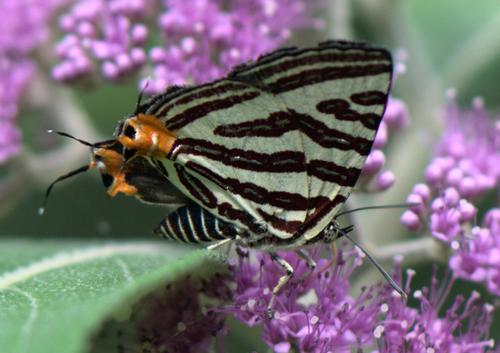
The closest relatives of the Zebra Blue that you can see in Xiamen City (family Lycaenidae, Gossamer-winged Butterflies) are Pale Grass Blue (about 20%), Plains Cupid (about 10%) and Long-Banded Silverline (about 10%), with each one's daily chance of a sighting.

Where does the Zebra Blue sighting chance come from?

GBIF citizen-science records

It is estimated from how often the Zebra Blue is recorded against all the insects logged in Xiamen City (6 verified sightings), calibrated against known sighting rates. Figures are rounded to the nearest 10% because citizen-science data supports honest approximations, not decimals, and months with records from fewer than five people show "—". How it works.

← Back to Xiamen City