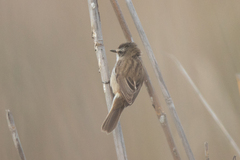
Moustached Warbler

Moustached Warbler

Acrocephalus melanopogon

Silhouette: Yves Hoebeke · PhyloPic

LCLeast ConcernNTVUENCR
Daily sighting probability <5% · Rare
at Yerevan

In 3 days ~10% in a week ~20%

8 Verified sightings at Yerevan
280 In all 5 parks From 2019 to 2026
May Best month
☀️ Diurnal When it's spotted

About the Moustached Warbler

The moustached warbler (Acrocephalus melanopogon) is an Old World warbler in the genus Acrocephalus. It breeds in southern Europe and southern temperate Asia with a few breeding in north-west Africa. It is partially migratory. South-west European birds are resident, south-east European birds winter in the Mediterranean breeding range, and the Asiatic race migrates to Arabia, India and Pakistan.

The moustached warbler was formally described and illustrated in 1823 by the Dutch zoologist Coenraad Jacob Temminck based on a specimen collected near Rome in Italy. He coined the binomial name Sylvia melanopogon. The moustached warbler is now one of 42 warblers placed in the genus Acrocephalus that was introduced in 1811 by the German naturalist Johann Andreas Naumann and his son Johann Friedrich Naumann. The genus name combines the Ancient Greek ακρος/akros meaning "point" or "crest" with -κεφαλος/-kephalos meaning "-headed". The specific epithet melanopogon combines the Ancient Greek μελας/melas, μελανος/melanos meaning "black" with πωγων/pōgōn, πωγωνος/pōgōnos meaning "beard".

Three subspecies are recognised: Wikipedia →

Sounds

Song1:21

France · 2025

© Christian Kerihuel · XC974707 · CC BY-NC-SA 4.0

Alarm call0:23

Spain · 2024

© Bernard BOUSQUET · XC891254 · CC BY-NC-SA 4.0

Call0:35

France · 2024

© Thierry THOMAS · XC872908 · CC BY-NC-SA 4.0

Global Distribution

Parks Where Found

# Park Country Daily sighting probability
1 Fertő-Hanság National Park 🇭🇺 Hungary
~10%
2 Hortobágy National Park 🇭🇺 Hungary
~10%
3 Kiskunság National Park 🇭🇺 Hungary
~10%
4 Camargue 🇫🇷 France
<5%
5 Keoladeo National Park 🇮🇳 India
<5%

Cities Where Found

# City Country Daily sighting probability
1 Yerevan 🇦🇲 Armenia
<5%
2 Kuwait City 🇰🇼 Kuwait
<5%
3 Antalya 🇹🇷 Turkey
<5%
4 Tehran 🇮🇷 Iran
<5%
5 Tel Aviv 🇮🇱 Israel
<5%
6 Athens 🇬🇷 Greece
<5%
7 Istanbul 🇹🇷 Turkey
<5%
8 Jerusalem 🇮🇱 Israel
<5%
9 New Delhi 🇮🇳 India
<5%
10 Barcelona 🇪🇸 Spain
<5%

Before you go

What are the chances of seeing a Moustached Warbler in Yerevan?

Rare

Under 5% of wildlife watchers report a Moustached Warbler sighting in Yerevan on a given day, based on 8 verified sightings from GBIF citizen-science data. It is the 68th most-seen of the 90 birds we can rate there. Over three days the chance rises to about 10%, and over a week to about 20%, if each day is a fresh chance.

When is the best time to see a Moustached Warbler in Yerevan?

May

In that month about 10% of wildlife watchers report a Moustached Warbler in Yerevan on a given day, against under 5% in June to April, the lowest months. That is one of Yerevan's wettest months, with about 60 mm of rain against 15 mm in February.

What time of day is best to see a Moustached Warbler?

Between 8 and 11 am

Across all the parks we cover, that three-hour window holds the most Moustached Warbler sightings with a recorded time, and about 8 in 10 of them come between 6 am and 6 pm: it is a daytime animal.

Is Yerevan the best place to see a Moustached Warbler?

Yes

Of the 10 cities where we can rate Moustached Warbler sightings, Yerevan has the highest daily chance: under 5%. Next come Kuwait City (Kuwait, under 5%) and Antalya (Turkey, under 5%).

Which relatives of the Moustached Warbler live in Yerevan?

Same genus: Acrocephalus

The closest relatives of the Moustached Warbler that you can see in Yerevan (genus Acrocephalus, Reed Warblers) are Great Reed-Warbler (about 10%) and Marsh Warbler (about 10%), with each one's daily chance of a sighting.

Where does the Moustached Warbler sighting chance come from?

GBIF citizen-science records

It is estimated from how often the Moustached Warbler is recorded against all the birds logged in Yerevan (8 verified sightings), calibrated against known sighting rates. Figures are rounded to the nearest 10% because citizen-science data supports honest approximations, not decimals, and months with records from fewer than five people show "—". How it works.

← Back to Yerevan