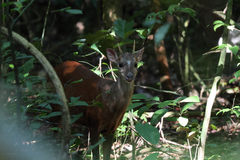
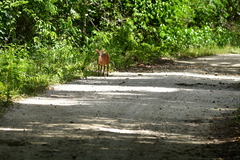
Central American Red Brocket

Central American Red Brocket

Mazama temama

Silhouette: Tracy A. Heath · PhyloPic

Daily sighting probability ~40% · Likely
at Cockscomb Basin Wildlife Sanctuary

In 3 days ~80% in a week >90%

12 Verified sightings at Cockscomb Basin Wildlife Sanctuary From 2019 to 2026
67 In all 5 parks
October Best month
☀️ Diurnal When it's spotted

About the Central American Red Brocket

The Central American or Mexican red brocket (Mazama temama), as it is sometimes called, is a species of brocket deer native to Mexico, Central America, and northern Colombia. In 1792 Robert Kerr originally described it as a separate species as opposed to a subspecies. It was subsequently treated as a subspecies of the red brocket (Mazama americana) from South America, but its karyotype has 2n = 50, while the latter's was initially described as having 2n = 68–70. However, a more recent description gives the red brocket a variable karyotype with 2n ranging from 48 to 54, suggesting that it represents several species. It is sympatric with the Yucatan brown brocket (Odocoileus pandora) over part of its range. Additionally, it was estimated that M. temama diverged from other red brocket deer about 2 million years ago. This was estimated through analysis of concatenated sequences from the mitochondrial gene ND2, Cytb, and tRNA-Pro-Control region.

Mazama temama is found in primary and secondary tropical forests, from sea level to cloud forest habitat at elevations of around 2,800 m (9,190 ft). In the northern reaches of its range, M. temama is known... Wikipedia →

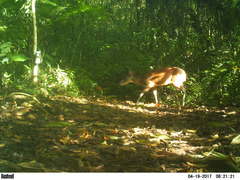
Global Distribution

Parks Where Found

# Park Country Daily sighting probability
1 Cockscomb Basin Wildlife Sanctuary 🇧🇿 Belize
~40%
2 Corcovado National Park 🇨🇷 Costa Rica
~20%
3 Tortuguero National Park 🇨🇷 Costa Rica
~10%
4 Braulio Carrillo National Park 🇨🇷 Costa Rica
~10%
5 Monteverde Cloud Forest Reserve 🇨🇷 Costa Rica
~10%

Zoos & Centres Where Found

# Zoo / Centre Country
1 Phoenix Zoo 🇺🇸 United States In captivity
2 Parque Municipal Summit 🇵🇦 Panama In captivity
3 Barbados Wildlife Reserve 🇧🇧 Barbados In captivity
4 Bergen County Zoological Park 🇺🇸 United States In captivity
5 National Zoo of Nicaragua 🇳🇮 Nicaragua In captivity
6 Zoológico Miguél Álvarez del Toro 🇲🇽 Mexico In captivity

Before you go

What are the chances of seeing a Central American Red Brocket in Cockscomb Basin Wildlife Sanctuary?

Likely

About 40% of wildlife watchers report a Central American Red Brocket sighting in Cockscomb Basin Wildlife Sanctuary on a given day, based on 12 verified sightings from GBIF citizen-science data from 2019 to 2026. It is the most-seen of the 7 mammals we can rate there. Over three days the chance rises to about 80%, and over a week to over 90%, if each day is a fresh chance.

When is the best time to see a Central American Red Brocket in Cockscomb Basin Wildlife Sanctuary?

January and October

In those months about 60% of wildlife watchers report a Central American Red Brocket in Cockscomb Basin Wildlife Sanctuary on a given day, against about 10% in April–July and November, the lowest months. September has too few records to rate.

What time of day is best to see a Central American Red Brocket?

Between 8 and 11 am

Across all the parks we cover, that three-hour window holds the most Central American Red Brocket sightings with a recorded time, and about 8 in 10 of them come between 6 am and 6 pm: it is a daytime animal.

Is Cockscomb Basin Wildlife Sanctuary the best place to see a Central American Red Brocket?

Yes

Of the 5 parks where we can rate Central American Red Brocket sightings, Cockscomb Basin Wildlife Sanctuary has the highest daily chance: about 40%. Next come Corcovado National Park (Costa Rica, about 20%) and Tortuguero National Park (Costa Rica, about 10%).

Where does the Central American Red Brocket sighting chance come from?

GBIF citizen-science records

It is estimated from how often the Central American Red Brocket is recorded against all the mammals logged in Cockscomb Basin Wildlife Sanctuary (12 verified sightings from 2019 to 2026), calibrated against known sighting rates. Figures are rounded to the nearest 10% because citizen-science data supports honest approximations, not decimals, and months with records from fewer than five people show "—". How it works.

← Back to Cockscomb Basin Wildlife Sanctuary