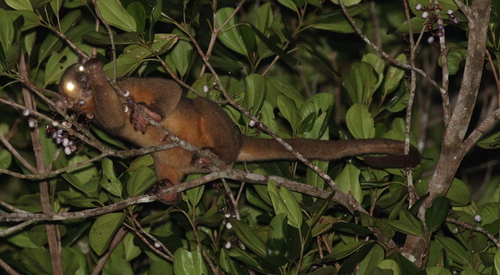
Mexican Black Howler Monkey

Mexican Black Howler Monkey

Alouatta pigra

Silhouette: PhyloPic

LCNTVUENEndangeredCR
Daily sighting probability ~30% · Possible
at Cockscomb Basin Wildlife Sanctuary

In 3 days ~70% in a week ~90%

56 Verified sightings at Cockscomb Basin Wildlife Sanctuary From 2019 to 2026
722 In all 5 parks
August Best month
☀️ Diurnal When it's spotted

About the Mexican Black Howler Monkey

The Yucatán black howler, or Guatemalan black howler, (Alouatta pigra) is a species of howler monkey, a type of New World monkey, from Central America. It is found in Belize, Guatemala and Mexico, in and near the Yucatán Peninsula. It lives in evergreen, semideciduous and lowland rain forests. It is also known as the baboon in Belize, although it is not closely related to the baboons in Africa.

The Yucatán black howler is the largest of the howler monkey species and one of the largest of the New World monkeys. Yucatán black howler males are larger than those of any other Central American monkey species. On average, males weigh 11.4 kg (25 lb) and females weigh 6.4 kg (14 lb). The body is between 521 and 639 mm (20.5 and 25.2 in) in length, excluding the tail. The tail is between 590 and 690 mm (23 and 27 in) long. Adults of both sexes have long, black hair and a prehensile tail, while infants have brown fur. Males over four months old have white scrotums.

The Yucatán black howler shares several adaptations with other species of howler monkey that allow it to pursue a folivorous diet (mostly leaves). Its molars have high shearing crests, to help it eat the leaves... Wikipedia →

Sounds

Recording0:29

Guatemala · 2025

© sammatey · iNaturalist · CC BY-NC 4.0

Recording0:25

Guatemala · 2023

© darmozrac · iNaturalist · CC BY 4.0

Recording0:38

Mexico · 2025

© Jan Ebr & Ivana Ebrová · iNaturalist · CC BY 4.0

Global Distribution

Parks Where Found

# Park Country Daily sighting probability
1 Calakmul Biosphere Reserve 🇲🇽 Mexico
~60%
2 Tikal National Park 🇬🇹 Guatemala
~60%
3 Montes Azules Biosphere Reserve 🇲🇽 Mexico
~50%
4 Cockscomb Basin Wildlife Sanctuary 🇧🇿 Belize
~30%
5 Sian Ka'an Biosphere Reserve 🇲🇽 Mexico
~20%

Zoos & Centres Where Found

# Zoo / Centre Country
1 Lisbon Oceanarium 🇵🇹 Portugal In captivity
2 Belize Zoo 🇧🇿 Belize In captivity
3 Banham Zoo 🇬🇧 United Kingdom In captivity
4 Parque Municipal Summit 🇵🇦 Panama In captivity
5 Xcaret 🇲🇽 Mexico In captivity
6 Zoológico de San Juan de Aragón 🇲🇽 Mexico In captivity
7 Jackson Zoo 🇺🇸 United States In captivity
8 El Nispero Zoo 🇵🇦 Panama In captivity
9 Biouniverzoo 🇲🇽 Mexico In captivity
10 Parque del Centenario 🇲🇽 Mexico In captivity
11 Seattle Marine Aquarium 🇺🇸 United States In captivity
12 Zoológico Miguél Álvarez del Toro 🇲🇽 Mexico In captivity

Before you go

What are the chances of seeing a Mexican Black Howler Monkey in Cockscomb Basin Wildlife Sanctuary?

Possible

About 30% of wildlife watchers report a Mexican Black Howler Monkey sighting in Cockscomb Basin Wildlife Sanctuary on a given day, based on 56 verified sightings from GBIF citizen-science data from 2019 to 2026. It is the 2nd most-seen of the 7 mammals we can rate there. Over three days the chance rises to about 70%, and over a week to about 90%, if each day is a fresh chance.

When is the best time to see a Mexican Black Howler Monkey in Cockscomb Basin Wildlife Sanctuary?

August

In that month about 50% of wildlife watchers report a Mexican Black Howler Monkey in Cockscomb Basin Wildlife Sanctuary on a given day, against under 5% in October, the lowest month. That is one of Cockscomb Basin Wildlife Sanctuary's wettest months, with about 250 mm of rain against 75 mm in April.

What time of day is best to see a Mexican Black Howler Monkey?

Between 10 am and 1 pm

Across all the parks we cover, that three-hour window holds the most Mexican Black Howler Monkey sightings with a recorded time, and about 9 in 10 of them come between 6 am and 6 pm: it is a daytime animal.

Where does the Mexican Black Howler Monkey sighting chance come from?

GBIF citizen-science records

It is estimated from how often the Mexican Black Howler Monkey is recorded against all the mammals logged in Cockscomb Basin Wildlife Sanctuary (56 verified sightings from 2019 to 2026), calibrated against known sighting rates. Figures are rounded to the nearest 10% because citizen-science data supports honest approximations, not decimals, and months with records from fewer than five people show "—". How it works.

← Back to Cockscomb Basin Wildlife Sanctuary