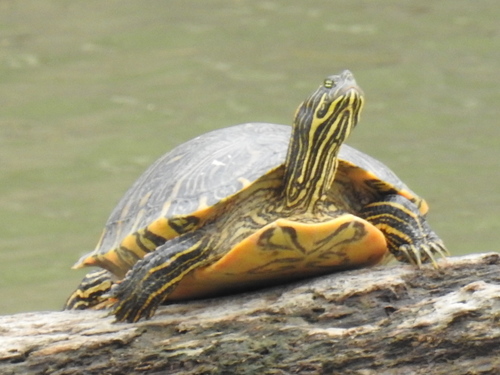
Eastern Mud Turtle

Eastern Mud Turtle

Kinosternon subrubrum

Silhouette: Jose Carlos Arenas-Monroy · PhyloPic

LCLeast ConcernNTVUENCR Endemic
Daily sighting probability ~20% · Possible
at Congaree National Park

In 3 days ~60% in a week ~90%

30 Verified sightings at Congaree National Park From 2019 to 2026
30 In 1 park
August Best month
🌅 Crepuscular When it's spotted

About the Eastern Mud Turtle

The eastern mud turtle (Kinosternon subrubrum) or common mud turtle is a common species of turtle in the family Kinosternidae. The species is endemic to the United States. There are two recognized subspecies. The eastern mud turtle is a small and often hard to identify species. It measures 3–4 in (7.6–10.2 cm) in carapace length. The carapace is keelless, lacks any pattern, and varies in color from yellowish to black. The plastron is large and double hinged, and can be yellowish to brown, and may sometimes have a dark pattern. The chin and throat are a yellowish grey, streaked and mottled with brown, while the limbs and tail are grayish. The eye, or iris, of the eastern mud turtle is yellow with dark clouding, and its feet are webbed.

The specific name, subrubrum, meaning "under red", refers to the red-orange plastron of hatchlings. The eastern mud turtle is omnivorous and feeds on insects, crustaceans, mollusks, amphibians, carrion, and aquatic vegetation. Smaller eastern mud turtles prey on small aquatic insects, algae, and carrion, whereas larger ones can feed on any type of food that they can fit in their mouth.

Eastern... Wikipedia →

Global Distribution

Parks Where Found

# Park Country Daily sighting probability
1 Congaree National Park 🇺🇸 United States
~20%

More parks will be added in future updates.

Cities Where Found

# City Country Daily sighting probability
1 Dallas 🇺🇸 United States
<5%
2 Washington 🇺🇸 United States
<5%
3 Houston 🇺🇸 United States
<5%

Zoos & Centres Where Found

# Zoo / Centre Country
1 The Maryland Zoo 🇺🇸 United States In captivity
2 Riverbanks Zoo 🇺🇸 United States In captivity
3 Western North Carolina Nature Center 🇺🇸 United States In captivity
4 Chattanooga Zoo at Warner Park 🇺🇸 United States In captivity
5 Elmwood Park Zoo 🇺🇸 United States In captivity
6 Texas Zoo 🇺🇸 United States In captivity
7 Zoo Samara 🇷🇺 Russia In captivity
8 UGA Marine Education Center and Aquarium 🇺🇸 United States In captivity
9 Edisto Island Serpentarium 🇺🇸 United States In captivity
10 Medicine Park Aquarium & Natural Sciences Center 🇺🇸 United States In captivity

Before you go

What are the chances of seeing an Eastern Mud Turtle in Congaree National Park?

Possible

About 20% of wildlife watchers report an Eastern Mud Turtle sighting in Congaree National Park on a given day, based on 30 verified sightings from GBIF citizen-science data from 2019 to 2026. It is the 16th most-seen of the 22 reptiles we can rate there. Over three days the chance rises to about 60%, and over a week to about 90%, if each day is a fresh chance.

When is the best time to see an Eastern Mud Turtle in Congaree National Park?

June and August

In those months about 40% of wildlife watchers report an Eastern Mud Turtle in Congaree National Park on a given day, against under 5% in December and January, the lowest months.

What time of day is best to see an Eastern Mud Turtle?

Between 1 and 4 pm

Across all the parks we cover, that three-hour window holds the most Eastern Mud Turtle sightings with a recorded time, and about 6 in 10 of them come between 6 pm and 6 am: it is most active around dawn and dusk.

Where else can you see an Eastern Mud Turtle?

Only Congaree National Park, in our data

Congaree National Park is the only park on Wallace's Line with enough records to rate Eastern Mud Turtle sightings: about 20% of wildlife watchers there report one on a given day.

Where does the Eastern Mud Turtle sighting chance come from?

GBIF citizen-science records

It is estimated from how often the Eastern Mud Turtle is recorded against all the reptiles logged in Congaree National Park (30 verified sightings from 2019 to 2026), calibrated against known sighting rates. Figures are rounded to the nearest 10% because citizen-science data supports honest approximations, not decimals, and months with records from fewer than five people show "—". How it works.

← Back to Congaree National Park