Morepork

Morepork

Ninox novaeseelandiae

Silhouette: Rachel T Mason · PhyloPic

LCLeast ConcernNTVUENCR
Daily sighting probability <5% · Rare
at Cradle Mountain-Lake St Clair National Park

In 3 days ~10% in a week ~20%

22 Verified sightings at Cradle Mountain-Lake St Clair National Park From 2019 to 2026
893 In all 7 parks
October Best month
☀️🌙 Day & Night When it's spotted

About the Morepork

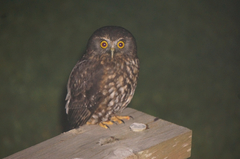
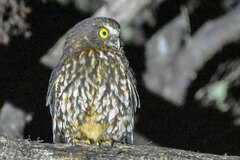
The morepork (Ninox novaeseelandiae), also known by its Māori name ruru, is a small brown owl found in New Zealand, the Australian islands of Norfolk Island, and formerly on Lord Howe Island. Its names (also including boobook and mopoke) are onomatopoeic, owing to the species’ distinctive calls. Three subspecies of the morepork are recognised, one of which is extinct and another that exists only as a hybrid population.

First described by Johann Friedrich Gmelin in 1788, the morepork was thought to be the same species as the Australian boobook (N. boobook), native to Australia, Timor-Leste and New Guinea, something that endured for more than two hundred years, until 1999. Similarly, it was also considered the same as the Tasmanian boobook (N. leucopsis) until 2022.

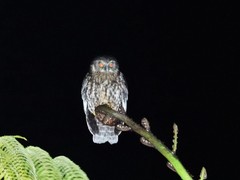
The morepork has dark-brown plumage with prominent pale spots and golden-yellow eyes. Like most owls, the species is generally nocturnal, though may be crepuscular at times (or active at dawn and dusk), retiring to roost in secluded spots within the branches of trees. The morepork feeds on larger insects and small vertebrates, hunting by pouncing on them from tree perches. As with all owls, the morepork has supreme night vision and excellent hearing, able to locate a tiny lizard or rodent from many metres above and away. They then stealthily approach their targeted prey with near-silent flight, without flapping their wings, the prey often not even aware they are being pursued.

The International Union for Conservation of Nature (IUCN) has assessed the morepork's population and its potential for decline, and ranked the species as being of least concern (not currently at-risk), owing to its presently large range and apparently stable population. Wikipedia →

Sounds

Song0:45

Australia · 2023

© Peter Boesman · XC859982 · CC BY-NC-ND 4.0

Call1:28

New Zealand · 2023

© Nathan El · XC822362 · CC BY-NC-SA 4.0

Begging call0:55

Australia · 2020

© Mark Carter · XC563321 · CC BY-NC-SA 4.0

Global Distribution

Parks Where Found

# Park Country Daily sighting probability
1 Rakiura National Park 🇳🇿 New Zealand
~20%
2 Arthur's Pass National Park 🇳🇿 New Zealand
~10%
3 Abel Tasman National Park 🇳🇿 New Zealand
~10%
4 Egmont National Park 🇳🇿 New Zealand
~10%
5 Fiordland National Park 🇳🇿 New Zealand
~10%
6 Maria Island National Park 🇦🇺 Australia
~10%
7 Cradle Mountain-Lake St Clair National Park 🇦🇺 Australia
<5%

Cities Where Found

# City Country Daily sighting probability
1 Auckland 🇳🇿 New Zealand
<5%
2 Melbourne 🇦🇺 Australia
<5%

Zoos & Centres Where Found

# Zoo / Centre Country
1 Orana Wildlife Park 🇳🇿 New Zealand In captivity
2 Willowbank Wildlife Reserve 🇳🇿 New Zealand In captivity
3 Kiwi Park 🇳🇿 New Zealand In captivity
4 Millcreek Bird Park 🇳🇿 New Zealand In captivity
5 Ōtorohanga Kiwi House 🇳🇿 New Zealand In captivity
6 Te Anau Bird Sanctuary 🇳🇿 New Zealand In captivity
7 Wingspan National Bird of Prey Centre 🇳🇿 New Zealand In captivity

Closest Relatives at Cradle Mountain-Lake St Clair National Park

No species of the same family or order lives in Cradle Mountain-Lake St Clair National Park, so these are its closest relatives here: other birds.

Before you go

What are the chances of seeing a Morepork in Cradle Mountain-Lake St Clair National Park?

Rare

Under 5% of wildlife watchers report a Morepork sighting in Cradle Mountain-Lake St Clair National Park on a given day, based on 22 verified sightings from GBIF citizen-science data from 2019 to 2026. It is the 40th most-seen of the 49 birds we can rate there. Over three days the chance rises to about 10%, and over a week to about 20%, if each day is a fresh chance.

When is the best time to see a Morepork in Cradle Mountain-Lake St Clair National Park?

October

In that month about 10% of wildlife watchers report a Morepork in Cradle Mountain-Lake St Clair National Park on a given day, against under 5% in November to September, the lowest months.

What time of day is best to see a Morepork?

Between 6 and 9 pm

Across all the parks we cover, that three-hour window holds the most Morepork sightings with a recorded time, and about half of them come between 6 pm and 6 am: it is seen both by day and at night.

Is Cradle Mountain-Lake St Clair National Park the best place to see a Morepork?

7th of 7

Of the 7 parks where we can rate Morepork sightings, Cradle Mountain-Lake St Clair National Park ranks 7th at under 5%. The best odds are in Rakiura National Park (New Zealand, about 20%), Arthur's Pass National Park (New Zealand, about 10%) and Abel Tasman National Park (New Zealand, about 10%).

Where does the Morepork sighting chance come from?

GBIF citizen-science records

It is estimated from how often the Morepork is recorded against all the birds logged in Cradle Mountain-Lake St Clair National Park (22 verified sightings from 2019 to 2026), calibrated against known sighting rates. Figures are rounded to the nearest 10% because citizen-science data supports honest approximations, not decimals, and months with records from fewer than five people show "—". How it works.

← Back to Cradle Mountain-Lake St Clair National Park