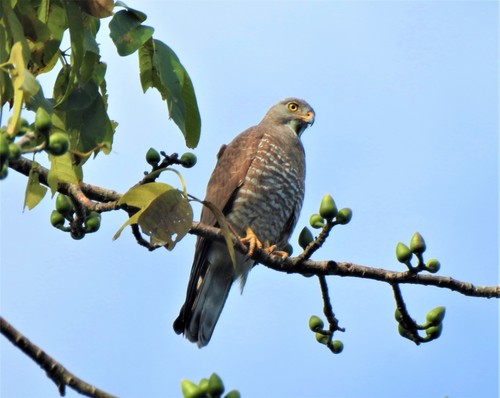
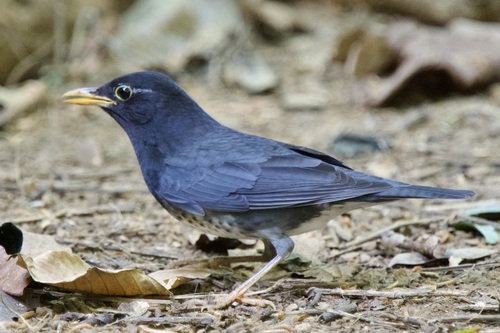
Eastern Marsh-Harrier

Eastern Marsh-Harrier

Circus spilonotus

Silhouette: Shyamal · PhyloPic

LCLeast ConcernNTVUENCR
Daily sighting probability <5% · Rare
at Cuc Phuong National Park

In 3 days ~10%

5 Verified sightings at Cuc Phuong National Park From 2019 to 2026
99 In all 5 parks
April Best month
☀️ Diurnal When it's spotted

About the Eastern Marsh-Harrier

The eastern marsh harrier (Circus spilonotus) is a bird of prey belonging to the marsh harrier group of harriers. It was previously considered to be conspecific with the western marsh harrier (Circus aeruginosus) but is now usually classified as a separate species.

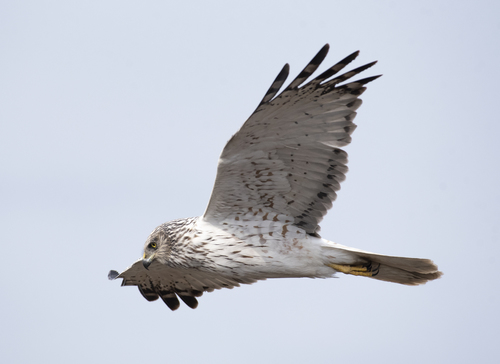
It is 48 to 58 cm long with a wingspan of 113 to 137 cm; like most birds of prey, the female is usually larger than the male. The male's plumage is variable; typically the head, breast, back and wing-coverts are blackish with pale streaks. The rest of the wing is grey with black wingtips and a white front edge. The tail is grey, the rump is white and the underparts are mostly white. The female is dark brown with buff streaking on the head and underparts. The rump is often whitish and the tail has dark bars. Young birds are dark brown with buff on the head and a pale patch on the underwing.

It is usually silent but has a mewing call which is most often uttered at roost sites. Eastern marsh harriers are generally migratory apart from the Papuan... Wikipedia →

Sounds

Call0:17

Malaysia · 2023

© Lim Ying Hien · XC774278 · CC BY-NC-ND 4.0

Display flight0:08

Mongolia · 2018

© Manuel Schweizer · XC423776 · CC BY-NC-SA 4.0

Song0:23

Mongolia · 2015

© Jarmo Pirhonen · XC254086 · CC BY-NC-SA 4.0

Global Distribution

Parks Where Found

# Park Country Daily sighting probability
1 Manas National Park 🇮🇳 India
<5%
2 Way Kambas National Park 🇮🇩 Indonesia
<5%
3 Cuc Phuong National Park 🇻🇳 Vietnam
<5%
4 Kaziranga National Park 🇮🇳 India
<5%
5 Cat Tien National Park 🇻🇳 Vietnam
<5%

Cities Where Found

# City Country Daily sighting probability
1 Kunming 🇨🇳 China
<5%
2 Beijing 🇨🇳 China
<5%
3 Kolkata 🇮🇳 India
<5%
4 Bangkok 🇹🇭 Thailand
<5%
5 Taipei 🇹🇼 Taiwan
<5%
6 Tuen Mun 🇨🇳 China
<5%
7 Guangzhou 🇨🇳 China
<5%
8 Nagoya 🇯🇵 Japan
<5%
9 Tokyo 🇯🇵 Japan
<5%
10 Singapore 🇸🇬 Singapore
<5%

Before you go

What are the chances of seeing an Eastern Marsh-Harrier in Cuc Phuong National Park?

Rare

Under 5% of wildlife watchers report an Eastern Marsh-Harrier sighting in Cuc Phuong National Park on a given day, based on 5 verified sightings from GBIF citizen-science data from 2019 to 2026. It is the 150th most-seen of the 159 birds we can rate there. Over three days the chance rises to about 10%, if each day is a fresh chance.

When is the best time to see an Eastern Marsh-Harrier in Cuc Phuong National Park?

April and November

In those months about 10% of wildlife watchers report an Eastern Marsh-Harrier in Cuc Phuong National Park on a given day, against under 5% in May–June, August–October and December–March, the lowest months. Those are among Cuc Phuong National Park's driest months, with about 90 mm of rain a month against 390 mm in August. July has too few records to rate.

What time of day is best to see an Eastern Marsh-Harrier?

Between 9 am and noon

Across all the parks we cover, that three-hour window holds the most Eastern Marsh-Harrier sightings with a recorded time, and about 9 in 10 of them come between 6 am and 6 pm: it is a daytime animal.

Is Cuc Phuong National Park the best place to see an Eastern Marsh-Harrier?

Among the best

Of the 5 parks where we can rate Eastern Marsh-Harrier sightings, Cuc Phuong National Park ranks 3rd at under 5%, level with the leaders once rounded. The best odds are in Manas National Park (India, under 5%) and Way Kambas National Park (Indonesia, under 5%).

Where does the Eastern Marsh-Harrier sighting chance come from?

GBIF citizen-science records

It is estimated from how often the Eastern Marsh-Harrier is recorded against all the birds logged in Cuc Phuong National Park (5 verified sightings from 2019 to 2026), calibrated against known sighting rates. Figures are rounded to the nearest 10% because citizen-science data supports honest approximations, not decimals, and months with records from fewer than five people show "—". How it works.
← Back to Cuc Phuong National Park