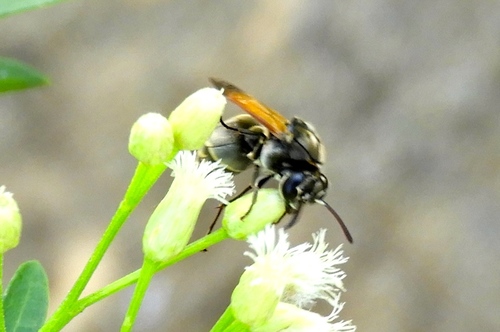
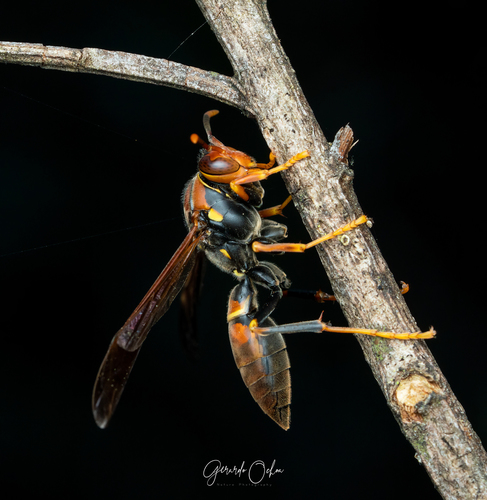
Long-Tailed Giant Ichneumonid Wasp

Long-Tailed Giant Ichneumonid Wasp

Megarhyssa macrura

Daily sighting probability <5% · Rare
at Cumbres de Monterrey National Park

In 3 days ~10% in a week ~20%

6 Verified sightings at Cumbres de Monterrey National Park From 2019 to 2026
14 In all 2 parks
April Best month
☀️ Diurnal When it's spotted

About the Long-Tailed Giant Ichneumonid Wasp

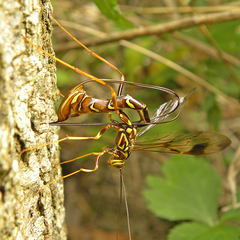
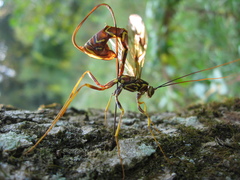
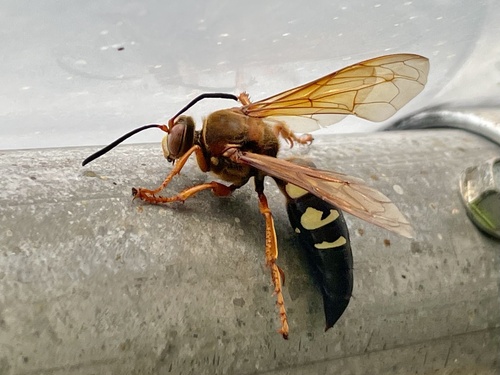
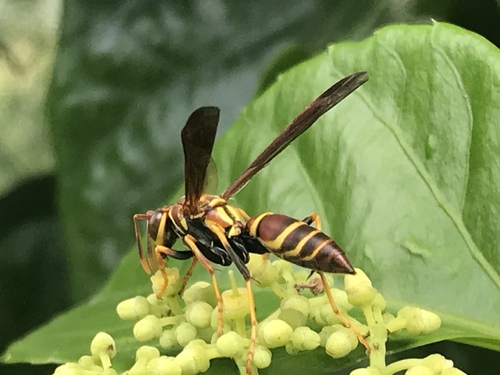
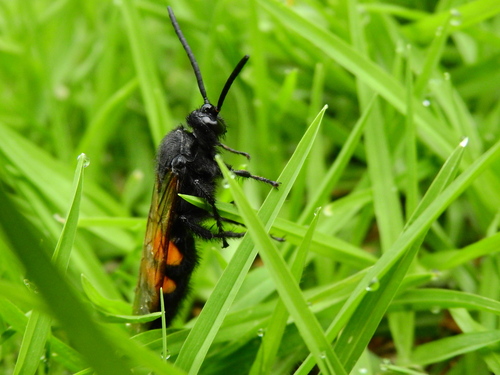
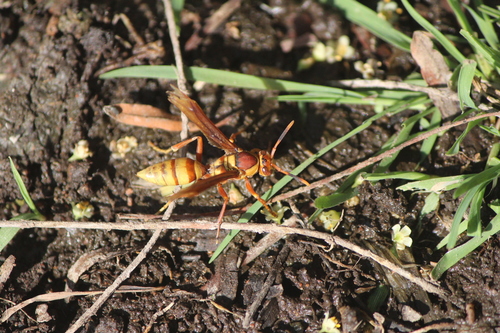
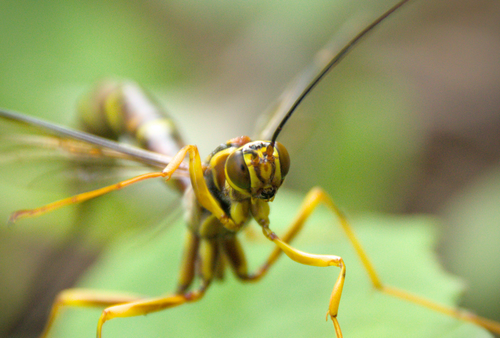
Megarhyssa macrurus, also known as the long-tailed giant ichneumonid wasp or long-tailed giant ichneumon wasp, is a species of large ichneumon wasp. It is a parasitoid, notable for its extremely long ovipositor which it uses to deposit an egg into a tunnel in dead wood bored by its host, the larva of a similarly large species of horntail.

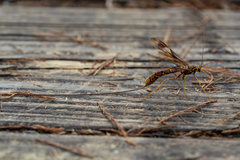
The specific epithet of macrurus is from the Greek words makrós (μακρός) meaning "long", and oùrá (οὐρά) meaning tail. Megarhyssa macrurus has a reddish-brown body of up to 2 inches (51 mm) long. It has black and yellow-orange stripes. Its wings are transparent and the body elongated. The body and ovipositor together can be more than 5 inches (130 mm) long in the female. Males are smaller and have no ovipositor.

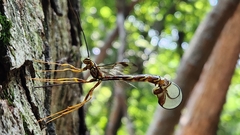
The ovipositor looks like a single filament, but it comprises three filaments, the middle one of which is the actual ovipositor, which is capable of drilling into wood. This central filament also appears to be a single filament, but is made of two parts, with a cutting edge at the tip. The two parts interlock and slide against each other.

Although very thin, the ovipositor is a tube and... Wikipedia →
Global Distribution

Parks Where Found

# Park Country Daily sighting probability
1 Zion National Park 🇺🇸 United States
~10%
2 Cumbres de Monterrey National Park 🇲🇽 Mexico
<5%

Cities Where Found

# City Country Daily sighting probability
1 Salt Lake City 🇺🇸 United States
~10%
2 Denver 🇺🇸 United States
~10%
3 Montreal 🇨🇦 Canada
<5%
4 Minneapolis [Saint Paul] 🇺🇸 United States
<5%
5 Toronto 🇨🇦 Canada
<5%
6 Chicago 🇺🇸 United States
<5%
7 Boston 🇺🇸 United States
<5%
8 Philadelphia 🇺🇸 United States
<5%
9 Dallas 🇺🇸 United States
<5%
10 Washington 🇺🇸 United States
<5%

Before you go

What are the chances of seeing a Long-Tailed Giant Ichneumonid Wasp in Cumbres de Monterrey National Park?

Rare

Under 5% of wildlife watchers report a Long-Tailed Giant Ichneumonid Wasp sighting in Cumbres de Monterrey National Park on a given day, based on 6 verified sightings from GBIF citizen-science data from 2019 to 2026. It is the 390th most-seen of the 431 insects we can rate there. Over three days the chance rises to about 10%, and over a week to about 20%, if each day is a fresh chance.

When is the best time to see a Long-Tailed Giant Ichneumonid Wasp in Cumbres de Monterrey National Park?

April

In that month about 10% of wildlife watchers report a Long-Tailed Giant Ichneumonid Wasp in Cumbres de Monterrey National Park on a given day, against under 5% in May to March, the lowest months.

What time of day is best to see a Long-Tailed Giant Ichneumonid Wasp?

Between 11 am and 2 pm

Across all the parks we cover, that three-hour window holds the most Long-Tailed Giant Ichneumonid Wasp sightings with a recorded time, and nearly all of them come between 6 am and 6 pm: it is a daytime animal.

Is Cumbres de Monterrey National Park the best place to see a Long-Tailed Giant Ichneumonid Wasp?

2nd of 2

Of the 2 parks where we can rate Long-Tailed Giant Ichneumonid Wasp sightings, Cumbres de Monterrey National Park ranks 2nd at under 5%. The best odds are in Zion National Park (United States, about 10%).

Which relatives of the Long-Tailed Giant Ichneumonid Wasp live in Cumbres de Monterrey National Park?

Same order: Hymenoptera

The closest relatives of the Long-Tailed Giant Ichneumonid Wasp that you can see in Cumbres de Monterrey National Park (order Hymenoptera, Ants, Bees, Wasps, and Sawflies) are Shimmering Golden Sugar Ant (about 20%), Chicatana Leafcutter Ant (about 10%) and Pachycondyla villosa (about 10%), with each one's daily chance of a sighting.

Where does the Long-Tailed Giant Ichneumonid Wasp sighting chance come from?

GBIF citizen-science records

It is estimated from how often the Long-Tailed Giant Ichneumonid Wasp is recorded against all the insects logged in Cumbres de Monterrey National Park (6 verified sightings from 2019 to 2026), calibrated against known sighting rates. Figures are rounded to the nearest 10% because citizen-science data supports honest approximations, not decimals, and months with records from fewer than five people show "—". How it works.

← Back to Cumbres de Monterrey National Park