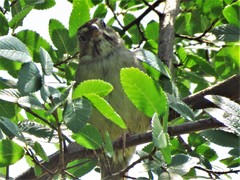

Rufous-crowned Sparrow

Rufous-crowned Sparrow

Aimophila ruficeps

Silhouette: L. Shyamal · PhyloPic

LCLeast ConcernNTVUENCR
Daily sighting probability ~20% · Possible
at Cumbres de Monterrey National Park

In 3 days ~40% in a week ~70%

330 Verified sightings at Cumbres de Monterrey National Park From 2019 to 2026
3,889 In all 8 parks
August Best month
☀️ Diurnal When it's spotted

About the Rufous-crowned Sparrow

The rufous-crowned sparrow (Aimophila ruficeps) is a small American sparrow. This passerine is primarily found across the Southwestern United States and much of the interior of Mexico, south to the transverse mountain range, and to the Pacific coast to the southwest of the transverse range. Its distribution is patchy, with populations often being isolated from each other. Twelve subspecies are generally recognized, though up to eighteen have been suggested. This bird has a brown back with darker streaks and gray underparts. The crown is rufous, and the face and supercilium are gray with a brown or rufous streak extending from each eye and a thick black malar streak.

These sparrows feed primarily on seeds in the winter and insects in the spring and summer. The birds are often territorial, with males guarding their territory through song and displays. Flight is awkward for this species, which prefers to hop along the ground for locomotion. They are monogamous and breed during spring. Two to five eggs are laid in the bird's nest, which is cup-shaped and well hidden. Adult sparrows are preyed upon by house cats and small raptors, while young may be taken by a range of mammals and reptiles. They have been known to live for up to three years, two months. Although the species has been classified as least concern, or unthreatened with extinction, some subspecies are threatened by habitat destruction and one may be extinct. Wikipedia →

Sounds

Song0:22

United States · 2026

© Ed Pandolfino · XC1136844 · CC BY-NC-SA 4.0

Alarm call1:20

Mexico · 2022

© Manuel Grosselet · XC726364 · CC BY-NC-SA 4.0

Call0:48

United States · 2017

© Paul Marvin · XC452181 · CC BY-NC-SA 4.0

Global Distribution

Parks Where Found

# Park Country Daily sighting probability
1 Guadalupe Mountains National Park 🇺🇸 United States
~50%
2 Big Bend National Park 🇺🇸 United States
~40%
3 Sequoia and Kings Canyon National Parks 🇺🇸 United States
~20%
4 Cumbres de Monterrey National Park 🇲🇽 Mexico
~20%
5 Channel Islands National Park 🇺🇸 United States
~10%
6 Grand Canyon National Park 🇺🇸 United States
<5%
7 Saguaro National Park 🇺🇸 United States
<5%
8 Zion National Park 🇺🇸 United States
<5%

Cities Where Found

# City Country Daily sighting probability
1 Mexico City 🇲🇽 México
~10%
2 Puebla 🇲🇽 México
<5%
3 Sacramento 🇺🇸 United States
<5%
4 Guadalajara 🇲🇽 México
<5%
5 San Diego 🇺🇸 United States
<5%
6 Los Angeles 🇺🇸 United States
<5%
7 Monterrey 🇲🇽 México
<5%
8 Phoenix 🇺🇸 United States
<5%
9 Austin 🇺🇸 United States
<5%
10 San Francisco 🇺🇸 United States
<5%

Before you go

What are the chances of seeing a Rufous-crowned Sparrow in Cumbres de Monterrey National Park?

Possible

About 20% of wildlife watchers report a Rufous-crowned Sparrow sighting in Cumbres de Monterrey National Park on a given day, based on 330 verified sightings from GBIF citizen-science data from 2019 to 2026. It is the 49th most-seen of the 275 birds we can rate there. Over three days the chance rises to about 40%, and over a week to about 70%, if each day is a fresh chance.

When is the best time to see a Rufous-crowned Sparrow in Cumbres de Monterrey National Park?

August

In that month about 40% of wildlife watchers report a Rufous-crowned Sparrow in Cumbres de Monterrey National Park on a given day, against under 5% in November, the lowest month.

What time of day is best to see a Rufous-crowned Sparrow?

Between 7 and 10 am

Across all the parks we cover, that three-hour window holds the most Rufous-crowned Sparrow sightings with a recorded time, and about 9 in 10 of them come between 6 am and 6 pm: it is a daytime animal.

Which relatives of the Rufous-crowned Sparrow live in Cumbres de Monterrey National Park?

Same family: Passerellidae

The closest relatives of the Rufous-crowned Sparrow that you can see in Cumbres de Monterrey National Park (family Passerellidae, New World Sparrows) are Olive Sparrow (about 40%), Spotted Towhee (about 10%) and Lincoln's Sparrow (about 10%), with each one's daily chance of a sighting.

Where does the Rufous-crowned Sparrow sighting chance come from?

GBIF citizen-science records

It is estimated from how often the Rufous-crowned Sparrow is recorded against all the birds logged in Cumbres de Monterrey National Park (330 verified sightings from 2019 to 2026), calibrated against known sighting rates. Figures are rounded to the nearest 10% because citizen-science data supports honest approximations, not decimals, and months with records from fewer than five people show "—". How it works.

← Back to Cumbres de Monterrey National Park