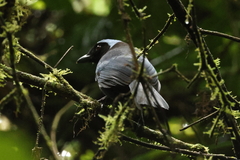

Azure-hooded Jay

Azure-hooded Jay

Cyanolyca cucullata

Silhouette: Sheatherius · PhyloPic

LCLeast ConcernNTVUENCR
Daily sighting probability ~10% · With luck
at Cusuco National Park

In 3 days ~30% in a week ~50%

96 Verified sightings at Cusuco National Park From 2019 to 2026
2,256 In all 7 parks
June Best month
☀️ Diurnal When it's spotted

About the Azure-hooded Jay

The azure-hooded jay (Cyanolyca cucullata) is a species of bird in the family Corvidae. It is found in Middle America. Its natural habitat is subtropical or tropical moist montane forest. This species is known to have four subspecies. It is 11 to 12 inches (28 to 30 cm) in length and is dark blue with a black head and upper chest. The back of the head and neck are sky blue with a white border.

The jays travel in groups of two to ten individuals and may join mixed-species flocks. It is a secretive species and therefore difficult to observe in the wild. As an omnivore, this jay eats berries, seeds, and small, dead animals. Females lay three to four eggs, and the young fledge after twenty days. This species is listed as Least Concern, meaning it is not threatened with extinction.

The species was first described by the American ornithologist Robert Ridgway in 1885. Its specific epithet, cucullata, is the Latin word for "hooded". Its closest relative is the beautiful jay (C. pulchra) of Colombia and Ecuador; in his 1934 study, Hellmayr treated these species as conspecific. Phylogenetic analysis published in 2009 confirmed the close relationship between the two species; Bonaccorso... Wikipedia →

Sounds

Call0:11

Costa Rica · 2019

© Hans Matheve · XC517656 · CC BY-NC-ND 4.0

Uncertain0:43

Honduras · 2021

© Mario Reyes Jr · XC654438 · CC BY-NC-SA 4.0

Alarm call0:12

Costa Rica · 2017

© Jorge Gabriel Campos · XC363644 · CC BY-NC-SA 4.0

Global Distribution

Parks Where Found

# Park Country Daily sighting probability
1 Monteverde Cloud Forest Reserve 🇨🇷 Costa Rica
~10%
2 Cusuco National Park 🇭🇳 Honduras
~10%
3 Arenal Volcano National Park 🇨🇷 Costa Rica
<5%
4 Poás Volcano National Park 🇨🇷 Costa Rica
<5%
5 La Amistad International Park (Panama) 🇵🇦 Panama
<5%
6 Braulio Carrillo National Park 🇨🇷 Costa Rica
<5%
7 Tapantí-Macizo de la Muerte National Park 🇨🇷 Costa Rica
<5%

Before you go

What are the chances of seeing an Azure-hooded Jay in Cusuco National Park?

With luck

About 10% of wildlife watchers report an Azure-hooded Jay sighting in Cusuco National Park on a given day, based on 96 verified sightings from GBIF citizen-science data from 2019 to 2026. It is the 104th most-seen of the 250 birds we can rate there. Over three days the chance rises to about 30%, and over a week to about 50%, if each day is a fresh chance.

When is the best time to see an Azure-hooded Jay in Cusuco National Park?

June

In that month about 40% of wildlife watchers report an Azure-hooded Jay in Cusuco National Park on a given day, against under 5% in April, August and November–January, the lowest months.

What time of day is best to see an Azure-hooded Jay?

Between 9 am and noon

Across all the parks we cover, that three-hour window holds the most Azure-hooded Jay sightings with a recorded time, and about 8 in 10 of them come between 6 am and 6 pm: it is a daytime animal.

Is Cusuco National Park the best place to see an Azure-hooded Jay?

Among the best

Of the 7 parks where we can rate Azure-hooded Jay sightings, Cusuco National Park ranks 2nd at about 10%, level with the leaders once rounded. The best odds are in Monteverde Cloud Forest Reserve (Costa Rica, about 10%).

Which relatives of the Azure-hooded Jay live in Cusuco National Park?

Same family: Corvidae

The closest relatives of the Azure-hooded Jay that you can see in Cusuco National Park (family Corvidae, Crows, Jays, and Magpies) are Brown Jay (about 70%) and Green Jay (about 10%), with each one's daily chance of a sighting.

Where does the Azure-hooded Jay sighting chance come from?

GBIF citizen-science records

It is estimated from how often the Azure-hooded Jay is recorded against all the birds logged in Cusuco National Park (96 verified sightings from 2019 to 2026), calibrated against known sighting rates. Figures are rounded to the nearest 10% because citizen-science data supports honest approximations, not decimals, and months with records from fewer than five people show "—". How it works.

← Back to Cusuco National Park