


Completed

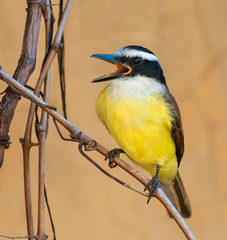

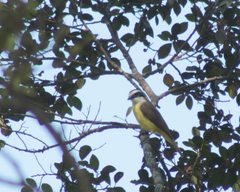


Great Kiskadee
Pitangus sulphuratus
Silhouette: Kai Caspar · PhyloPic
- KingdomAnimalia (Animals)
- PhylumChordata (Chordates)
- ClassAves (Birds)
- OrderPasseriformes (Perching Birds)
- FamilyTyrannidae (Tyrant Flycatchers)
- GenusPitangus (Great Kiskadees)
- SpeciesPitangus sulphuratus (Great Kiskadee)
In 3 days ~90% in a week >90%
358 Verified sightings at Cusuco National Park From 2019 to 2026
96,858 In all 81 parks
November Best month
☀️ Diurnal When it's spotted
About the Great Kiskadee
The great kiskadee (Pitangus sulphuratus) is a passerine bird in the tyrant flycatcher family Tyrannidae. It is the only member of the genus Pitangus. It breeds in open woodland with some tall trees, including cultivation and around human habitation. It is found from the extreme southern United States south to Argentina. It was introduced to Bermuda in 1957, and to Tobago in about 1970.
The great kiskadee was described and illustrated in 1648 by the German naturalist Georg Marcgrave in the Historia Naturalis Brasiliae. He used the name Pitangua-guaçu, the word for a large flycatcher in the Tupi language. In 1760 the French zoologist Mathurin Jacques Brisson included a description of the species in his Ornithologie based on a specimen collected in Cayenne, French Guiana. He used the French name La Pie-Griesche jaune de Cayenne and the Latin name Lanius Cayanensis Luteus. Although Brisson coined Latin names, these do not conform to the binomial system and are not recognised by the International Commission on Zoological Nomenclature.
When the Swedish naturalist Carl Linnaeus updated his Systema Naturae for the twelfth edition in 1766 he added 240 species that had been previously... Wikipedia →
Recent sightings of Great Kiskadee in Cusuco National Park
LIVEiNaturalistGlobal Distribution
Parks Where Found
Cities Where Found
| # | City | Country | Daily sighting probability |
|---|---|---|---|
| 1 | Niterói | 🇧🇷 Brazil | |
| 2 | Salvador | 🇧🇷 Brazil | |
| 3 | São Paulo | 🇧🇷 Brazil | |
| 4 | Porto Alegre | 🇧🇷 Brazil | |
| 5 | Cordoba | 🇦🇷 Argentina | |
| 6 | João Pessoa | 🇧🇷 Brazil | |
| 7 | Goiânia | 🇧🇷 Brazil | |
| 8 | Belo Horizonte | 🇧🇷 Brazil | |
| 9 | Natal | 🇧🇷 Brazil | |
| 10 | Brasilia | 🇧🇷 Brazil |
Zoos & Centres Where Found
| # | Zoo / Centre | Country | |
|---|---|---|---|
| 1 | Prague Zoo | 🇨🇿 Czechia | |
| 2 | Parque das Aves | 🇧🇷 Brazil | |
| 3 | Zoo Pilsen | 🇨🇿 Czechia | |
| 4 | Mangal das Garças | 🇧🇷 Brazil | |
| 5 | Croco Cun Zoo | 🇲🇽 Mexico | |
| 6 | Rákosův pavilon | 🇨🇿 Czechia | |
| 7 | Velemlokárium | 🇨🇿 Czechia |
Closest Relatives at Cusuco National Park


Before you go
What are the chances of seeing a Great Kiskadee in Cusuco National Park?
Likely
About 50% of wildlife watchers report a Great Kiskadee sighting in Cusuco National Park on a given day, based on 358 verified sightings from GBIF citizen-science data from 2019 to 2026. It is the 8th most-seen of the 250 birds we can rate there. Over three days the chance rises to about 90%, and over a week to over 90%, if each day is a fresh chance.
When is the best time to see a Great Kiskadee in Cusuco National Park?
November
In that month about 80% of wildlife watchers report a Great Kiskadee in Cusuco National Park on a given day, against about 30% in August, the lowest month. That is one of Cusuco National Park's wettest months, with about 420 mm of rain against 80 mm in April.
What time of day is best to see a Great Kiskadee?
Between 8 and 11 am
Across all the parks we cover, that three-hour window holds the most Great Kiskadee sightings with a recorded time, and about 9 in 10 of them come between 6 am and 6 pm: it is a daytime animal.
Is Cusuco National Park the best place to see a Great Kiskadee?
32nd of 81
Of the 81 parks where we can rate Great Kiskadee sightings, Cusuco National Park ranks 32nd at about 50%. The best odds are in Tijuca National Park (Brazil, about 90%), Las Baulas Marine National Park (Costa Rica, about 80%) and Iberá National Park (Argentina, about 80%). All parks ranked.
Which relatives of the Great Kiskadee live in Cusuco National Park?
Same family: Tyrannidae
The closest relatives of the Great Kiskadee that you can see in Cusuco National Park (family Tyrannidae, Tyrant Flycatchers) are Social Flycatcher (about 50%), Yellow-olive Flycatcher (about 30%) and Tropical Kingbird (about 30%), with each one's daily chance of a sighting.
Where does the Great Kiskadee sighting chance come from?
GBIF citizen-science records
It is estimated from how often the Great Kiskadee is recorded against all the birds logged in Cusuco National Park (358 verified sightings from 2019 to 2026), calibrated against known sighting rates. Figures are rounded to the nearest 10% because citizen-science data supports honest approximations, not decimals, and months with records from fewer than five people show "—". How it works.
