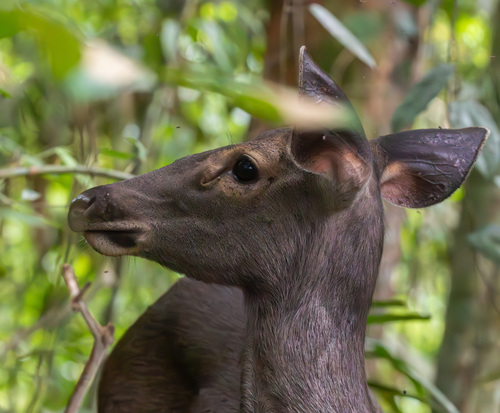
Greater Mouse-deer

Greater Mouse-deer

Tragulus napu

Silhouette: T. Michael Keesey · PhyloPic

LCLeast ConcernNTVUENCR
Daily sighting probability ~30% · Possible
at Danum Valley Conservation Area

In 3 days ~60% in a week ~90%

15 Verified sightings at Danum Valley Conservation Area From 2019 to 2026
15 In 1 park
March Best month
☀️ Diurnal When it's spotted

About the Greater Mouse-deer

The greater mouse-deer, greater Malay chevrotain, or napu (Tragulus napu) is a species of even-toed ungulate in the family Tragulidae found in Sumatra, Borneo, and smaller Malaysian and Indonesian islands, and in southern Myanmar, southern Thailand, and peninsular Malaysia. Its natural habitat is subtropical or tropical, moist, lowland forest.

Tragos is Greek for "goat" and –ulus in Latin means "tiny". Napu is a local name, from Malay napuh. The name "mouse-deer" refers to its small size and does not imply that it is a true deer. It is called "greater" because it is larger than other Tragulus species.

The greater mouse-deer is an even-toed ungulate. Although very small for an ungulate, the greater mouse-deer is one of the largest members of its genus. It is rivalled in size by Williamson's mouse-deer. It weighs 5 to 8 kg (11 to 18 lb). Its head-and-body length is 70 to 75 cm (2.30 to 2.46 ft) and its tail length is 8 to 10 cm (3.1 to 3.9 in). Its shoulder height is about 30 to 35 cm (12 to 14 in) It has a small, triangular head with a small, pointed, black nose and large eyes. Its long legs are as thin as a pencil. The hind legs are visibly longer... Wikipedia →

Global Distribution

Parks Where Found

# Park Country Daily sighting probability
1 Danum Valley Conservation Area 🇲🇾 Malaysia
~30%

More parks will be added in future updates.

Zoos & Centres Where Found

# Zoo / Centre Country
1 National Zoological Park 🇺🇸 United States In captivity
2 Cleveland Metroparks Zoo 🇺🇸 United States In captivity
3 Columbus Zoo and Aquarium 🇺🇸 United States In captivity
4 Bronx Zoo 🇺🇸 United States In captivity
5 Toledo Zoo 🇺🇸 United States In captivity
6 Night Safari 🇸🇬 Singapore In captivity
7 National Zoo of Malaysia 🇲🇾 Malaysia In captivity
8 Singapore Zoo 🇸🇬 Singapore In captivity
9 Bird Paradise 🇸🇬 Singapore In captivity
10 Rainforest Wild Asia 🇸🇬 Singapore In captivity
11 River Wonders 🇸🇬 Singapore In captivity
12 Central Park Zoo 🇺🇸 United States In captivity

Before you go

What are the chances of seeing a Greater Mouse-deer in Danum Valley Conservation Area?

Possible

About 30% of wildlife watchers report a Greater Mouse-deer sighting in Danum Valley Conservation Area on a given day, based on 15 verified sightings from GBIF citizen-science data from 2019 to 2026. It is the 18th most-seen of the 26 mammals we can rate there. Over three days the chance rises to about 60%, and over a week to about 90%, if each day is a fresh chance.

When is the best time to see a Greater Mouse-deer in Danum Valley Conservation Area?

March

In that month about 50% of wildlife watchers report a Greater Mouse-deer in Danum Valley Conservation Area on a given day, against under 5% in January, April–May and July–September, the lowest months.

What time of day is best to see a Greater Mouse-deer?

Between 1 and 4 pm

Across all the parks we cover, that three-hour window holds the most Greater Mouse-deer sightings with a recorded time, and about 7 in 10 of them come between 6 am and 6 pm: it is a daytime animal.

Where else can you see a Greater Mouse-deer?

Only Danum Valley Conservation Area, in our data

Danum Valley Conservation Area is the only park on Wallace's Line with enough records to rate Greater Mouse-deer sightings: about 30% of wildlife watchers there report one on a given day.

Where does the Greater Mouse-deer sighting chance come from?

GBIF citizen-science records

It is estimated from how often the Greater Mouse-deer is recorded against all the mammals logged in Danum Valley Conservation Area (15 verified sightings from 2019 to 2026), calibrated against known sighting rates. Figures are rounded to the nearest 10% because citizen-science data supports honest approximations, not decimals, and months with records from fewer than five people show "—". How it works.

← Back to Danum Valley Conservation Area