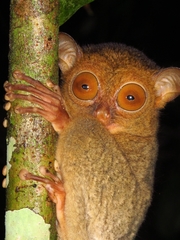
Horsfield's Tarsier

Horsfield's Tarsier

Cephalopachus bancanus

Silhouette: Yan Wong · PhyloPic

LCNTVUVulnerableENCR
Daily sighting probability ~40% · Likely
at Danum Valley Conservation Area

In 3 days ~80% in a week >90%

36 Verified sightings at Danum Valley Conservation Area From 2019 to 2026
257 In all 3 parks
August Best month
☀️ Diurnal When it's spotted

About the Horsfield's Tarsier

Horsfield's tarsier (Cephalopachus bancanus) is the only species of tarsier in the genus Cephalopachus. Named by American naturalist Thomas Horsfield, it is also referred to as western tarsier. The species occurs on Borneo, Sumatra and nearby islands and is, like other members of the group, entirely nocturnal.

Although Horsfield's tarsier was usually placed in the genus Tarsius with all other living tarsiers, it is quite distinct from the Philippine tarsier and the various tarsiers of Sulawesi and nearby islands; therefore, scientists have placed it in a separate genus, Cephalopachus.

The taxonomy of this species is in doubt, with some subspecies considered unsure. In fact, over 20 years few studies have been done on C. bancanus and a taxonomic revision based upon intensive and systematic field surveys is overdue. The IUCN believes that these subspecies should be treated as distinct and named as separate taxa until more definitive evidence is available. When splitting the species into its own genus, Colin Groves and Myron Shekelle recognized the natunensis population as a distinct subspecies.

There are four recognized subspecies of Horsfield's tarsier: Cephalopachus... Wikipedia →

Global Distribution

Parks Where Found

# Park Country Daily sighting probability
1 Danum Valley Conservation Area 🇲🇾 Malaysia
~40%
2 Sepilok 🇲🇾 Malaysia
~40%
3 Kinabatangan Wildlife Sanctuary 🇲🇾 Malaysia
~20%

Before you go

What are the chances of seeing a Horsfield's Tarsier in Danum Valley Conservation Area?

Likely

About 40% of wildlife watchers report a Horsfield's Tarsier sighting in Danum Valley Conservation Area on a given day, based on 36 verified sightings from GBIF citizen-science data from 2019 to 2026. It is the 10th most-seen of the 26 mammals we can rate there. Over three days the chance rises to about 80%, and over a week to over 90%, if each day is a fresh chance.

When is the best time to see a Horsfield's Tarsier in Danum Valley Conservation Area?

August

In that month about 60% of wildlife watchers report a Horsfield's Tarsier in Danum Valley Conservation Area on a given day, against under 5% in January, the lowest month.

What time of day is best to see a Horsfield's Tarsier?

Between noon and 3 pm

Across all the parks we cover, that three-hour window holds the most Horsfield's Tarsier sightings with a recorded time, and about 9 in 10 of them come between 6 am and 6 pm: it is a daytime animal.

Is Danum Valley Conservation Area the best place to see a Horsfield's Tarsier?

Yes

Of the 3 parks where we can rate Horsfield's Tarsier sightings, Danum Valley Conservation Area has the highest daily chance: about 40%. Next come Sepilok (Malaysia, about 40%) and Kinabatangan Wildlife Sanctuary (Malaysia, about 20%).

Which relatives of the Horsfield's Tarsier live in Danum Valley Conservation Area?

Same order: Primates

The closest relatives of the Horsfield's Tarsier that you can see in Danum Valley Conservation Area (order Primates) are Maroon Leaf Monkey (about 80%), Bornean Orangutan (about 50%) and North Bornean Gray Gibbon (about 40%), with each one's daily chance of a sighting.

Where does the Horsfield's Tarsier sighting chance come from?

GBIF citizen-science records

It is estimated from how often the Horsfield's Tarsier is recorded against all the mammals logged in Danum Valley Conservation Area (36 verified sightings from 2019 to 2026), calibrated against known sighting rates. Figures are rounded to the nearest 10% because citizen-science data supports honest approximations, not decimals, and months with records from fewer than five people show "—". How it works.

← Back to Danum Valley Conservation Area