Western Bearded Pig

Western Bearded Pig

Sus barbatus

Silhouette: Steven Traver · PhyloPic

LCNTVUVulnerableENCR
Daily sighting probability ~20% · Possible
at Danum Valley Conservation Area

In 3 days ~50% in a week ~80%

13 Verified sightings at Danum Valley Conservation Area From 2019 to 2026
257 In all 2 parks
October Best month
🌅 Crepuscular When it's spotted

About the Western Bearded Pig

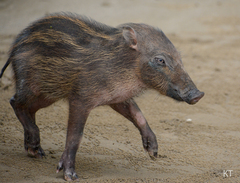
The Bornean bearded pig (Sus barbatus), also known as the Sunda bearded pig or simply bearded pig, is a species in the pig genus, Sus. It can be recognized by its prominent beard. It also sometimes has tassels on its tail. It is found in Southeast Asia—Sumatra, Borneo, the Malay Peninsula, and various smaller islands like in Sulu archipelago such as Tawi-Tawi, where it inhabits rainforests and mangrove forests. The bearded pig lives in a family. It can reproduce from the age of 18 months, and can be cross-bred with other species in the family Suidae.

Potential predators of Bornean bearded pigs in East Kalimantan include reticulated pythons. The species is also frequently hunted by the indigenous Kadazan-Dusun, Murut, and Rungus people of northern Borneo as a traditional delicacy known as the sinalau bakas (smoked wild boar meat) which is part of the pusas (snack food), sold along the main Pan Borneo Highway roads in some parts of Sabah.

The two subspecies of this pig are: S. b. barbatus (the nominate subspecies) As traditionally defined, the nominate is from Borneo. The species is widely ranging in Borneo. It is also found in Tawi-Tawi... Wikipedia →

Global Distribution

Parks Where Found

# Park Country Daily sighting probability
1 Bako National Park 🇲🇾 Malaysia
~80%
2 Danum Valley Conservation Area 🇲🇾 Malaysia
~20%

Zoos & Centres Where Found

# Zoo / Centre Country
1 Palawan Wildlife Rescue and Conservation Center 🇵🇭 Philippines In captivity
2 Battersea Park Children's Zoo 🇬🇧 United Kingdom In captivity
3 Johor Zoo 🇲🇾 Malaysia In captivity

Before you go

What are the chances of seeing a Western Bearded Pig in Danum Valley Conservation Area?

Possible

About 20% of wildlife watchers report a Western Bearded Pig sighting in Danum Valley Conservation Area on a given day, based on 13 verified sightings from GBIF citizen-science data from 2019 to 2026. It is the 20th most-seen of the 26 mammals we can rate there. Over three days the chance rises to about 50%, and over a week to about 80%, if each day is a fresh chance.

When is the best time to see a Western Bearded Pig in Danum Valley Conservation Area?

October

In that month about 40% of wildlife watchers report a Western Bearded Pig in Danum Valley Conservation Area on a given day, against under 5% in February–June, August and November–December, the lowest months.

What time of day is best to see a Western Bearded Pig?

Between 2 and 5 am

Across all the parks we cover, that three-hour window holds the most Western Bearded Pig sightings with a recorded time, and about 6 in 10 of them come between 6 pm and 6 am: it is most active around dawn and dusk.

Is Danum Valley Conservation Area the best place to see a Western Bearded Pig?

2nd of 2

Of the 2 parks where we can rate Western Bearded Pig sightings, Danum Valley Conservation Area ranks 2nd at about 20%. The best odds are in Bako National Park (Malaysia, about 80%).

Which relatives of the Western Bearded Pig live in Danum Valley Conservation Area?

Same order: Artiodactyla

The closest relatives of the Western Bearded Pig that you can see in Danum Valley Conservation Area (order Artiodactyla, Even-toed Ungulates and Cetaceans) are Sambar (about 40%), Greater Mouse-deer (about 30%) and Lesser Oriental Chevrotain (about 20%), with each one's daily chance of a sighting.

Where does the Western Bearded Pig sighting chance come from?

GBIF citizen-science records

It is estimated from how often the Western Bearded Pig is recorded against all the mammals logged in Danum Valley Conservation Area (13 verified sightings from 2019 to 2026), calibrated against known sighting rates. Figures are rounded to the nearest 10% because citizen-science data supports honest approximations, not decimals, and months with records from fewer than five people show "—". How it works.

← Back to Danum Valley Conservation Area