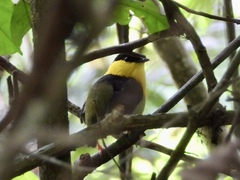
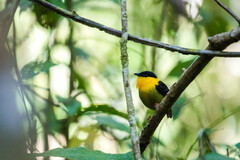
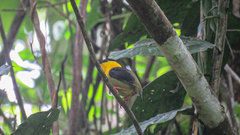
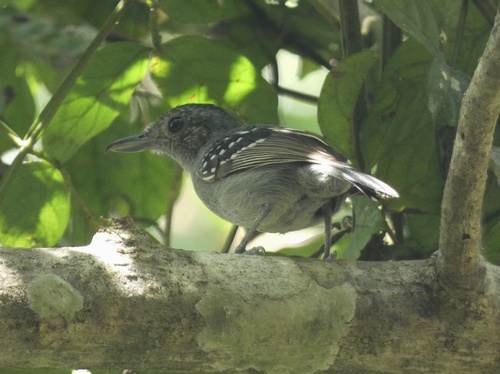
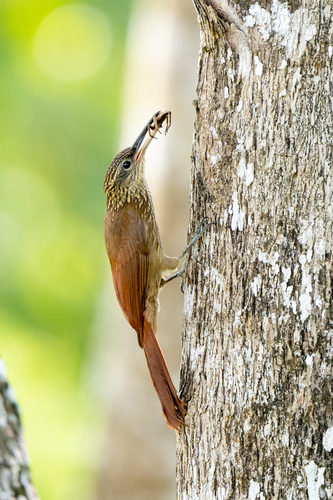
Golden-collared Manakin

Golden-collared Manakin

Manacus vitellinus

Silhouette: Edwin Price · PhyloPic

LCLeast ConcernNTVUENCR
Daily sighting probability ~30% · Possible
at Darién National Park

In 3 days ~60% in a week ~90%

132 Verified sightings at Darién National Park From 2019 to 2026
8,863 In all 9 parks
December Best month
☀️ Diurnal When it's spotted

About the Golden-collared Manakin

The golden-collared manakin (Manacus vitellinus) is a species of bird in the family Pipridae. It is found in Colombia and Panama. The golden-collared manakin was originally described in 1843 as Pipra vitellina. It was later assigned to genus Manacus that Carl Linnaeus had erected in 1766.

The further taxonomy of the golden-collared manakin is unsettled. The IOC, the Clements taxonomy, BirdLife International's Handbook of the Birds of the World, and the American Ornithological Society (AOS) treat it as a species with these four subspecies:

The independent South American Classification Committee, formerly part of the AOS, treats the four taxa as subspecies of the widespread white-bearded manakin (M. manacus) as did many other taxonomists during much of the twentieth century. The SACC recognizes that their treatment is probably not correct and is seeking a formal proposal to change it.

This article follows the IOC et al. model. The golden-collared manakin is about 10 to 12 cm (3.9 to 4.7 in) long and weighs about 15... Wikipedia →

Sounds

Call1:10

Colombia · 2026

© Manuel Sánchez-Nivicela · XC1162168 · CC BY-NC-ND 4.0

Flight call0:22

Colombia · 2020

© David Monroy Rengifo · XC524391 · CC BY-NC-SA 4.0

Song0:23

Panama · 2019

© Jerome Fischer · XC454261 · CC BY-NC-SA 4.0

Global Distribution

Parks Where Found

# Park Country Daily sighting probability
1 Bastimentos Island National Marine Park 🇵🇦 Panama
~50%
2 Soberanía National Park 🇵🇦 Panama
~30%
3 Utría National Natural Park 🇨🇴 Colombia
~30%
4 San Lorenzo Protected Forest 🇵🇦 Panama
~30%
5 Darién National Park 🇵🇦 Panama
~30%
6 La Amistad International Park (Panama) 🇵🇦 Panama
~20%
7 Chagres National Park 🇵🇦 Panama
~20%
8 Farallones de Cali National Natural Park 🇨🇴 Colombia
~10%
9 Parque Natural Metropolitano 🇵🇦 Panama
<5%

Cities Where Found

# City Country Daily sighting probability
1 Cali 🇨🇴 Colombia
<5%
2 Panama City 🇵🇦 Panama
<5%

Zoos & Centres Where Found

# Zoo / Centre Country
1 San Diego Zoo 🇺🇸 United States In captivity

Before you go

What are the chances of seeing a Golden-collared Manakin in Darién National Park?

Possible

About 30% of wildlife watchers report a Golden-collared Manakin sighting in Darién National Park on a given day, based on 132 verified sightings from GBIF citizen-science data from 2019 to 2026. It is the 26th most-seen of the 397 birds we can rate there. Over three days the chance rises to about 60%, and over a week to about 90%, if each day is a fresh chance.

When is the best time to see a Golden-collared Manakin in Darién National Park?

December

In that month about 50% of wildlife watchers report a Golden-collared Manakin in Darién National Park on a given day, against about 10% in January, March and May, the lowest months.

What time of day is best to see a Golden-collared Manakin?

Between 8 and 11 am

Across all the parks we cover, that three-hour window holds the most Golden-collared Manakin sightings with a recorded time, and about 9 in 10 of them come between 6 am and 6 pm: it is a daytime animal.

Which relatives of the Golden-collared Manakin live in Darién National Park?

Same family: Pipridae

The closest relatives of the Golden-collared Manakin that you can see in Darién National Park (family Pipridae, Manakins) are Golden-headed Manakin (about 40%) and White-ruffed Manakin (about 30%), with each one's daily chance of a sighting.

Where does the Golden-collared Manakin sighting chance come from?

GBIF citizen-science records

It is estimated from how often the Golden-collared Manakin is recorded against all the birds logged in Darién National Park (132 verified sightings from 2019 to 2026), calibrated against known sighting rates. Figures are rounded to the nearest 10% because citizen-science data supports honest approximations, not decimals, and months with records from fewer than five people show "—". How it works.

← Back to Darién National Park