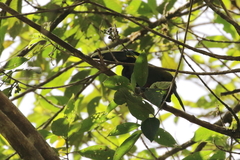
Yellow-eared Toucanet

Yellow-eared Toucanet

Selenidera spectabilis

Silhouette: Edwin Price · PhyloPic

LCLeast ConcernNTVUENCR
Daily sighting probability ~20% · Possible
at Darién National Park

In 3 days ~40% in a week ~70%

98 Verified sightings at Darién National Park From 2019 to 2026
1,650 In all 11 parks
February Best month
☀️ Diurnal When it's spotted

About the Yellow-eared Toucanet

The yellow-eared toucanet (Selenidera spectabilis) is a near-passerine bird in the toucan family Ramphastidae. It is found from Honduras to Ecuador. Despite its placement in genus Selenidera, the yellow-eared toucanet might be more closely related to the mountain toucans of genus Andigena. It is monotypic.

The yellow-eared toucanet is 36 to 38 cm (14 to 15 in) long and weighs 175 to 245 g (6.2 to 8.6 oz). It is the largest and most distinctively plumaged member of its genus. Males and females have the same bill pattern but the female's bill is shorter. The bill has a vertical black line at its base. The maxilla is yellow with a triangle of olive brown below it narrowing from the base and horn-colored tips on the tomium. The mandible is dark olive to brownish black. Adult males have a black cap that extends down the hindneck, blue to green bare skin around the eye, and a large yellow tuft that extends back behind the eye. Their back and uppertail coverts are green and their tail blackish. They are black from their chin to their belly with a yellow patch on the flank, chestnut thighs, and red undertail coverts. Adult females have a chestnut... Wikipedia →

Sounds

Song1:29

Colombia · 2020

© Iván Lau · XC588709 · CC BY-NC-SA 4.0

Call0:07

Costa Rica · 2017

© Jorge Gabriel Campos · XC386931 · CC BY-NC-SA 4.0

Song0:38

Costa Rica · 2010

© Peter Boesman · XC274644 · CC BY-NC-ND 4.0

Global Distribution

Parks Where Found

# Park Country Daily sighting probability
1 Darién National Park 🇵🇦 Panama
~20%
2 Chagres National Park 🇵🇦 Panama
~10%
3 Tenorio Volcano National Park 🇨🇷 Costa Rica
~10%
4 Utría National Natural Park 🇨🇴 Colombia
~10%
5 Rincón de la Vieja National Park 🇨🇷 Costa Rica
<5%
6 Arenal Volcano National Park 🇨🇷 Costa Rica
<5%
7 Braulio Carrillo National Park 🇨🇷 Costa Rica
<5%
8 Tapantí-Macizo de la Muerte National Park 🇨🇷 Costa Rica
<5%
9 Pico Bonito National Park 🇭🇳 Honduras
<5%
10 Soberanía National Park 🇵🇦 Panama
<5%
11 La Amistad International Park (Panama) 🇵🇦 Panama
<5%

Before you go

What are the chances of seeing a Yellow-eared Toucanet in Darién National Park?

Possible

About 20% of wildlife watchers report a Yellow-eared Toucanet sighting in Darién National Park on a given day, based on 98 verified sightings from GBIF citizen-science data from 2019 to 2026. It is the 69th most-seen of the 397 birds we can rate there. Over three days the chance rises to about 40%, and over a week to about 70%, if each day is a fresh chance.

When is the best time to see a Yellow-eared Toucanet in Darién National Park?

January to March

In those months about 30% of wildlife watchers report a Yellow-eared Toucanet in Darién National Park on a given day, against under 5% in June and October–November, the lowest months. Those are among Darién National Park's driest months, with about 130 mm of rain a month against 450 mm in November.

What time of day is best to see a Yellow-eared Toucanet?

Between 10 am and 1 pm

Across all the parks we cover, that three-hour window holds the most Yellow-eared Toucanet sightings with a recorded time, and about 9 in 10 of them come between 6 am and 6 pm: it is a daytime animal.

Is Darién National Park the best place to see a Yellow-eared Toucanet?

Yes

Of the 11 parks where we can rate Yellow-eared Toucanet sightings, Darién National Park has the highest daily chance: about 20%. Next come Chagres National Park (Panama, about 10%) and Tenorio Volcano National Park (Costa Rica, about 10%).

Which relatives of the Yellow-eared Toucanet live in Darién National Park?

Same family: Ramphastidae

The closest relatives of the Yellow-eared Toucanet that you can see in Darién National Park (family Ramphastidae, Toucans) are Black-mandibled Toucan (about 40%), Keel-billed Toucan (about 40%) and Collared Aracari (about 20%), with each one's daily chance of a sighting.

Where does the Yellow-eared Toucanet sighting chance come from?

GBIF citizen-science records

It is estimated from how often the Yellow-eared Toucanet is recorded against all the birds logged in Darién National Park (98 verified sightings from 2019 to 2026), calibrated against known sighting rates. Figures are rounded to the nearest 10% because citizen-science data supports honest approximations, not decimals, and months with records from fewer than five people show "—". How it works.

← Back to Darién National Park