
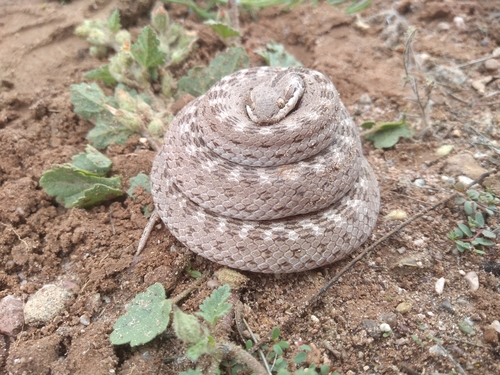
Coachwhip

Coachwhip

Masticophis flagellum

Silhouette: Alex Slavenko · PhyloPic

LCLeast ConcernNTVUENCR
Daily sighting probability ~30% · Possible
at Death Valley National Park

In 3 days ~70% in a week ~90%

52 Verified sightings at Death Valley National Park From 2019 to 2026
380 In all 5 parks
April Best month
☀️ Diurnal When it's spotted

About the Coachwhip

Masticophis flagellum is a species of nonvenomous colubrid snake, commonly referred to as the coachwhip, whip snake or the red racer. It is endemic to the United States and Mexico. Three subspecies are recognized (including the nominotypical subspecies). It is listed as a species of Least Concern by the ICUN.

The generic name Masticophis is derived from the Greek words mastix, meaning "whip", and ophis, meaning "serpent". The specific name flagellum is Latin for "whip". The scientific name was given due to the braided, whip-like appearance of the tail coupled with the length of the snake. Subspecific translations are as follows: lineatulus, (linea) Latin for "line"; testaceus, Latin for "hard covering made of brick or tile", in reference to the scaling pattern of the snake.

Including the nominotypical subspecies, there are three subspecies of Masticophis flagellum that are recognized as being valid. Scientific and common names are listed below. Nota bene: A trinomial authority in parentheses indicates that the subspecies was originally described in a genus other than Masticophis.

Coachwhips are thin-bodied snakes... Wikipedia →

Sounds

Recording0:13

United States · 2026

© Erin Scott · iNaturalist · CC BY-NC 4.0

Global Distribution

Parks Where Found

# Park Country Daily sighting probability
1 Death Valley National Park 🇺🇸 United States
~30%
2 Padre Island National Seashore 🇺🇸 United States
~30%
3 Joshua Tree National Park 🇺🇸 United States
~30%
4 Big Bend National Park 🇺🇸 United States
~20%
5 Saguaro National Park 🇺🇸 United States
~20%

Cities Where Found

# City Country Daily sighting probability
1 Las Vegas 🇺🇸 United States
~10%
2 Torreón 🇲🇽 México
~10%
3 Phoenix 🇺🇸 United States
~10%
4 Austin 🇺🇸 United States
~10%
5 San Antonio 🇺🇸 United States
<5%
6 Los Angeles 🇺🇸 United States
<5%
7 Miami 🇺🇸 United States
<5%
8 Dallas 🇺🇸 United States
<5%
9 San Diego 🇺🇸 United States
<5%

Zoos & Centres Where Found

# Zoo / Centre Country
1 Phoenix Zoo 🇺🇸 United States In captivity
2 Fort Worth Zoo 🇺🇸 United States In captivity
3 Cameron Park Zoo 🇺🇸 United States In captivity

Before you go

What are the chances of seeing a Coachwhip in Death Valley National Park?

Possible

About 30% of wildlife watchers report a Coachwhip sighting in Death Valley National Park on a given day, based on 52 verified sightings from GBIF citizen-science data from 2019 to 2026. It is the 13th most-seen of the 30 reptiles we can rate there. Over three days the chance rises to about 70%, and over a week to about 90%, if each day is a fresh chance.

When is the best time to see a Coachwhip in Death Valley National Park?

April and May

In those months about 50% of wildlife watchers report a Coachwhip in Death Valley National Park on a given day, against under 5% in November to February, the lowest months.

What time of day is best to see a Coachwhip?

Between 9 am and noon

Across all the parks we cover, that three-hour window holds the most Coachwhip sightings with a recorded time, and about 8 in 10 of them come between 6 am and 6 pm: it is a daytime animal.

Is Death Valley National Park the best place to see a Coachwhip?

Yes

Of the 5 parks where we can rate Coachwhip sightings, Death Valley National Park has the highest daily chance: about 30%. Next come Padre Island National Seashore (United States, about 30%) and Joshua Tree National Park (United States, about 30%).

Which relatives of the Coachwhip live in Death Valley National Park?

Same family: Colubridae

The closest relatives of the Coachwhip that you can see in Death Valley National Park (family Colubridae, Colubrid Snakes) are Gopher Snake (about 30%), Western Patch-nosed Snake (about 30%) and Long-nosed Snake (about 20%), with each one's daily chance of a sighting.

Where does the Coachwhip sighting chance come from?

GBIF citizen-science records

It is estimated from how often the Coachwhip is recorded against all the reptiles logged in Death Valley National Park (52 verified sightings from 2019 to 2026), calibrated against known sighting rates. Figures are rounded to the nearest 10% because citizen-science data supports honest approximations, not decimals, and months with records from fewer than five people show "—". How it works.

← Back to Death Valley National Park