Pallid Bat

Pallid Bat

Antrozous pallidus

Silhouette: Margot Michaud · PhyloPic

LCLeast ConcernNTVUENCR
Daily sighting probability ~10% · With luck
at Death Valley National Park

In 3 days ~30% in a week ~50%

6 Verified sightings at Death Valley National Park From 2019 to 2026
23 In all 3 parks
September Best month
☀️🌙 Day & Night When it's spotted

About the Pallid Bat

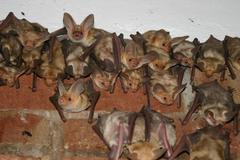
The pallid bat (Antrozous pallidus) is a species of bat that ranges from western Canada to central Mexico. It is the sole species of its genus and is closely related to Van Gelder's bat (Bauerus dubiaquercus), which is sometimes included in Antrozous. Although it has in the past been placed in its own subfamily (Antrozoinae) or even family (Antrozoidae), it is now considered part of the subfamily Vespertilioninae and the tribe Antrozoini.

It is the state bat of California. Pallid bats have a head and body length of approximately 2.75 inches (6.2-7.9 cm), forearm length of approximately 2.1 inches (4.5–6 cm), a tail of approximately 1.75 inches (3.9-4.9 cm), and a wingspan of 15-16 inches (38–40 cm). They weigh 14-25 grams. These bats are large, with long forward pointing ears (over 2.5 cm). Fur is pale at the roots, brown on their back, with a light underside. Pallid bats have a blunt piglike snout. The dental formula for pallid bats is 1.1.1.32.1.2.3 × 2 = 28. The bacula of pallid bats are wedge or spade-shaped, generally with a short narrow base which widens and then tapers towards the tip. The bone also has a characteristic downward 'dip' around the midpoint, with... Wikipedia →

Global Distribution

Parks Where Found

# Park Country Daily sighting probability
1 Death Valley National Park 🇺🇸 United States
~10%
2 Sequoia and Kings Canyon National Parks 🇺🇸 United States
~10%
3 Big Bend National Park 🇺🇸 United States
~10%

Before you go

What are the chances of seeing a Pallid Bat in Death Valley National Park?

With luck

About 10% of wildlife watchers report a Pallid Bat sighting in Death Valley National Park on a given day, based on 6 verified sightings from GBIF citizen-science data from 2019 to 2026. It is the 14th most-seen of the 16 mammals we can rate there. Over three days the chance rises to about 30%, and over a week to about 50%, if each day is a fresh chance.

When is the best time to see a Pallid Bat in Death Valley National Park?

September

In that month about 40% of wildlife watchers report a Pallid Bat in Death Valley National Park on a given day, against under 5% in July–August and October–April, the lowest months. That is one of Death Valley National Park's driest months, with about 5 mm of rain against 30 mm in March.

What time of day is best to see a Pallid Bat?

Between 8 and 11 pm

Across all the parks we cover, that three-hour window holds the most Pallid Bat sightings with a recorded time, and about 6 in 10 of them come between 6 pm and 6 am: it is seen both by day and at night.

Is Death Valley National Park the best place to see a Pallid Bat?

Yes

Of the 3 parks where we can rate Pallid Bat sightings, Death Valley National Park has the highest daily chance: about 10%. Next come Sequoia and Kings Canyon National Parks (United States, about 10%) and Big Bend National Park (United States, about 10%).

Where does the Pallid Bat sighting chance come from?

GBIF citizen-science records

It is estimated from how often the Pallid Bat is recorded against all the mammals logged in Death Valley National Park (6 verified sightings from 2019 to 2026), calibrated against known sighting rates. Figures are rounded to the nearest 10% because citizen-science data supports honest approximations, not decimals, and months with records from fewer than five people show "—". How it works.

← Back to Death Valley National Park