Yellow-backed Spiny Lizard

Yellow-backed Spiny Lizard

Sceloporus uniformis

Silhouette: SeismicShrimp · PhyloPic

Daily sighting probability ~40% · Likely
at Death Valley National Park

In 3 days ~80% in a week >90%

90 Verified sightings at Death Valley National Park From 2019 to 2026
450 In all 3 parks
May Best month
☀️ Diurnal When it's spotted

About the Yellow-backed Spiny Lizard

Sceloporus uniformis, also known as the yellow-backed spiny lizard, is a reptile of the family Phrynosomatidae. It is native to the Mojave, Great Basin, and San Joaquin deserts. Until recently, it was considered to be a subspecies of Sceloporus magister.

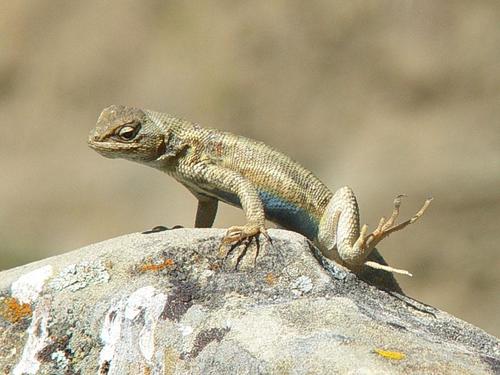
Sceloporus uniformis was originally described as a subspecies of Sceloporus magister in 1955. In 2006, genetic analysis revealed that S. uniformis is sufficiently distinct to merit classification as its own species. S. uniformis is a large robust lizard, and adults can grow to 5.5 inches in body length (snout-to-vent), with a tail slightly longer than the body. Color is brown or tan with yellow and black dorsal stripes or mottling and a black collar on the sides of the neck.

Males are larger than females, and have a swollen tail base, enlarged postanal scales and femoral pores, and bluish markings on the throat and belly. Females have a pale throat and underbelly, with faint or no blue markings. The head of a female may be orange or reddish in the breeding season.

This lizard is native to the Mojave, Great Basin, and San Joaquin deserts. It is endemic to the United States... Wikipedia →

Global Distribution

Parks Where Found

# Park Country Daily sighting probability
1 Zion National Park 🇺🇸 United States
~70%
2 Death Valley National Park 🇺🇸 United States
~40%
3 Joshua Tree National Park 🇺🇸 United States
<5%

Cities Where Found

# City Country Daily sighting probability
1 Las Vegas 🇺🇸 United States
~20%

Before you go

What are the chances of seeing a Yellow-backed Spiny Lizard in Death Valley National Park?

Likely

About 40% of wildlife watchers report a Yellow-backed Spiny Lizard sighting in Death Valley National Park on a given day, based on 90 verified sightings from GBIF citizen-science data from 2019 to 2026. It is the 10th most-seen of the 30 reptiles we can rate there. Over three days the chance rises to about 80%, and over a week to over 90%, if each day is a fresh chance.

When is the best time to see a Yellow-backed Spiny Lizard in Death Valley National Park?

May

In that month about 70% of wildlife watchers report a Yellow-backed Spiny Lizard in Death Valley National Park on a given day, against under 5% in November to January, the lowest months.

What time of day is best to see a Yellow-backed Spiny Lizard?

Between 7 and 10 am

Across all the parks we cover, that three-hour window holds the most Yellow-backed Spiny Lizard sightings with a recorded time, and about 9 in 10 of them come between 6 am and 6 pm: it is a daytime animal.

Is Death Valley National Park the best place to see a Yellow-backed Spiny Lizard?

2nd of 3

Of the 3 parks where we can rate Yellow-backed Spiny Lizard sightings, Death Valley National Park ranks 2nd at about 40%. The best odds are in Zion National Park (United States, about 70%).

Which relatives of the Yellow-backed Spiny Lizard live in Death Valley National Park?

Same genus: Sceloporus

The closest relatives of the Yellow-backed Spiny Lizard that you can see in Death Valley National Park (genus Sceloporus, Spiny Lizards) are Western Fence Lizard (about 20%), Sagebrush Lizard (about 10%) and Desert Spiny Lizard (about 10%), with each one's daily chance of a sighting.

Where does the Yellow-backed Spiny Lizard sighting chance come from?

GBIF citizen-science records

It is estimated from how often the Yellow-backed Spiny Lizard is recorded against all the reptiles logged in Death Valley National Park (90 verified sightings from 2019 to 2026), calibrated against known sighting rates. Figures are rounded to the nearest 10% because citizen-science data supports honest approximations, not decimals, and months with records from fewer than five people show "—". How it works.

← Back to Death Valley National Park