Desert Horned Lizard

Desert Horned Lizard

Phrynosoma platyrhinos

Silhouette: Jose Carlos Arenas-Monroy · PhyloPic

LCLeast ConcernNTVUENCR
Daily sighting probability ~50% · Likely
at Death Valley National Park

In 3 days ~90% in a week >90%

166 Verified sightings at Death Valley National Park From 2019 to 2026
777 In all 3 parks
July Best month
☀️ Diurnal When it's spotted

About the Desert Horned Lizard

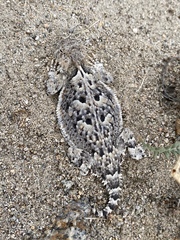
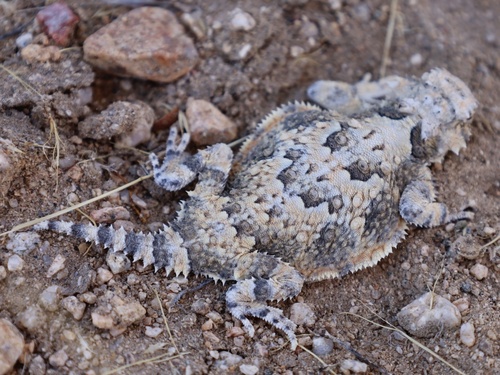
The desert horned lizard (Phrynosoma platyrhinos) is a species of phrynosomatid lizard native to western North America. They are often referred to as "horny toads", although they are not toads, but lizards. They typically range from southern Idaho in the north to northern Mexico in the south. These lizards can generally be found in areas with desert climates throughout western North America.

Changes in the environment due to climate change can trigger shifts in the geographic ranges of animals. Phrynosoma platyrhinos has experienced some changes after the Last Glacial Maximum (LGM) which ended approximately 21,000 years ago. The end of the LGM resulted in the expansion of deserts throughout western North America, and with that expansion Phrynsoma platyrhinos had more areas suitable for them to live in. At the end of the LGM P. platyrhinos was able to expand north into the Great Basin, which is now part of their current geographical range.

There are two subspecies which are found in a different geographic ranges: the northern desert horned lizard (Phrynosoma platyrhinos platyrhinos) ranging in Idaho, Wyoming, Utah, Nevada, the Colorado front range... Wikipedia →
Global Distribution

Parks Where Found

# Park Country Daily sighting probability
1 Joshua Tree National Park 🇺🇸 United States
~50%
2 Death Valley National Park 🇺🇸 United States
~50%
3 Grand Canyon National Park 🇺🇸 United States
~10%

Zoos & Centres Where Found

# Zoo / Centre Country
1 Mesker Park Zoo and Botanic Garden 🇺🇸 United States In captivity
2 Budapest Zoo & Botanical Garden 🇭🇺 Hungary In captivity
3 Chattanooga Zoo at Warner Park 🇺🇸 United States In captivity

Before you go

What are the chances of seeing a Desert Horned Lizard in Death Valley National Park?

Likely

About 50% of wildlife watchers report a Desert Horned Lizard sighting in Death Valley National Park on a given day, based on 166 verified sightings from GBIF citizen-science data from 2019 to 2026. It is the 5th most-seen of the 30 reptiles we can rate there. Over three days the chance rises to about 90%, and over a week to over 90%, if each day is a fresh chance.

When is the best time to see a Desert Horned Lizard in Death Valley National Park?

July

In that month about 80% of wildlife watchers report a Desert Horned Lizard in Death Valley National Park on a given day, against under 5% in December, the lowest month.

What time of day is best to see a Desert Horned Lizard?

Between 8 and 11 am

Across all the parks we cover, that three-hour window holds the most Desert Horned Lizard sightings with a recorded time, and about 8 in 10 of them come between 6 am and 6 pm: it is a daytime animal.

Is Death Valley National Park the best place to see a Desert Horned Lizard?

Among the best

Of the 3 parks where we can rate Desert Horned Lizard sightings, Death Valley National Park ranks 2nd at about 50%, level with the leaders once rounded. The best odds are in Joshua Tree National Park (United States, about 50%).

Where does the Desert Horned Lizard sighting chance come from?

GBIF citizen-science records

It is estimated from how often the Desert Horned Lizard is recorded against all the reptiles logged in Death Valley National Park (166 verified sightings from 2019 to 2026), calibrated against known sighting rates. Figures are rounded to the nearest 10% because citizen-science data supports honest approximations, not decimals, and months with records from fewer than five people show "—". How it works.

← Back to Death Valley National Park