Desert Collared Lizard

Desert Collared Lizard

Crotaphytus bicinctores

Silhouette: Jose Carlos Arenas-Monroy · PhyloPic

LCLeast ConcernNTVUENCR
Daily sighting probability ~50% · Likely
at Death Valley National Park

In 3 days ~90% in a week >90%

131 Verified sightings at Death Valley National Park From 2019 to 2026
651 In all 4 parks
May Best month
☀️ Diurnal When it's spotted

About the Desert Collared Lizard

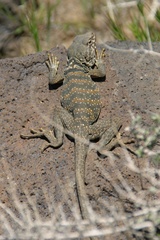
The Great Basin collared lizard (Crotaphytus bicinctores), also known commonly as the desert collared lizard or the Mojave black-collared lizard, is a species of lizard in the family Crotaphytidae. The species is endemic to the Western United States.

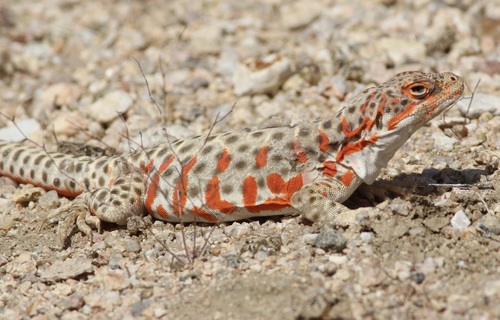
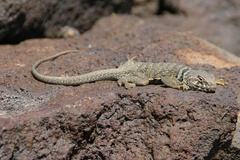
C. bicinctores is very similar to the common collared lizard, Crotaphytus collaris, in shape and size, but it lacks the bright extravagant colors. Males can be brown to orange and some red or pink on the belly. Females are more black or dark brown. C. bicintores has elongated scales near the claws, and the tail is more triangular in shape than round as with C. collaris.

C. bicinctores has a broad head, large hind legs, and derives its specific name from the pair of black bands on the neck. Males have broader heads than females, with a dark-colored throat and more pronounced orange crossbands on the body. Adults range in size from 2.5 to 4.5 in (6.4 to 11.4 cm) in snout-to-vent length (SVL), with a thick tail that is often twice as long as the body.

The Great Basin collared lizard is endemic to the Western United States, and is found in California, most of Nevada, southeastern Oregon... Wikipedia →

Global Distribution

Parks Where Found

# Park Country Daily sighting probability
1 Death Valley National Park 🇺🇸 United States
~50%
2 Joshua Tree National Park 🇺🇸 United States
~40%
3 Zion National Park 🇺🇸 United States
~30%
4 Grand Canyon National Park 🇺🇸 United States
~30%

Zoos & Centres Where Found

# Zoo / Centre Country
1 Living Desert Zoo and Gardens 🇺🇸 United States In captivity
2 Houston Zoo 🇺🇸 United States In captivity
3 Chattanooga Zoo at Warner Park 🇺🇸 United States In captivity
4 Newport Aquarium 🇺🇸 United States In captivity

Before you go

What are the chances of seeing a Desert Collared Lizard in Death Valley National Park?

Likely

About 50% of wildlife watchers report a Desert Collared Lizard sighting in Death Valley National Park on a given day, based on 131 verified sightings from GBIF citizen-science data from 2019 to 2026. It is the 6th most-seen of the 30 reptiles we can rate there. Over three days the chance rises to about 90%, and over a week to over 90%, if each day is a fresh chance.

When is the best time to see a Desert Collared Lizard in Death Valley National Park?

May

In that month about 80% of wildlife watchers report a Desert Collared Lizard in Death Valley National Park on a given day, against under 5% in December and January, the lowest months.

What time of day is best to see a Desert Collared Lizard?

Between 10 am and 1 pm

Across all the parks we cover, that three-hour window holds the most Desert Collared Lizard sightings with a recorded time, and about 9 in 10 of them come between 6 am and 6 pm: it is a daytime animal.

Is Death Valley National Park the best place to see a Desert Collared Lizard?

Yes

Of the 4 parks where we can rate Desert Collared Lizard sightings, Death Valley National Park has the highest daily chance: about 50%. Next come Joshua Tree National Park (United States, about 40%) and Zion National Park (United States, about 30%). All parks ranked.

Where does the Desert Collared Lizard sighting chance come from?

GBIF citizen-science records

It is estimated from how often the Desert Collared Lizard is recorded against all the reptiles logged in Death Valley National Park (131 verified sightings from 2019 to 2026), calibrated against known sighting rates. Figures are rounded to the nearest 10% because citizen-science data supports honest approximations, not decimals, and months with records from fewer than five people show "—". How it works.

← Back to Death Valley National Park