About the Desert Iguana
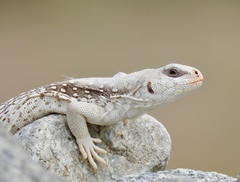
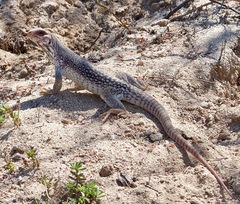
The desert iguana (Dipsosaurus dorsalis) is an iguana species found in the Sonoran and Mojave Deserts of the Southwestern United States and northwestern Mexico, as well as on several Gulf of California islands. The species was first described in the Proceedings of the Academy of Natural Sciences of Philadelphia, by Spencer Fullerton Baird and Charles Frédéric Girard, in 1852 as Crotaphytus dorsalis. It was reclassified two years later as Dipsosaurus dorsalis by Edward Hallowell. The generic name comes from a combination of two Greek words meaning "thirsty lizard": "Dipsa" (δίψα) for "thirsty", and "sauros" (σαῦρος) for "lizard". The specific name, "dorsalis", comes from the Latin word dorsum meaning "spike", in reference to a row of enlarged spiked scales on the middle of the lizard's back which form a crest that extends almost to the tip of its vent. Dipsosaurus contains two species, D. dorsalis, and D. catalinensis. Genetic evidence supports Dipsosaurus being the sister lineage to all other members of Iguanidae, diverging during the late Eocene, about 38 million years ago.
There are two peninsular and one continental subspecies of the desert iguana. Wikipedia →