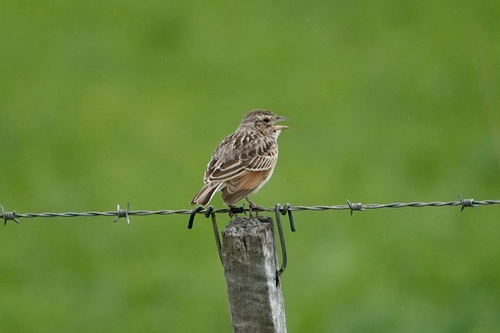
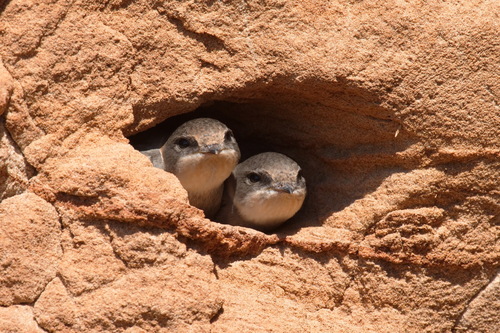
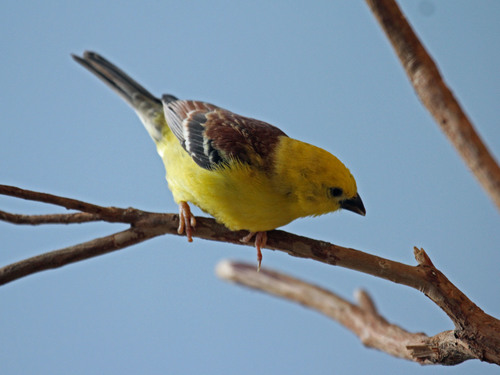
Chestnut-backed Sparrow-Lark

Chestnut-backed Sparrow-Lark

Eremopterix leucotis

Silhouette: Gossipguy and T. Michael Keesey · PhyloPic

LCLeast ConcernNTVUENCR
Daily sighting probability ~20% · Possible
at Djoudj National Bird Sanctuary

In 3 days ~50% in a week ~80%

31 Verified sightings at Djoudj National Bird Sanctuary From 2019 to 2026
1,173 In all 16 parks
March Best month
☀️ Diurnal When it's spotted

About the Chestnut-backed Sparrow-Lark

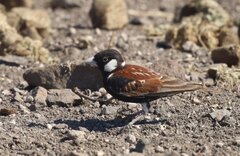
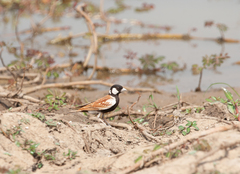
The chestnut-backed sparrow-lark (Eremopterix leucotis) is a passerine bird which is a resident breeder in Africa south of the Sahara Desert. The chestnut-backed sparrow-lark was originally placed in the genus Loxia. It was later moved to the Lark family Alaudidae under the genus Eremopterix which includes all other sparrow-lark species. Alternate names for this species include: chestnut-backed finch-lark and white-cheeked sparrow-lark.

Found from Senegal and Gambia to central Sudan

Wikipedia →

Sounds

Flight song0:10

South Africa · 2013

© Peter Boesman · XC280283 · CC BY-NC-ND 4.0

Song1:18

Ethiopia · 2014

© Andrew Spencer · XC209983 · CC BY-NC-SA 4.0

Call0:09

Mali · 2018

© Bram Piot · XC440458 · CC BY-NC-SA 4.0

Global Distribution

Parks Where Found

# Park Country Daily sighting probability
1 Djoudj National Bird Sanctuary 🇸🇳 Senegal
~20%
2 Etosha National Park 🇳🇦 Namibia
~10%
3 Mole National Park 🇬🇭 Ghana
~10%
4 Awash National Park 🇪🇹 Ethiopia
~10%
5 Kruger National Park 🇿🇦 South Africa
~10%
6 Tsavo East National Park 🇰🇪 Kenya
~10%
7 South Luangwa National Park 🇿🇲 Zambia
<5%
8 Hwange National Park 🇿🇼 Zimbabwe
<5%
9 Liwonde National Park 🇲🇼 Malawi
<5%
10 Niokolo-Koba National Park 🇸🇳 Senegal
<5%
11 Lower Zambezi National Park 🇿🇲 Zambia
<5%
12 Samburu National Reserve 🇰🇪 Kenya
<5%
13 Chobe National Park 🇧🇼 Botswana
<5%
14 Mana Pools National Park 🇿🇼 Zimbabwe
<5%
15 Ngorongoro Conservation Area 🇹🇿 Tanzania
<5%
16 Moremi Game Reserve 🇧🇼 Botswana
<5%

Zoos & Centres Where Found

# Zoo / Centre Country
1 Tierpark Hagenbeck 🇩🇪 Germany In captivity

Before you go

What are the chances of seeing a Chestnut-backed Sparrow-Lark in Djoudj National Bird Sanctuary?

Possible

About 20% of wildlife watchers report a Chestnut-backed Sparrow-Lark sighting in Djoudj National Bird Sanctuary on a given day, based on 31 verified sightings from GBIF citizen-science data from 2019 to 2026. It is the 106th most-seen of the 173 birds we can rate there. Over three days the chance rises to about 50%, and over a week to about 80%, if each day is a fresh chance.

When is the best time to see a Chestnut-backed Sparrow-Lark in Djoudj National Bird Sanctuary?

February and March

In those months about 30% of wildlife watchers report a Chestnut-backed Sparrow-Lark in Djoudj National Bird Sanctuary on a given day, against about 20% in April and November–January, the lowest months. Those are among Djoudj National Bird Sanctuary's driest months, with almost no rain against 55 mm in August. May to October have too few records to rate.

What time of day is best to see a Chestnut-backed Sparrow-Lark?

Between 10 am and 1 pm

Across all the parks we cover, that three-hour window holds the most Chestnut-backed Sparrow-Lark sightings with a recorded time, and about 9 in 10 of them come between 6 am and 6 pm: it is a daytime animal.

Is Djoudj National Bird Sanctuary the best place to see a Chestnut-backed Sparrow-Lark?

Yes

Of the 16 parks where we can rate Chestnut-backed Sparrow-Lark sightings, Djoudj National Bird Sanctuary has the highest daily chance: about 20%. Next come Etosha National Park (Namibia, about 10%) and Mole National Park (Ghana, about 10%).

Where does the Chestnut-backed Sparrow-Lark sighting chance come from?

GBIF citizen-science records

It is estimated from how often the Chestnut-backed Sparrow-Lark is recorded against all the birds logged in Djoudj National Bird Sanctuary (31 verified sightings from 2019 to 2026), calibrated against known sighting rates. Figures are rounded to the nearest 10% because citizen-science data supports honest approximations, not decimals, and months with records from fewer than five people show "—". How it works.

← Back to Djoudj National Bird Sanctuary