
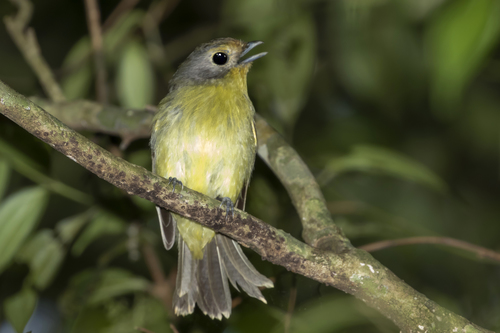
Red-ruffed Fruitcrow

Red-ruffed Fruitcrow

Pyroderus scutatus

Silhouette: Edwin Price · PhyloPic

LCLeast ConcernNTVUENCR
Daily sighting probability <5% · Rare
at Iguaçu National Park

In 3 days ~10%

67 Verified sightings at Iguaçu National Park From 2019 to 2026
1,065 In all 5 parks
September Best month
☀️ Diurnal When it's spotted

About the Red-ruffed Fruitcrow

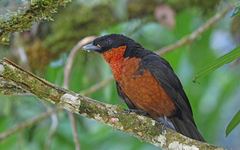
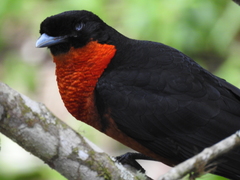
The red-ruffed fruitcrow (Pyroderus scutatus) is a species of bird in the monotypic genus Pyroderus. It belongs to the family Cotingidae, and is one of the largest passerines in South America. Its common names in Spanish include yacutoro, toropisco montañero, sangretoro, pájaro torero, and cuervo-frutero de garganta roja. This species was first named Coracias scutata by Shaw in 1792, but was later changed to the current scientific name.

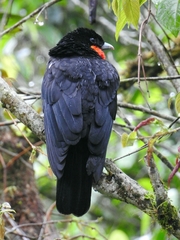
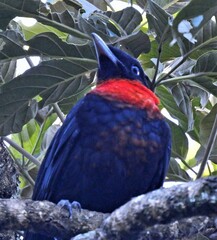
It has a relatively heavy pale bluish bill, and the plumage is primarily black, but with a dull brown to bright orange-crimson patch on the throat depending on the subspecies, (thereby superficially resembling the smaller male purple-throated fruitcrow). Some subspecies have brown underparts. Males gather in loose leks where they call to attract the smaller, but otherwise similar, females.

Pyroderus scutatus scutatus is the nominated subspecies with a glossy black back with some iridescence. A crimson patch... Wikipedia →

Sounds

Song0:58

Brazil · 2021

© GABRIEL LEITE · XC672195 · CC BY-NC-SA 4.0

Male(s) at lek0:43

Colombia · 2010

© Frank Lambert · XC59584 · CC BY-NC-ND 4.0

Call0:45

Brazil · 2020

© Arthur Gomes · XC586403 · CC BY-NC-SA 4.0

Global Distribution

Parks Where Found

# Park Country Daily sighting probability
1 Los Nevados National Natural Park 🇨🇴 Colombia
~10%
2 Itatiaia National Park 🇧🇷 Brazil
~10%
3 Iguaçu National Park 🇧🇷 Brazil
<5%
4 Iguazú National Park 🇦🇷 Argentina
<5%
5 Farallones de Cali National Natural Park 🇨🇴 Colombia
<5%

Cities Where Found

# City Country Daily sighting probability
1 São Paulo 🇧🇷 Brazil
<5%

Zoos & Centres Where Found

# Zoo / Centre Country
1 Parque das Aves 🇧🇷 Brazil In captivity
2 Rio de Janeiro Zoological Garden 🇧🇷 Brazil In captivity

Before you go

What are the chances of seeing a Red-ruffed Fruitcrow in Iguaçu National Park?

Rare

Under 5% of wildlife watchers report a Red-ruffed Fruitcrow sighting in Iguaçu National Park on a given day, based on 67 verified sightings from GBIF citizen-science data from 2019 to 2026. It is the 219th most-seen of the 346 birds we can rate there. Over three days the chance rises to about 10%, if each day is a fresh chance.

When is the best time to see a Red-ruffed Fruitcrow in Iguaçu National Park?

Any time of year

In every month with enough records, under 5% of wildlife watchers report a Red-ruffed Fruitcrow in Iguaçu National Park on a given day, so our monthly data shows no clear season.

What time of day is best to see a Red-ruffed Fruitcrow?

Between 7 and 10 am

Across all the parks we cover, that three-hour window holds the most Red-ruffed Fruitcrow sightings with a recorded time, and about 9 in 10 of them come between 6 am and 6 pm: it is a daytime animal.

Is Iguaçu National Park the best place to see a Red-ruffed Fruitcrow?

3rd of 5

Of the 5 parks where we can rate Red-ruffed Fruitcrow sightings, Iguaçu National Park ranks 3rd at under 5%. The best odds are in Los Nevados National Natural Park (Colombia, about 10%) and Itatiaia National Park (Brazil, about 10%).

Which relatives of the Red-ruffed Fruitcrow live in Iguaçu National Park?

Same family: Cotingidae

The closest relatives of the Red-ruffed Fruitcrow that you can see in Iguaçu National Park (family Cotingidae, Cotingas) are Masked Tityra (about 10%), Black-crowned Tityra (about 10%) and Greenish Schiffornis (about 10%), with each one's daily chance of a sighting.

Where does the Red-ruffed Fruitcrow sighting chance come from?

GBIF citizen-science records

It is estimated from how often the Red-ruffed Fruitcrow is recorded against all the birds logged in Iguaçu National Park (67 verified sightings from 2019 to 2026), calibrated against known sighting rates. Figures are rounded to the nearest 10% because citizen-science data supports honest approximations, not decimals, and months with records from fewer than five people show "—". How it works.

← Back to Iguaçu National Park