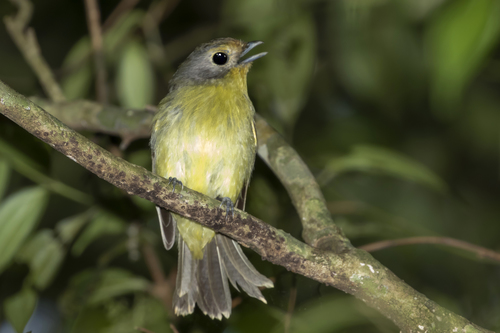
Bare-throated Bellbird

Bare-throated Bellbird

Procnias nudicollis

Silhouette: Kai Caspar · PhyloPic

LCNTNear ThreatenedVUENCR
Daily sighting probability <5% · Rare
at Iguaçu National Park

In 3 days <5%

17 Verified sightings at Iguaçu National Park From 2019 to 2026
472 In all 6 parks
September Best month
☀️ Diurnal When it's spotted

About the Bare-throated Bellbird

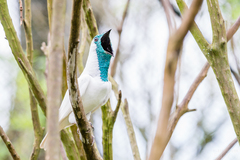
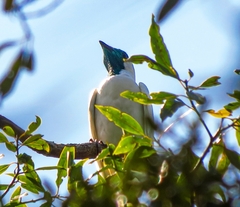
The bare-throated bellbird (Procnias nudicollis) is a species of bird in the family Cotingidae. It is found in moist subtropical and tropical forests in Argentina, Brazil, and Paraguay. The male has white plumage and bristly bluish-black bare skin around its eye, beak and throat. The female is more drab, being olive-brown above with streaked yellow underparts. The male has one of the loudest known bird calls, producing a metallic sound similar to a hammer striking an anvil. This bird feeds strictly on fruit and plays a part in dispersing the seeds of forest trees. It is considered Near Threatened because of loss of its forest habitat and collection for the pet bird trade.

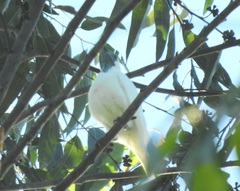
The male bird has striking white plumage and a bare bluish-black patch of skin around its eyes and beak and on its throat. The female is duller in colour with a black crown, olive-brown upper parts and yellowish underparts streaked with olive green. This bird is about 27 cm (11 in) long.

Like other bellbirds (Procnias), P. nudicollis has a short bill with a very wide gape. The male has one of the loudest calls of any bird—a sharp sound like that of a hammer striking an anvil or a bell. Before making such... Wikipedia →

Sounds

Call0:33

Brazil · 2026

© JAYRSON ARAUJO DE OLIVEIRA · XC1150302 · CC BY-NC-SA 4.0

Song0:45

Brazil · 2025

© Teus Luijendijk · XC1036340 · CC BY-NC-ND 4.0

Canto0:40

Brazil · 2017

© Caio Brito · XC427846 · CC BY-NC-SA 4.0

Global Distribution

Parks Where Found

# Park Country Daily sighting probability
1 Itatiaia National Park 🇧🇷 Brazil
~10%
2 Serra dos Órgãos National Park 🇧🇷 Brazil
~10%
3 Tijuca National Park 🇧🇷 Brazil
<5%
4 Chapada Diamantina National Park 🇧🇷 Brazil
<5%
5 Iguazú National Park 🇦🇷 Argentina
<5%
6 Iguaçu National Park 🇧🇷 Brazil
<5%

Cities Where Found

# City Country Daily sighting probability
1 Santos 🇧🇷 Brazil
<5%
2 São Paulo 🇧🇷 Brazil
<5%
3 Curitiba 🇧🇷 Brazil
<5%
4 Rio de Janeiro 🇧🇷 Brazil
<5%

Zoos & Centres Where Found

# Zoo / Centre Country
1 Parque das Aves 🇧🇷 Brazil In captivity
2 Zoobotanic Park of Brusque 🇧🇷 Brazil In captivity
3 Jardín Botánico y Zoológico de Asunción 🇵🇾 Paraguay In captivity
4 Zoo das Aves 🇧🇷 Brazil In captivity
5 Parque Zoológico Bosque Guarani 🇧🇷 Brazil In captivity
6 Zoológico 🇧🇷 Brazil In captivity
7 GüiráOga 🇦🇷 Argentina In captivity

Before you go

What are the chances of seeing a Bare-throated Bellbird in Iguaçu National Park?

Rare

Under 5% of wildlife watchers report a Bare-throated Bellbird sighting in Iguaçu National Park on a given day, based on 17 verified sightings from GBIF citizen-science data from 2019 to 2026. It is the 291st most-seen of the 346 birds we can rate there. Over three days the chance rises to under 5%, if each day is a fresh chance.

When is the best time to see a Bare-throated Bellbird in Iguaçu National Park?

Any time of year

In every month with enough records, under 5% of wildlife watchers report a Bare-throated Bellbird in Iguaçu National Park on a given day, so our monthly data shows no clear season.

What time of day is best to see a Bare-throated Bellbird?

Between 8 and 11 am

Across all the parks we cover, that three-hour window holds the most Bare-throated Bellbird sightings with a recorded time, and about 9 in 10 of them come between 6 am and 6 pm: it is a daytime animal.

Which relatives of the Bare-throated Bellbird live in Iguaçu National Park?

Same family: Cotingidae

The closest relatives of the Bare-throated Bellbird that you can see in Iguaçu National Park (family Cotingidae, Cotingas) are Masked Tityra (about 10%), Black-crowned Tityra (about 10%) and Greenish Schiffornis (about 10%), with each one's daily chance of a sighting.

Where does the Bare-throated Bellbird sighting chance come from?

GBIF citizen-science records

It is estimated from how often the Bare-throated Bellbird is recorded against all the birds logged in Iguaçu National Park (17 verified sightings from 2019 to 2026), calibrated against known sighting rates. Figures are rounded to the nearest 10% because citizen-science data supports honest approximations, not decimals, and months with records from fewer than five people show "—". How it works.

← Back to Iguaçu National Park