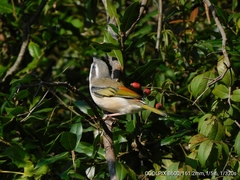

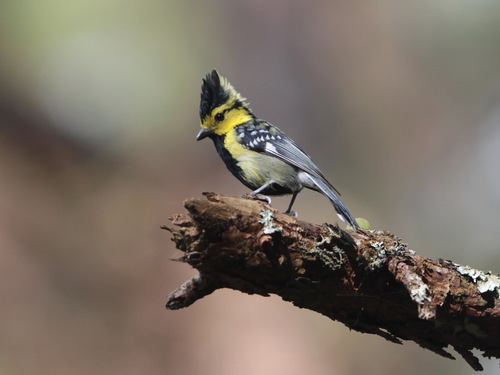
Blyth's Shrike-Babbler

Blyth's Shrike-Babbler

Pteruthius aeralatus

Silhouette: Sheatherius · PhyloPic

LCLeast ConcernNTVUENCR
Daily sighting probability ~30% · Possible
at Doi Inthanon National Park

In 3 days ~70% in a week ~90%

1,045 Verified sightings at Doi Inthanon National Park From 2019 to 2026
2,789 In all 9 parks
June Best month
🌅 Crepuscular When it's spotted

About the Blyth's Shrike-Babbler

The white-browed shrike-babbler (Pteruthius aeralatus) is a bird species found in the eastern Himalayas and Southeast Asia from northern Burma to southern Cambodia. Like others in the genus it is found in montane forests. Males and females have different plumages and variations occur through its range with several populations being treated as subspecies. It is part of a cryptic species complex and was earlier lumped as a subspecies of the white-browed shrike-babbler. Clements lumps this bird into the white-browed shrike-babbler.

The white-browed shrike-babbler is sexually dimorphic. There are many variations between the populations and some are more distinctive than others but they may not be easy to diagnose in the field. In general appearance it is very similar to the Himalayan shrike-babbler but all subspecies with the exception of validirostris have the tertials of males partly coloured rufous and partly fulvous.

The common name commemorates Edward Blyth (1810–1873), who published the description and notes based on Samuel Tickell's specimen. It was earlier called Tickell's shrike-Tit. The species Pteruthius aeralatus was described by Edward Blyth... Wikipedia →

Sounds

Song0:23

China · 2026

© Yang Li · XC1133289 · CC BY-NC-SA 4.0

Call0:26

Malaysia · 2014

© Peter Boesman · XC290910 · CC BY-NC-ND 4.0

Song0:32

Malaysia · 2026

© Ding Li Yong · XC1105058 · CC BY-NC-ND 4.0

Global Distribution

Parks Where Found

# Park Country Daily sighting probability
1 Kinabalu Park 🇲🇾 Malaysia
~40%
2 Doi Inthanon National Park 🇹🇭 Thailand
~30%
3 Kerinci Seblat National Park 🇮🇩 Indonesia
~30%
4 Namdapha National Park 🇮🇳 India
~10%
5 Royal Manas National Park 🇧🇹 Bhutan
~10%
6 Langtang National Park 🇳🇵 Nepal
~10%
7 Kaeng Krachan National Park 🇹🇭 Thailand
~10%
8 Khao Yai National Park 🇹🇭 Thailand
<5%
9 Jim Corbett National Park 🇮🇳 India
<5%

Cities Where Found

# City Country Daily sighting probability
1 Kathmandu 🇳🇵 Nepal
<5%

Before you go

What are the chances of seeing a Blyth's Shrike-Babbler in Doi Inthanon National Park?

Possible

About 30% of wildlife watchers report a Blyth's Shrike-Babbler sighting in Doi Inthanon National Park on a given day, based on 1,045 verified sightings from GBIF citizen-science data from 2019 to 2026. It is the 28th most-seen of the 367 birds we can rate there. Over three days the chance rises to about 70%, and over a week to about 90%, if each day is a fresh chance.

When is the best time to see a Blyth's Shrike-Babbler in Doi Inthanon National Park?

June

In that month about 50% of wildlife watchers report a Blyth's Shrike-Babbler in Doi Inthanon National Park on a given day, against about 10% in November, the lowest month. That is one of Doi Inthanon National Park's wettest months, with about 270 mm of rain against 20 mm in February.

What time of day is best to see a Blyth's Shrike-Babbler?

Between 2 and 5 am

Across all the parks we cover, that three-hour window holds the most Blyth's Shrike-Babbler sightings with a recorded time, and about 6 in 10 of them come between 6 pm and 6 am: it is most active around dawn and dusk.

Is Doi Inthanon National Park the best place to see a Blyth's Shrike-Babbler?

2nd of 9

Of the 9 parks where we can rate Blyth's Shrike-Babbler sightings, Doi Inthanon National Park ranks 2nd at about 30%. The best odds are in Kinabalu Park (Malaysia, about 40%).

Where does the Blyth's Shrike-Babbler sighting chance come from?

GBIF citizen-science records

It is estimated from how often the Blyth's Shrike-Babbler is recorded against all the birds logged in Doi Inthanon National Park (1,045 verified sightings from 2019 to 2026), calibrated against known sighting rates. Figures are rounded to the nearest 10% because citizen-science data supports honest approximations, not decimals, and months with records from fewer than five people show "—". How it works.

← Back to Doi Inthanon National Park