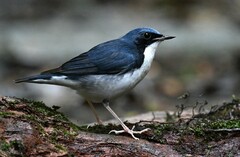
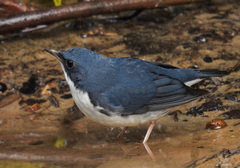
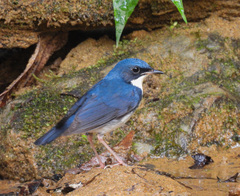
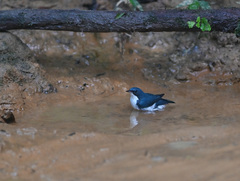
Siberian Blue Robin

Siberian Blue Robin

Luscinia cyane

Silhouette: Stephan Sprinz · PhyloPic

Daily sighting probability ~10% · With luck
at Doi Inthanon National Park

In 3 days ~30% in a week ~60%

369 Verified sightings at Doi Inthanon National Park From 2019 to 2026
1,929 In all 11 parks
November Best month
🌅 Crepuscular When it's spotted

About the Siberian Blue Robin

The Siberian blue robin (Larvivora cyane) is a small passerine bird that was formerly classified as a member of the thrush family, Turdidae, but is now more generally considered to belong to the Old World flycatcher family, Muscicapidae. It and similar small European species are often called chats. Recent research suggests that this species and some other East Asian members of Luscinia should be classified in a new genus, together with the Japanese and Ryūkyū robins. The genus name Larvivora comes from the Neo-Latin larva meaning caterpillar and -vorus meaning eating (vorace to devour), and cyane is Latin for "dark-blue".

This bird is a migratory insectivorous species breeding in the eastern Palearctic from Siberia and northern Mongolia, northeastern China, Korea and across to Japan. It winters in southern and south-eastern Asia and Indonesia.

The breeding habitat is coniferous forest with dense understory, often beside rivers or at woodland edges. It feeds on the ground but is very 'skulking'. In winter, this bird also tends to stay in dense vegetation. This species is a very rare vagrant to Europe, and has vagrant status even as far east as Pakistan. The Siberian blue robin was previously placed in the genus Luscinia. A large molecular phylogenetic study published in 2010 found that Luscinia was not monophyletic. The genus was therefore split and several species including the Siberian blue robin were moved to the reinstated genus Larvivora. Wikipedia →

Sounds

Recording1:05

Russia · 2026

© Владимир Бо. · iNaturalist · CC BY-NC 4.0

Recording0:04

Thailand · 2023

© Sam Hambly · iNaturalist · CC BY 4.0

Recording0:37

Russia · 2026

© Татьяна · iNaturalist · CC BY-NC 4.0

Global Distribution

Parks Where Found

# Park Country Daily sighting probability
1 Cat Tien National Park 🇻🇳 Vietnam
~30%
2 Kaeng Krachan National Park 🇹🇭 Thailand
~20%
3 Khao Luang National Park 🇹🇭 Thailand
~10%
4 Doi Inthanon National Park 🇹🇭 Thailand
~10%
5 Khao Sok National Park 🇹🇭 Thailand
~10%
6 Nikko National Park 🇯🇵 Japan
<5%
7 Way Kambas National Park 🇮🇩 Indonesia
<5%
8 Danum Valley Conservation Area 🇲🇾 Malaysia
<5%
9 Khao Yai National Park 🇹🇭 Thailand
<5%
10 Taman Negara National Park 🇲🇾 Malaysia
<5%
11 Kinabalu Park 🇲🇾 Malaysia
<5%

Cities Where Found

# City Country Daily sighting probability
1 Hanoi 🇻🇳 Vietnam
<5%
2 Beijing 🇨🇳 China
<5%
3 Kuala Lumpur 🇲🇾 Malaysia
<5%
4 Singapore 🇸🇬 Singapore
<5%
5 Chengdu 🇨🇳 China
<5%
6 Guangzhou 🇨🇳 China
<5%
7 Osaka 🇯🇵 Japan
<5%
8 Bangkok 🇹🇭 Thailand
<5%
9 Hangzhou 🇨🇳 China
<5%
10 Kolkata 🇮🇳 India
<5%

Before you go

What are the chances of seeing a Siberian Blue Robin in Doi Inthanon National Park?

With luck

About 10% of wildlife watchers report a Siberian Blue Robin sighting in Doi Inthanon National Park on a given day, based on 369 verified sightings from GBIF citizen-science data from 2019 to 2026. It is the 120th most-seen of the 367 birds we can rate there. Over three days the chance rises to about 30%, and over a week to about 60%, if each day is a fresh chance.

When is the best time to see a Siberian Blue Robin in Doi Inthanon National Park?

November to January

In those months about 20% of wildlife watchers report a Siberian Blue Robin in Doi Inthanon National Park on a given day, against under 5% in May to October, the lowest months. Those are among Doi Inthanon National Park's driest months, with about 60 mm of rain a month against 340 mm in August.

What time of day is best to see a Siberian Blue Robin?

Between 10 am and 1 pm

Across all the parks we cover, that three-hour window holds the most Siberian Blue Robin sightings with a recorded time, and about half of them come between 6 am and 6 pm: it is most active around dawn and dusk.

Is Doi Inthanon National Park the best place to see a Siberian Blue Robin?

4th of 11

Of the 11 parks where we can rate Siberian Blue Robin sightings, Doi Inthanon National Park ranks 4th at about 10%. The best odds are in Cat Tien National Park (Vietnam, about 30%), Kaeng Krachan National Park (Thailand, about 20%) and Khao Luang National Park (Thailand, about 10%).

Where does the Siberian Blue Robin sighting chance come from?

GBIF citizen-science records

It is estimated from how often the Siberian Blue Robin is recorded against all the birds logged in Doi Inthanon National Park (369 verified sightings from 2019 to 2026), calibrated against known sighting rates. Figures are rounded to the nearest 10% because citizen-science data supports honest approximations, not decimals, and months with records from fewer than five people show "—". How it works.

← Back to Doi Inthanon National Park