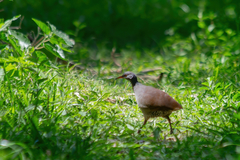
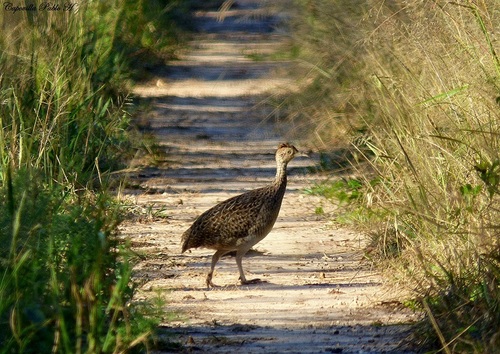
Tataupá Tinamou

Tataupá Tinamou

Crypturellus tataupa

Silhouette: J. N. Wiegers · PhyloPic

LCLeast ConcernNTVUENCR
Daily sighting probability ~40% · Likely
at El Impenetrable National Park

In 3 days ~80% in a week >90%

143 Verified sightings at El Impenetrable National Park From 2019 to 2026
703 In all 7 parks
July Best month
☀️ Diurnal When it's spotted

About the Tataupá Tinamou

The Tataupa tinamou (Crypturellus tataupa) is a type of tinamou commonly found in dry forest in subtropical and tropical regions in southeastern South America. Crypturellus is formed from three Latin or Greek words: kruptos meaning covered or hidden, oura meaning tail, and ellus meaning diminutive. Therefore, Crypturellus means small hidden tail.

Tataupa is a Guarani term, referring to the bird's ashy-colored plumage. All tinamou are from the family Tinamidae, and in the larger scheme are also ratites. Unlike other ratites, tinamous can fly, although in general, they are not strong fliers. All ratites evolved from prehistoric flying birds, and tinamous are the closest living relative of these birds.

The Tataupa tinamou has four subspecies as follows: C. t. tataupa Nominate race, occurs in eastern Bolivia, southern Brazil, northern Argentina, and Paraguay. C. t. inops occurs in northwestern Peru in the Marañón Valley,. and also extreme southern Ecuador

C. t. peruvianus occurs in west central Peru in the Chanchamayo Valley of Junín Region. C. t. lepidotus occurs in northeastern Brazil; Bahia, Ceará, Piauí, Pernambuco, and Maranhão States... Wikipedia →

Sounds

Subsong0:04

Brazil · 2025

© Fabrício Grigolin · XC989803 · CC BY-NC-SA 4.0

Call0:30

Brazil · 2025

© JAYRSON ARAUJO DE OLIVEIRA · XC978453 · CC BY-NC-SA 4.0

Song1:04

Brazil · 2024

© Ricardo José Mitidieri · XC952439 · CC BY-NC-SA 4.0

Global Distribution

Parks Where Found

# Park Country Daily sighting probability
1 El Impenetrable National Park 🇦🇷 Argentina
~40%
2 Serra dos Órgãos National Park 🇧🇷 Brazil
~10%
3 Chapada dos Guimarães National Park 🇧🇷 Brazil
~10%
4 Amboró National Park 🇧🇴 Bolivia
~10%
5 Iguazú National Park 🇦🇷 Argentina
~10%
6 Iguaçu National Park 🇧🇷 Brazil
~10%
7 Itatiaia National Park 🇧🇷 Brazil
<5%

Cities Where Found

# City Country Daily sighting probability
1 Santa Cruz de la Sierra 🇧🇴 Bolivia
<5%
2 São Paulo 🇧🇷 Brazil
<5%

Zoos & Centres Where Found

# Zoo / Centre Country
1 Prague Zoo 🇨🇿 Czechia In captivity
2 Rákosův pavilon 🇨🇿 Czechia In captivity
3 Velemlokárium 🇨🇿 Czechia In captivity

Before you go

What are the chances of seeing a Tataupá Tinamou in El Impenetrable National Park?

Likely

About 40% of wildlife watchers report a Tataupá Tinamou sighting in El Impenetrable National Park on a given day, based on 143 verified sightings from GBIF citizen-science data from 2019 to 2026. It is the 38th most-seen of the 219 birds we can rate there. Over three days the chance rises to about 80%, and over a week to over 90%, if each day is a fresh chance.

When is the best time to see a Tataupá Tinamou in El Impenetrable National Park?

June–July and September–November

In those months about 50% of wildlife watchers report a Tataupá Tinamou in El Impenetrable National Park on a given day, against about 20% in February, the lowest month. December has too few records to rate.

What time of day is best to see a Tataupá Tinamou?

Between 8 and 11 am

Across all the parks we cover, that three-hour window holds the most Tataupá Tinamou sightings with a recorded time, and about 8 in 10 of them come between 6 am and 6 pm: it is a daytime animal.

Where does the Tataupá Tinamou sighting chance come from?

GBIF citizen-science records

It is estimated from how often the Tataupá Tinamou is recorded against all the birds logged in El Impenetrable National Park (143 verified sightings from 2019 to 2026), calibrated against known sighting rates. Figures are rounded to the nearest 10% because citizen-science data supports honest approximations, not decimals, and months with records from fewer than five people show "—". How it works.

← Back to El Impenetrable National Park