American Avocet

American Avocet

Recurvirostra americana

Silhouette: Alexandre Vong · PhyloPic

LCLeast ConcernNTVUENCR
Daily sighting probability ~20% · Possible
at El Vizcaíno Biosphere Reserve

In 3 days ~40% in a week ~70%

173 Verified sightings at El Vizcaíno Biosphere Reserve From 2019 to 2026
4,122 In all 17 parks
November Best month
☀️ Diurnal When it's spotted

About the American Avocet

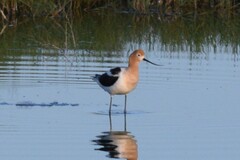
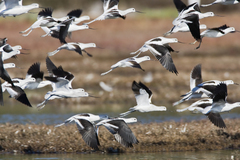
The American avocet (Recurvirostra americana) is a large wader in the avocet and stilt family, Recurvirostridae, found in North America. It spends much of its time foraging in shallow water or on mud flats, often sweeping its bill from side to side in water as it seeks crustacean and insect prey.

The American avocet was formally described in 1789 by the German naturalist Johann Friedrich Gmelin in his revised and expanded edition of Carl Linnaeus's Systema Naturae. He placed it with the pied avocet in the genus Recurvirostra and coined the binomial name Recurvirostra americana. Gmelin based his description on that by the English ornithologist John Latham who in 1785 had described and illustrated the American avocet in his A General Synopsis of Birds. Latham cited the earlier publication by William Dampier and also that by Thomas Pennant. The genus name combines the Latin recurvus meaning 'bent' or 'curved backwards' with rostrum meaning 'bill'. The species is monotypic: no subspecies are recognised.

The American avocet is a member of the order Charadriiformes, which includes shorebirds, gulls, and alcids. Its family, Recurvirostridae, includes stilts and avocets. The... Wikipedia →

Sounds

Call0:10

United States · 2016

© Craig Robertson · XC587206 · CC BY-NC-SA 4.0

Alarm call0:15

United States · 2020

© Thomas G. Graves · XC554605 · CC BY-NC-SA 4.0

Flight call0:56

United States · 2015

© Frank Lambert · XC408636 · CC BY-NC-ND 4.0

Global Distribution

Parks Where Found

# Park Country Daily sighting probability
1 Merritt Island National Wildlife Refuge 🇺🇸 United States
~20%
2 El Vizcaíno Biosphere Reserve 🇲🇽 Mexico
~20%
3 Celestún Biosphere Reserve 🇲🇽 Mexico
~10%
4 Ría Lagartos Biosphere Reserve 🇲🇽 Mexico
~10%
5 Elk Island National Park 🇨🇦 Canada
~10%
6 Death Valley National Park 🇺🇸 United States
~10%
7 Channel Islands National Park 🇺🇸 United States
<5%
8 Yellowstone National Park 🇺🇸 United States
<5%
9 Everglades National Park 🇺🇸 United States
<5%
10 Ciénaga de Zapata 🇨🇺 Cuba
<5%
11 Padre Island National Seashore 🇺🇸 United States
<5%
12 Grand Teton National Park 🇺🇸 United States
<5%
13 Big Bend National Park 🇺🇸 United States
<5%
14 Big Cypress National Preserve 🇺🇸 United States
<5%
15 Zion National Park 🇺🇸 United States
<5%
16 Point Pelee National Park 🇨🇦 Canada
<5%
17 Rocky Mountain National Park 🇺🇸 United States
<5%

Cities Where Found

# City Country Daily sighting probability
1 León 🇲🇽 México
~30%
2 Mesa 🇺🇸 United States
~30%
3 San Francisco 🇺🇸 United States
~20%
4 Los Angeles 🇺🇸 United States
~10%
5 Mexico City 🇲🇽 México
~10%
6 San Diego 🇺🇸 United States
~10%
7 Ciudad Juárez 🇲🇽 México
~10%
8 Salt Lake City 🇺🇸 United States
<5%
9 Denver 🇺🇸 United States
<5%
10 Sacramento 🇺🇸 United States
<5%

Zoos & Centres Where Found

# Zoo / Centre Country
1 National Zoological Park 🇺🇸 United States In captivity
2 Minnesota Zoo 🇺🇸 United States In captivity
3 Milwaukee County Zoo 🇺🇸 United States In captivity
4 Phoenix Zoo 🇺🇸 United States In captivity
5 Oklahoma City Zoo and Botanical Garden 🇺🇸 United States In captivity
6 San Antonio Zoo 🇺🇸 United States In captivity
7 Lincoln Park Zoo 🇺🇸 United States In captivity
8 Tracy Aviary 🇺🇸 United States In captivity
9 Aquarium of the Pacific 🇺🇸 United States In captivity
10 Monterey Bay Aquarium 🇺🇸 United States In captivity

Before you go

What are the chances of seeing an American Avocet in El Vizcaíno Biosphere Reserve?

Possible

About 20% of wildlife watchers report an American Avocet sighting in El Vizcaíno Biosphere Reserve on a given day, based on 173 verified sightings from GBIF citizen-science data from 2019 to 2026. It is the 77th most-seen of the 237 birds we can rate there. Over three days the chance rises to about 40%, and over a week to about 70%, if each day is a fresh chance.

When is the best time to see an American Avocet in El Vizcaíno Biosphere Reserve?

April and November

In those months about 30% of wildlife watchers report an American Avocet in El Vizcaíno Biosphere Reserve on a given day, against about 10% in March, May–July and December–January, the lowest months.

What time of day is best to see an American Avocet?

Between 9 am and noon

Across all the parks we cover, that three-hour window holds the most American Avocet sightings with a recorded time, and about 9 in 10 of them come between 6 am and 6 pm: it is a daytime animal.

Is El Vizcaíno Biosphere Reserve the best place to see an American Avocet?

Among the best

Of the 17 parks where we can rate American Avocet sightings, El Vizcaíno Biosphere Reserve ranks 2nd at about 20%, level with the leaders once rounded. The best odds are in Merritt Island National Wildlife Refuge (United States, about 20%).

Where does the American Avocet sighting chance come from?

GBIF citizen-science records

It is estimated from how often the American Avocet is recorded against all the birds logged in El Vizcaíno Biosphere Reserve (173 verified sightings from 2019 to 2026), calibrated against known sighting rates. Figures are rounded to the nearest 10% because citizen-science data supports honest approximations, not decimals, and months with records from fewer than five people show "—". How it works.

← Back to El Vizcaíno Biosphere Reserve