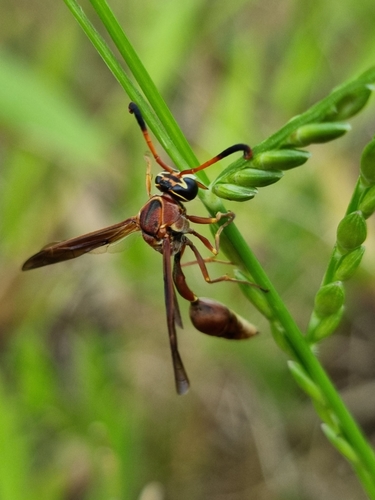
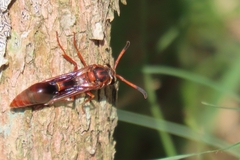
Zeta argillaceum

Zeta argillaceum

Zeta argillaceum

Daily sighting probability ~20% · Possible
at Emas National Park

In 3 days ~50% in a week ~80%

5 Verified sightings at Emas National Park From 2019 to 2026
5 In 1 park
August Best month
☀️ Diurnal When it's spotted

About the Zeta argillaceum

Zeta argillaceum is one of the most common species of potter wasp in South America. It is found throughout the continent and as far north as Mexico and the southern United States (where it is thought to have been accidentally introduced).

This wasp adapts easily to habitat change and the nests are a common sight, often in small groups, attached to the walls of buildings in urban areas. The nest cell is roughly spherical, up to 18 mm in diameter, with a single small entrance hole. A single egg is laid in each cell: the adult wasp stocks the cell with paralyzed living food (usually geometrid moth larvae) for the emerging wasp larva to feed on. The nest is only used once by Z. argillaceum but is often reused by other potter wasps such as Pachodynerus spp.

Zeta argillaceum is often affected by parasitoids such as the eulophid Melittobia australica. Wikipedia →

Global Distribution

Parks Where Found

# Park Country Daily sighting probability
1 Emas National Park 🇧🇷 Brazil
~20%

More parks will be added in future updates.

Cities Where Found

# City Country Daily sighting probability
1 São Luís 🇧🇷 Brazil
~20%
2 Salvador 🇧🇷 Brazil
~20%
3 Recife 🇧🇷 Brazil
~10%
4 Fortaleza 🇧🇷 Brazil
~10%
5 Porto Alegre 🇧🇷 Brazil
~10%
6 Curitiba 🇧🇷 Brazil
~10%
7 Cordoba 🇦🇷 Argentina
~10%
8 Maceió 🇧🇷 Brazil
~10%
9 Caracas 🇻🇪 Venezuela
~10%
10 Lima 🇵🇪 Peru
~10%

Closest Relatives at Emas National Park

No species of the same family or order lives in Emas National Park, so these are its closest relatives here: other insects.

Before you go

What are the chances of seeing a Zeta argillaceum in Emas National Park?

Possible

About 20% of wildlife watchers report a Zeta argillaceum sighting in Emas National Park on a given day, based on 5 verified sightings from GBIF citizen-science data from 2019 to 2026. Over three days the chance rises to about 50%, and over a week to about 80%, if each day is a fresh chance.

When is the best time to see a Zeta argillaceum in Emas National Park?

August

In that month about 40% of wildlife watchers report a Zeta argillaceum in Emas National Park on a given day, against under 5% in February–July and December, the lowest months. That is one of Emas National Park's driest months, with about 15 mm of rain against 190 mm in January.

What time of day is best to see a Zeta argillaceum?

Between 11 am and 2 pm

Across all the parks we cover, that three-hour window holds the most Zeta argillaceum sightings with a recorded time, and nearly all of them come between 6 am and 6 pm: it is a daytime animal.

Where else can you see a Zeta argillaceum?

Only Emas National Park, in our data

Emas National Park is the only park on Wallace's Line with enough records to rate Zeta argillaceum sightings: about 20% of wildlife watchers there report one on a given day.

Where does the Zeta argillaceum sighting chance come from?

GBIF citizen-science records

It is estimated from how often the Zeta argillaceum is recorded against all the insects logged in Emas National Park (5 verified sightings from 2019 to 2026), calibrated against known sighting rates. Figures are rounded to the nearest 10% because citizen-science data supports honest approximations, not decimals, and months with records from fewer than five people show "—". How it works.

← Back to Emas National Park