
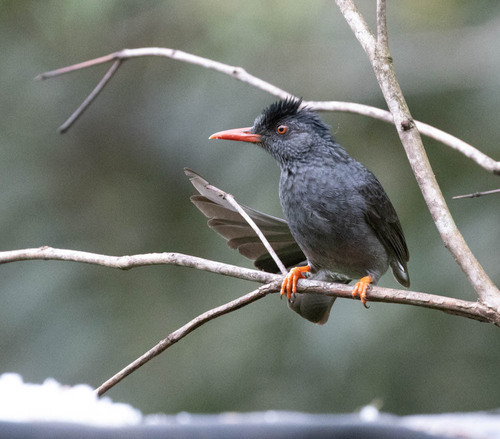
Indian Scimitar-Babbler

Indian Scimitar-Babbler

Pomatorhinus horsfieldii

Silhouette: Sheatherius · PhyloPic

LCLeast ConcernNTVUENCR Endemic
Daily sighting probability ~20% · Possible
at Eravikulam National Park

In 3 days ~40% in a week ~70%

84 Verified sightings at Eravikulam National Park From 2019 to 2026
5,495 In all 8 parks
May Best month
🌅 Crepuscular When it's spotted

About the Indian Scimitar-Babbler

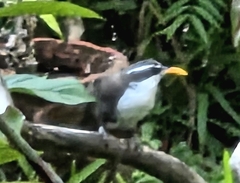
The Indian scimitar babbler (Pomatorhinus horsfieldii) is an Old World babbler. It is found in peninsular India in a range of forest habitats. They are most often detected by their distinctive calls, which include an antiphonal duet by a pair of birds. They are often hard to see as they forage through dense vegetation. The long, curved yellow, scimitar-shaped bills give them their name. It has been treated in the past as a subspecies of the white-browed scimitar babbler which is found along the Himalayas but now separated into two species, the peninsular Indian species and the Sri Lanka scimitar babbler (Pomatorhinus melanurus).

The most distinctive feature of this 22 cm long bird is the long down-curved yellow bill which is blackish at the base of the upper mandible. It has a striking head pattern, with a long white supercilium above a broad black band through the eye. The white throat and breast contrast with the dark greyish brown on the upperside and dark grey to black on most of the underside. The tail is broad, long and graduated. They have short, round wings and being weak fliers are rarely seen flying in the open.

Indian scimitar-babblers have long down-curved... Wikipedia →

Sounds

Song0:50

India · 2023

© Barry Edmonston · XC796962 · CC BY-NC-SA 4.0

Call0:58

India · 2023

© Sathyan Meppayur · XC786585 · CC BY-NC-SA 4.0

Uncertain0:05

India · 2018

© Lakshmi Ravishankar · XC665060 · CC BY-NC-SA 4.0

Global Distribution

Parks Where Found

# Park Country Daily sighting probability
1 Periyar National Park 🇮🇳 India
~40%
2 Kanha National Park 🇮🇳 India
~30%
3 Mudumalai National Park 🇮🇳 India
~20%
4 Eravikulam National Park 🇮🇳 India
~20%
5 Nagarhole National Park 🇮🇳 India
~10%
6 Bandipur National Park 🇮🇳 India
~10%
7 Satpura National Park 🇮🇳 India
<5%
8 Bandhavgarh National Park 🇮🇳 India
<5%

Cities Where Found

# City Country Daily sighting probability
1 Bhubaneshwar 🇮🇳 India
<5%
2 Mumbai 🇮🇳 India
<5%
3 Kochi 🇮🇳 India
<5%

Before you go

What are the chances of seeing an Indian Scimitar-Babbler in Eravikulam National Park?

Possible

About 20% of wildlife watchers report an Indian Scimitar-Babbler sighting in Eravikulam National Park on a given day, based on 84 verified sightings from GBIF citizen-science data from 2019 to 2026. It is the 32nd most-seen of the 116 birds we can rate there. Over three days the chance rises to about 40%, and over a week to about 70%, if each day is a fresh chance.

When is the best time to see an Indian Scimitar-Babbler in Eravikulam National Park?

April–May and September

In those months about 30% of wildlife watchers report an Indian Scimitar-Babbler in Eravikulam National Park on a given day, against under 5% in November, the lowest month.

What time of day is best to see an Indian Scimitar-Babbler?

Between 3 and 6 am

Across all the parks we cover, that three-hour window holds the most Indian Scimitar-Babbler sightings with a recorded time, and about half of them come between 6 pm and 6 am: it is most active around dawn and dusk.

Is Eravikulam National Park the best place to see an Indian Scimitar-Babbler?

4th of 8

Of the 8 parks where we can rate Indian Scimitar-Babbler sightings, Eravikulam National Park ranks 4th at about 20%. The best odds are in Periyar National Park (India, about 40%), Kanha National Park (India, about 30%) and Mudumalai National Park (India, about 20%).

Which relatives of the Indian Scimitar-Babbler live in Eravikulam National Park?

Same order: Passeriformes

The closest relatives of the Indian Scimitar-Babbler that you can see in Eravikulam National Park (order Passeriformes, Perching Birds) are Palani Laughingthrush (about 90%), Red-whiskered Bulbul (about 80%) and Pied Bushchat (about 70%), with each one's daily chance of a sighting.

Where does the Indian Scimitar-Babbler sighting chance come from?

GBIF citizen-science records

It is estimated from how often the Indian Scimitar-Babbler is recorded against all the birds logged in Eravikulam National Park (84 verified sightings from 2019 to 2026), calibrated against known sighting rates. Figures are rounded to the nearest 10% because citizen-science data supports honest approximations, not decimals, and months with records from fewer than five people show "—". How it works.

← Back to Eravikulam National Park