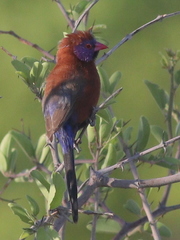
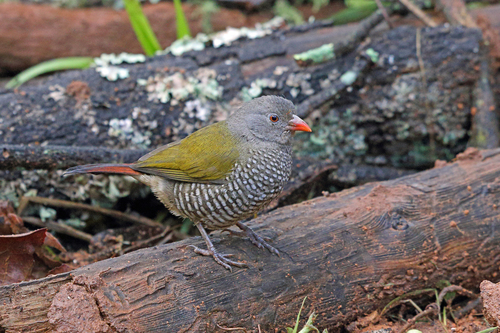
Violet-eared Waxbill

Violet-eared Waxbill

Uraeginthus granatinus

Silhouette: Jim Bendon (photography) and T. Michael Keesey (vectorization) · PhyloPic

Daily sighting probability ~20% · Possible
at Etosha National Park

In 3 days ~50% in a week ~80%

325 Verified sightings at Etosha National Park From 2019 to 2026
867 In all 8 parks
October Best month
☀️ Diurnal When it's spotted

About the Violet-eared Waxbill

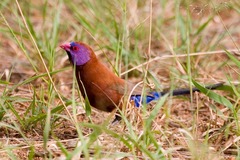
The violet-eared waxbill or common grenadier (Granatina granatina) is a common species of estrildid finch found in drier land of Southern Africa. The violet-eared waxbill was formally described in 1766 by the Swedish naturalist Carl Linnaeus in the twelfth edition of his Systema Naturae under the binomial name Fringilla granatina. Linnaeus took the specific epithet from the earlier description by the French zoologist Mathurin Jacques Brisson who in 1760 had used the French name Le Grenadin and the Latin Granatinus, meaning "grenadier" in English. Linnaeus mistakenly specified the locality as Brazil. This was an error originally introduced by the English naturalist George Edwards in 1743 who had believed that his specimen had come from Brazil. The locality was amended to Angola by William Lutley Sclater in 1930 and restricted to Huíla Province in Angola by Phillip Clancey in 1959. The violet-eared waxbill is now placed in the genus Granatina that was introduced in 1890 by the English ornithologist Richard Bowdler Sharpe. The species is treated as monotypic: no subspecies are recognised.

It is found in subtropical/ tropical (lowland) dry shrubland and savanna... Wikipedia →

Sounds

Recording0:20

Botswana · 2020

© Dewald du Plessis · iNaturalist · CC BY-NC 4.0

Global Distribution

Parks Where Found

# Park Country Daily sighting probability
1 Pilanesberg National Park 🇿🇦 South Africa
~40%
2 Waterberg Plateau Park 🇳🇦 Namibia
~30%
3 Etosha National Park 🇳🇦 Namibia
~20%
4 Hwange National Park 🇿🇼 Zimbabwe
~10%
5 Chobe National Park 🇧🇼 Botswana
<5%
6 Kgalagadi Transfrontier Park 🇿🇦 South Africa
<5%
7 Moremi Game Reserve 🇧🇼 Botswana
<5%
8 Kruger National Park 🇿🇦 South Africa
<5%

Before you go

What are the chances of seeing a Violet-eared Waxbill in Etosha National Park?

Possible

About 20% of wildlife watchers report a Violet-eared Waxbill sighting in Etosha National Park on a given day, based on 325 verified sightings from GBIF citizen-science data from 2019 to 2026. It is the 71st most-seen of the 260 birds we can rate there. Over three days the chance rises to about 50%, and over a week to about 80%, if each day is a fresh chance.

When is the best time to see a Violet-eared Waxbill in Etosha National Park?

January and October

In those months about 30% of wildlife watchers report a Violet-eared Waxbill in Etosha National Park on a given day, against about 10% in May, the lowest month. Those are among Etosha National Park's wettest months, with about 40 mm of rain a month against almost none in June.

What time of day is best to see a Violet-eared Waxbill?

Between 9 am and noon

Across all the parks we cover, that three-hour window holds the most Violet-eared Waxbill sightings with a recorded time, and about 9 in 10 of them come between 6 am and 6 pm: it is a daytime animal.

Is Etosha National Park the best place to see a Violet-eared Waxbill?

3rd of 8

Of the 8 parks where we can rate Violet-eared Waxbill sightings, Etosha National Park ranks 3rd at about 20%. The best odds are in Pilanesberg National Park (South Africa, about 40%) and Waterberg Plateau Park (Namibia, about 30%).

Where does the Violet-eared Waxbill sighting chance come from?

GBIF citizen-science records

It is estimated from how often the Violet-eared Waxbill is recorded against all the birds logged in Etosha National Park (325 verified sightings from 2019 to 2026), calibrated against known sighting rates. Figures are rounded to the nearest 10% because citizen-science data supports honest approximations, not decimals, and months with records from fewer than five people show "—". How it works.

← Back to Etosha National Park