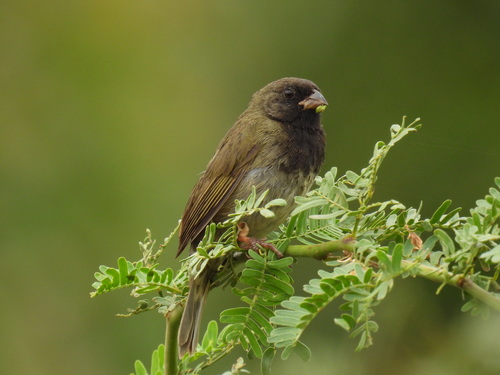
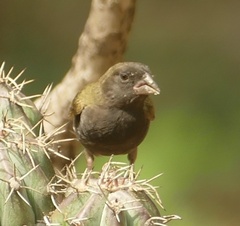
Black-faced Grassquit

Black-faced Grassquit

Melanospiza bicolor

Silhouette: Sheatherius · PhyloPic

LCLeast ConcernNTVUENCR
Daily sighting probability <5% · Rare
at Everglades National Park

In 3 days ~10% in a week ~30%

8 Verified sightings at Everglades National Park From 2019 to 2026
722 In all 5 parks
May Best month
☀️ Diurnal When it's spotted

About the Black-faced Grassquit

The black-faced grassquit (Melanospiza bicolor) is a small bird in the family Thraupidae, the tanagers and allies. It is found in the West Indies except Cuba Colombia, Venezuela and islands off its coast, and on islands in the western Caribbean Sea.

The first formal description of the black-faced grassquit was by the Swedish naturalist Carl Linnaeus in 1766 in the twelfth edition of his Systema Naturae. He introduced the binomial name Fringilla bicolor. Linnaeus based his description on the "Bahama Sparrow" that was described and illustrated by Mark Catesby in his The Natural History of Carolina, Florida and the Bahama Islands which was published between 1729 and 1732. By 1970 it had been reassigned to the genus Tiaris. A molecular phylogenetic study published in 2014 found that this genus was polyphyletic and that the black-faced grassquit was closely related to the Saint Lucia black finch in the (then) monospecific genus Melanospiza. In the resulting reorganization of the genera, between 2016 and 2020 taxonomic systems moved the black-faced grassquit to Melanospiza.

The black-faced grassquit has these eight subspecies: The black-faced... Wikipedia →

Sounds

Song0:18

Venezuela · 2023

© Francisco contreras · XC841610 · CC BY-NC-SA 4.0

Recording0:15

Venezuela · 2021

© Rafael Gianni · XC692086 · CC BY-NC-SA 4.0

Call0:08

Bahamas · 2010

© Paul Driver · XC50159 · CC BY-NC-ND 2.5

Global Distribution

Parks Where Found

# Park Country Daily sighting probability
1 Blue and John Crow Mountains National Park 🇯🇲 Jamaica
~40%
2 Main Ridge Forest Reserve 🇹🇹 Trinidad and Tobago
~30%
3 Everglades National Park 🇺🇸 United States
<5%
4 Henri Pittier National Park 🇻🇪 Venezuela
<5%
5 Los Haitises National Park 🇩🇴 Dominican Republic
<5%

Cities Where Found

# City Country Daily sighting probability
1 Caracas 🇻🇪 Venezuela
~50%
2 Maracaibo 🇻🇪 Venezuela
~30%
3 Valencia 🇻🇪 Venezuela
~10%

Zoos & Centres Where Found

# Zoo / Centre Country
1 Hong Kong Zoological and Botanical Gardens 🇨🇳 China In captivity
2 Edward Youde Aviary 🇭🇰 Hong Kong SAR China In captivity
3 Key West Butterfly and Nature Conservatory 🇺🇸 United States In captivity

Before you go

What are the chances of seeing a Black-faced Grassquit in Everglades National Park?

Rare

Under 5% of wildlife watchers report a Black-faced Grassquit sighting in Everglades National Park on a given day, based on 8 verified sightings from GBIF citizen-science data from 2019 to 2026. It is the 116th most-seen of the 273 birds we can rate there. Over three days the chance rises to about 10%, and over a week to about 30%, if each day is a fresh chance.

When is the best time to see a Black-faced Grassquit in Everglades National Park?

May

In that month about 20% of wildlife watchers report a Black-faced Grassquit in Everglades National Park on a given day, against under 5% in July to April, the lowest months.

What time of day is best to see a Black-faced Grassquit?

Between 7 and 10 am

Across all the parks we cover, that three-hour window holds the most Black-faced Grassquit sightings with a recorded time, and about 9 in 10 of them come between 6 am and 6 pm: it is a daytime animal.

Is Everglades National Park the best place to see a Black-faced Grassquit?

3rd of 5

Of the 5 parks where we can rate Black-faced Grassquit sightings, Everglades National Park ranks 3rd at under 5%. The best odds are in Blue and John Crow Mountains National Park (Jamaica, about 40%) and Main Ridge Forest Reserve (Trinidad and Tobago, about 30%).

Which relatives of the Black-faced Grassquit live in Everglades National Park?

Same order: Passeriformes

The closest relatives of the Black-faced Grassquit that you can see in Everglades National Park (order Passeriformes, Perching Birds) are Northern Cardinal (about 70%), Northern Mockingbird (about 70%) and American Crow (about 60%), with each one's daily chance of a sighting.

Where does the Black-faced Grassquit sighting chance come from?

GBIF citizen-science records

It is estimated from how often the Black-faced Grassquit is recorded against all the birds logged in Everglades National Park (8 verified sightings from 2019 to 2026), calibrated against known sighting rates. Figures are rounded to the nearest 10% because citizen-science data supports honest approximations, not decimals, and months with records from fewer than five people show "—". How it works.
← Back to Everglades National Park