Gray Catbird

Gray Catbird

Dumetella carolinensis

Silhouette: Andy Wilson · PhyloPic

LCLeast ConcernNTVUENCR
Daily sighting probability ~60% · Likely
at Everglades National Park

In 3 days ~90% in a week >90%

8,229 Verified sightings at Everglades National Park From 2019 to 2026
41,948 In all 53 parks
February Best month
☀️ Diurnal When it's spotted

About the Gray Catbird

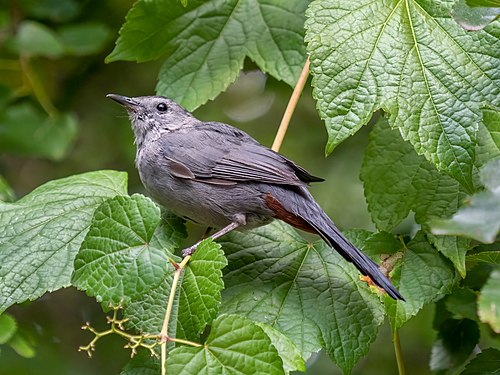
The gray catbird (Dumetella carolinensis), also spelled grey catbird, is a medium-sized North American and Central American perching bird of the mimid family. It is the only member of the "catbird" genus Dumetella. Like the black catbird (Melanoptila glabrirostris), it is among the basal lineages of the Mimidae, probably a closer relative of the Caribbean thrasher and trembler assemblage than of the mockingbirds and Toxostoma thrashers. In some areas it is known as the slate-colored mockingbird.

The name Dumetella is based upon the Latin term dūmus ("thorny thicket"); it thus means approximately "small thornbush-dweller" or "small bird of the thornbushes". It refers to the species' habit of singing when hidden in undergrowth. The specific name carolinensis is Neo-Latin for "from the Carolinas".

The species was first described by Carl Linnaeus in his 1766 edition of Systema Naturae. His original name Muscicapa carolinensis reflected the belief, widespread at that time, that the gray catbird was some sort of Old World flycatcher (presumably due to its remarkably plain coloration, not similar to other mimids).

The genus name has a convoluted nomenclatorial history. The monotypic... Wikipedia →
Sounds

Alarm call0:46

United States · 2024

© Manuel Sánchez-Nivicela · XC1148847 · CC BY-NC-ND 4.0

Song1:29

United States · 2026

© Scott Olmstead · XC1141321 · CC BY-NC-SA 4.0

Begging call0:47

United States · 2025

© Sue Riffe · XC1002792 · CC BY-NC-SA 4.0

Global Distribution

Parks Where Found

# Park Country Daily sighting probability
1 Point Pelee National Park 🇨🇦 Canada
~60%
2 Everglades National Park 🇺🇸 United States
~60%
3 Cockscomb Basin Wildlife Sanctuary 🇧🇿 Belize
~50%
4 Ciénaga de Zapata 🇨🇺 Cuba
~50%
5 Big Cypress National Preserve 🇺🇸 United States
~50%
6 Merritt Island National Wildlife Refuge 🇺🇸 United States
~40%
7 Arrecifes de Cozumel National Park 🇲🇽 Mexico
~40%
8 Calakmul Biosphere Reserve 🇲🇽 Mexico
~40%
9 Pico Bonito National Park 🇭🇳 Honduras
~30%
10 Shenandoah National Park 🇺🇸 United States
~30%
11 Sian Ka'an Biosphere Reserve 🇲🇽 Mexico
~30%
12 Tikal National Park 🇬🇹 Guatemala
~30%
13 Lago de Yojoa 🇭🇳 Honduras
~30%
14 Montes Azules Biosphere Reserve 🇲🇽 Mexico
~30%
15 Acadia National Park 🇺🇸 United States
~20%
16 Cerro Azul Meámbar National Park 🇭🇳 Honduras
~20%
17 Biotopo Cerro Cahuí 🇬🇹 Guatemala
~20%
18 Cañón del Sumidero National Park 🇲🇽 Mexico
~20%
19 Cusuco National Park 🇭🇳 Honduras
~20%
20 Riding Mountain National Park 🇨🇦 Canada
~20%
21 Celaque National Park 🇭🇳 Honduras
~10%
22 Elk Island National Park 🇨🇦 Canada
~10%
23 Celestún Biosphere Reserve 🇲🇽 Mexico
~10%
24 Great Smoky Mountains National Park 🇺🇸 United States
~10%
25 Bastimentos Island National Marine Park 🇵🇦 Panama
~10%
26 Glacier National Park 🇺🇸 United States
~10%
27 Grand Teton National Park 🇺🇸 United States
~10%
28 Cumbres de Monterrey National Park 🇲🇽 Mexico
~10%
29 Congaree National Park 🇺🇸 United States
~10%
30 La Amistad International Park (Panama) 🇵🇦 Panama
~10%
31 Ría Lagartos Biosphere Reserve 🇲🇽 Mexico
<5%
32 Voyageurs National Park 🇺🇸 United States
<5%
33 La Tigra National Park 🇭🇳 Honduras
<5%
34 Rocky Mountain National Park 🇺🇸 United States
<5%
35 Big Bend National Park 🇺🇸 United States
<5%
36 Badlands National Park 🇺🇸 United States
<5%
37 Tortuguero National Park 🇨🇷 Costa Rica
<5%
38 Banff National Park 🇨🇦 Canada
<5%
39 Cahuita National Park 🇨🇷 Costa Rica
<5%
40 Cape Breton Highlands National Park 🇨🇦 Canada
<5%
41 Gandoca-Manzanillo Wildlife Refuge 🇨🇷 Costa Rica
<5%
42 Yellowstone National Park 🇺🇸 United States
<5%
43 Death Valley National Park 🇺🇸 United States
<5%
44 Jasper National Park 🇨🇦 Canada
<5%
45 Padre Island National Seashore 🇺🇸 United States
<5%
46 El Vizcaíno Biosphere Reserve 🇲🇽 Mexico
<5%
47 Saguaro National Park 🇺🇸 United States
<5%
48 Soberanía National Park 🇵🇦 Panama
<5%
49 Braulio Carrillo National Park 🇨🇷 Costa Rica
<5%
50 Parque Natural Metropolitano 🇵🇦 Panama
<5%
51 Tenorio Volcano National Park 🇨🇷 Costa Rica
<5%
52 Arenal Volcano National Park 🇨🇷 Costa Rica
<5%
53 Monteverde Cloud Forest Reserve 🇨🇷 Costa Rica
<5%

Cities Where Found

# City Country Daily sighting probability
1 Philadelphia 🇺🇸 United States
~50%
2 New York City 🇺🇸 United States
~40%
3 Baltimore 🇺🇸 United States
~40%
4 Orlando 🇺🇸 United States
~40%
5 Washington 🇺🇸 United States
~40%
6 Boston 🇺🇸 United States
~30%
7 Minneapolis [Saint Paul] 🇺🇸 United States
~30%
8 Miami 🇺🇸 United States
~30%
9 Chicago 🇺🇸 United States
~30%
10 Montreal 🇨🇦 Canada
~20%

Zoos & Centres Where Found

# Zoo / Centre Country
1 National Zoological Park 🇺🇸 United States In captivity
2 Zoo Miami 🇺🇸 United States In captivity
3 Toronto Zoo 🇨🇦 Canada In captivity
4 Columbus Zoo and Aquarium 🇺🇸 United States In captivity
5 Fort Worth Zoo 🇺🇸 United States In captivity

Before you go

What are the chances of seeing a Gray Catbird in Everglades National Park?

Likely

About 60% of wildlife watchers report a Gray Catbird sighting in Everglades National Park on a given day, based on 8,229 verified sightings from GBIF citizen-science data from 2019 to 2026. It is the 10th most-seen of the 273 birds we can rate there. Over three days the chance rises to about 90%, and over a week to over 90%, if each day is a fresh chance.

When is the best time to see a Gray Catbird in Everglades National Park?

January–March and October–November

In those months about 70% of wildlife watchers report a Gray Catbird in Everglades National Park on a given day, against under 5% in May to July, the lowest months. Those are among Everglades National Park's driest months, with about 65 mm of rain a month against 240 mm in June.

What time of day is best to see a Gray Catbird?

Between 8 and 11 am

Across all the parks we cover, that three-hour window holds the most Gray Catbird sightings with a recorded time, and about 9 in 10 of them come between 6 am and 6 pm: it is a daytime animal.

Is Everglades National Park the best place to see a Gray Catbird?

Among the best

Of the 53 parks where we can rate Gray Catbird sightings, Everglades National Park ranks 2nd at about 60%, level with the leaders once rounded. The best odds are in Point Pelee National Park (Canada, about 60%). All parks ranked.

Which relatives of the Gray Catbird live in Everglades National Park?

Same family: Mimidae

The closest relatives of the Gray Catbird that you can see in Everglades National Park (family Mimidae, Mockingbirds and Thrashers) are Northern Mockingbird (about 70%) and Brown Thrasher (about 10%), with each one's daily chance of a sighting.

Where does the Gray Catbird sighting chance come from?

GBIF citizen-science records

It is estimated from how often the Gray Catbird is recorded against all the birds logged in Everglades National Park (8,229 verified sightings from 2019 to 2026), calibrated against known sighting rates. Figures are rounded to the nearest 10% because citizen-science data supports honest approximations, not decimals, and months with records from fewer than five people show "—". How it works.

← Back to Everglades National Park