Blackish Tapaculo

Blackish Tapaculo

Scytalopus latrans

Silhouette: Ferran Sayol · PhyloPic

LCLeast ConcernNTVUENCR
Daily sighting probability <5% · Rare
at Farallones de Cali National Natural Park

In 3 days ~10% in a week ~20%

110 Verified sightings at Farallones de Cali National Natural Park From 2019 to 2026
779 In all 4 parks
December Best month
☀️ Diurnal When it's spotted

About the Blackish Tapaculo

The blackish tapaculo (Scytalopus latrans) is a species of bird in the family Rhinocryptidae. It is found in Colombia, Ecuador, Peru, and Venezuela. The blackish tapaculo was originally described by Hellmayr as a species. Later it was reclassified as a subspecies of unicolored tapaculo (Scytalopus unicolor) and later still returned to full species status. The latter is sometimes considered to be a separate species. The former "Peruvian" subspecies S. l. intermedius has been elevated to species status as Utcubamba tapaculo by the International Ornithological Congress (IOC).

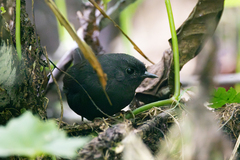
The blackish tapaculo is approximately 11 cm (4.3 in) long. Males weigh 16 to 21 g (0.56 to 0.74 oz) and females 14 to 20 g (0.49 to 0.71 oz). The male of the "blackish" subspecies is dark to very dark gray and the female is dark gray, sometimes with an olive wash. The juvenile is not well known but is believed to be dull brown. The "Pacific" subspecies male is black while the female is gray, darker above and lighter below, with brown flanks. The juvenile is brown. Wikipedia →

Sounds

Song0:19

Ecuador · 2026

© Daan van der Hoeven · XC1155231 · CC BY-NC-SA 4.0

Call0:35

Ecuador · 2025

© Manuel Sánchez-Nivicela · XC1018742 · CC BY-NC-ND 4.0

Uncertain0:30

Colombia · 2017

© A Edwar H Guarín · XC678959 · CC BY-NC-SA 4.0

Global Distribution

Parks Where Found

# Park Country Daily sighting probability
1 Podocarpus National Park 🇪🇨 Ecuador
~10%
2 Los Nevados National Natural Park 🇨🇴 Colombia
~10%
3 Farallones de Cali National Natural Park 🇨🇴 Colombia
<5%
4 Chingaza National Natural Park 🇨🇴 Colombia
<5%

Cities Where Found

# City Country Daily sighting probability
1 Quito 🇪🇨 Ecuador
<5%

Before you go

What are the chances of seeing a Blackish Tapaculo in Farallones de Cali National Natural Park?

Rare

Under 5% of wildlife watchers report a Blackish Tapaculo sighting in Farallones de Cali National Natural Park on a given day, based on 110 verified sightings from GBIF citizen-science data from 2019 to 2026. It is the 279th most-seen of the 542 birds we can rate there. Over three days the chance rises to about 10%, and over a week to about 20%, if each day is a fresh chance.

When is the best time to see a Blackish Tapaculo in Farallones de Cali National Natural Park?

Any time of year

In every month with enough records, under 5% of wildlife watchers report a Blackish Tapaculo in Farallones de Cali National Natural Park on a given day, so our monthly data shows no clear season.

What time of day is best to see a Blackish Tapaculo?

Between 7 and 10 am

Across all the parks we cover, that three-hour window holds the most Blackish Tapaculo sightings with a recorded time, and about 8 in 10 of them come between 6 am and 6 pm: it is a daytime animal.

Is Farallones de Cali National Natural Park the best place to see a Blackish Tapaculo?

3rd of 4

Of the 4 parks where we can rate Blackish Tapaculo sightings, Farallones de Cali National Natural Park ranks 3rd at under 5%. The best odds are in Podocarpus National Park (Ecuador, about 10%) and Los Nevados National Natural Park (Colombia, about 10%).

Where does the Blackish Tapaculo sighting chance come from?

GBIF citizen-science records

It is estimated from how often the Blackish Tapaculo is recorded against all the birds logged in Farallones de Cali National Natural Park (110 verified sightings from 2019 to 2026), calibrated against known sighting rates. Figures are rounded to the nearest 10% because citizen-science data supports honest approximations, not decimals, and months with records from fewer than five people show "—". How it works.

← Back to Farallones de Cali National Natural Park
