About the Manuka Beetle
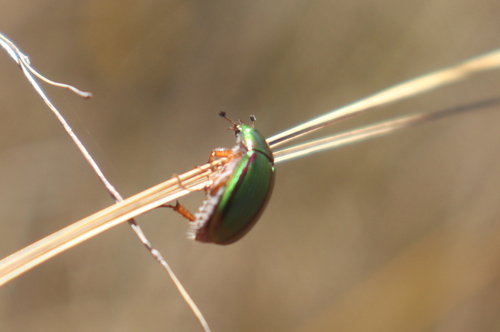
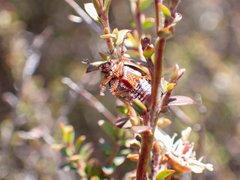
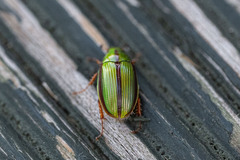
Pyronota festiva, commonly known as mānuka beetle or mānuka chafer, as well as the Kerewai Beetle is a member of the genus Pyronota of the beetle family Scarabaeidae (order Coleoptera). It is a scarab beetle endemic to New Zealand, and is commonly found in mānuka trees (Leptospermum scoparium), hence the beetle's name. In some areas it is considered a pasture pest.
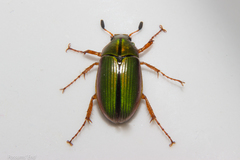
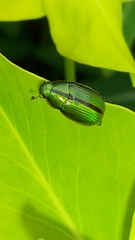
The mānuka beetle is bright green with shades of blue and yellow on areas of its back. Its dark longitudinal stripe down the back of its hard wing case is often brown or yellow. It can vary in length between 3 and 25mm in length, but the most common is 9mm. They are a part of the superfamily Scarabaeoidea and are characterized for their modified prothorax and have a large coxae. Their antennae is a lamellate antennal club and has a head with anterior margins which are either semicircular or emarginate mesocoxae, strongly oblique.
The mānuka beetle is a part of the subfamily Melolonthinaes, which is characterized by its stout body and glossy exterior, and the presence of either labrums or mandibles. These appear as segments either elongated or as oval lobes which can be folded together tightly to form compact... Wikipedia →