African Rail

African Rail

Rallus caerulescens

Silhouette: Ferran Sayol · PhyloPic

LCLeast ConcernNTVUENCR
Daily sighting probability <5% · Rare
at Garden Route National Park

In 3 days ~10% in a week ~20%

31 Verified sightings at Garden Route National Park From 2019 to 2026
554 In all 14 parks
January Best month
☀️ Diurnal When it's spotted

About the African Rail

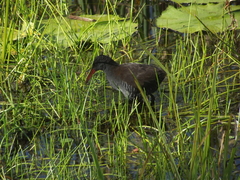
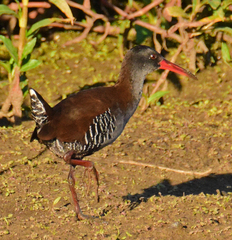
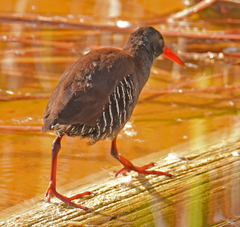
The African rail (Rallus caerulescens), sometimes also Kaffir rail, is a small wetland bird of the rail family that is found in eastern and southern Africa. The African rail was formally described in 1789 by the German naturalist Johann Friedrich Gmelin in his revised and expanded edition of Carl Linnaeus's Systema Naturae. He placed it with all the other rails in the genus Rallus and coined the binomial name Rallus caerulescens. Gmelin based his description on the "blue necked rail" from the Cape of Good Hope that had been described in 1785 by the English ornithologist John Latham in his book A General Synopsis of Birds. The naturalist Joseph Banks had provided Latham with a water-colour drawing of the rail by Georg Forster who had accompanied James Cook on his second voyage to the Pacific Ocean. The picture was painted in 1773 at the Cape of Good Hope. It is now the holotype for the species and is held by the Natural History Museum in London. The specific epithet caerulescens is from Latin and means "bluish". The species is monotypic: no subspecies are recognised.

Adults are 27–28 cm (10.6–11.0 in) long, and have mainly brown upperparts and blue-grey... Wikipedia →

Sounds

Duet0:18

South Africa · 2007

© Nature sounds by Simply Birding · XC647192 · CC BY-NC-ND 4.0

Song0:14

Namibia · 2016

© Peter Boesman · XC347035 · CC BY-NC-ND 4.0

Call0:34

South Africa · 2022

© Dawie de Swardt · XC729571 · CC BY-NC-SA 4.0

Global Distribution

Parks Where Found

# Park Country Daily sighting probability
1 West Coast National Park 🇿🇦 South Africa
~20%
2 Ngorongoro Conservation Area 🇹🇿 Tanzania
<5%
3 Nairobi National Park 🇰🇪 Kenya
<5%
4 Bwindi Impenetrable National Park 🇺🇬 Uganda
<5%
5 Kidepo Valley National Park 🇺🇬 Uganda
<5%
6 Garden Route National Park 🇿🇦 South Africa
<5%
7 Akagera National Park 🇷🇼 Rwanda
<5%
8 Tarangire National Park 🇹🇿 Tanzania
<5%
9 Arusha National Park 🇹🇿 Tanzania
<5%
10 Lake Mburo National Park 🇺🇬 Uganda
<5%
11 iSimangaliso Wetland Park 🇿🇦 South Africa
<5%
12 Moremi Game Reserve 🇧🇼 Botswana
<5%
13 Amboseli National Park 🇰🇪 Kenya
<5%
14 Etosha National Park 🇳🇦 Namibia
<5%

Cities Where Found

# City Country Daily sighting probability
1 Harare 🇿🇼 Zimbabwe
<5%
2 Kampala 🇺🇬 Uganda
<5%

Before you go

What are the chances of seeing an African Rail in Garden Route National Park?

Rare

Under 5% of wildlife watchers report an African Rail sighting in Garden Route National Park on a given day, based on 31 verified sightings from GBIF citizen-science data from 2019 to 2026. It is the 169th most-seen of the 222 birds we can rate there. Over three days the chance rises to about 10%, and over a week to about 20%, if each day is a fresh chance.

When is the best time to see an African Rail in Garden Route National Park?

January

In that month about 10% of wildlife watchers report an African Rail in Garden Route National Park on a given day, against under 5% in February to December, the lowest months.

What time of day is best to see an African Rail?

Between 9 am and noon

Across all the parks we cover, that three-hour window holds the most African Rail sightings with a recorded time, and about 9 in 10 of them come between 6 am and 6 pm: it is a daytime animal.

Which relatives of the African Rail live in Garden Route National Park?

Same family: Rallidae

The closest relatives of the African Rail that you can see in Garden Route National Park (family Rallidae, Rails, Gallinules, and Coots) are Red-knobbed Coot (about 30%), Common Moorhen (about 30%) and Western Swamphen (about 10%), with each one's daily chance of a sighting.

Where does the African Rail sighting chance come from?

GBIF citizen-science records

It is estimated from how often the African Rail is recorded against all the birds logged in Garden Route National Park (31 verified sightings from 2019 to 2026), calibrated against known sighting rates. Figures are rounded to the nearest 10% because citizen-science data supports honest approximations, not decimals, and months with records from fewer than five people show "—". How it works.

← Back to Garden Route National Park