Springbok

Springbok

Antidorcas marsupialis

Silhouette: Sarah Werning · PhyloPic

LCLeast ConcernNTVUENCR
Daily sighting probability ~10% · With luck
at Garden Route National Park

In 3 days ~10% in a week ~30%

7 Verified sightings at Garden Route National Park From 2019 to 2026
1,025 In all 7 parks
April Best month
☀️ Diurnal When it's spotted

About the Springbok

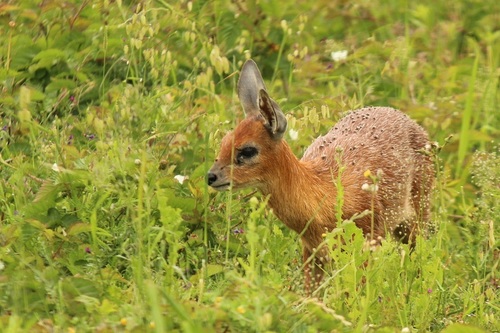
The springbok or springbuck (Antidorcas marsupialis) is an antelope found mainly in south and southwest Africa. The sole living member of the genus Antidorcas, this bovid was first described by the German zoologist Eberhard August Wilhelm von Zimmermann in 1780. Three subspecies are identified. A slender, long-legged antelope, the springbok reaches 71 to 86 cm (28 to 34 in) at the shoulder and weighs between 27 and 42 kg (60 and 93 lb). Both sexes have a pair of black, 35 to 50 cm (14 to 20 in) long horns that curve backwards. The springbok is characterised by a white face, a dark stripe running from the eyes to the mouth, a light brown coat marked by a reddish-brown stripe that runs from the upper foreleg to the buttocks across the flanks like the Thomson's gazelle, and a white rump flap.

Active mainly at dawn and dusk, springbok form harems (mixed-sex herds). In earlier times, springbok of the Kalahari Desert and Karoo migrated in large numbers across the countryside, a practice known as trekbokking. A feature, peculiar but not unique, to the springbok is pronking, in which the springbok performs multiple leaps into the air, up to 2 m (6 ft 7 in) above the ground, in a stiff-legged posture, with the back bowed and the white flap lifted. Primarily a browser, the springbok feeds on shrubs and succulents; this antelope can live without drinking water for years, meeting its requirements through eating succulent vegetation. Breeding takes place year-round, and peaks in the rainy season, when forage is most abundant. A single calf is born after a five- to six-month-long pregnancy; weaning occurs at nearly six months of age, and the calf leaves its mother a few months later.

Springbok inhabit the dry areas of south and southwestern Africa. The International Union for Conservation of Nature and Natural Resources classifies the springbok as a least concern species. No major threats to the long-term survival of the species are known; the springbok is one of the few antelope species considered to have an expanding population. They are popular game animals and are valued for their meat and skin. The springbok is the national mammal of South Africa. Wikipedia →

Global Distribution

Parks Where Found

# Park Country Daily sighting probability
1 Etosha National Park 🇳🇦 Namibia
~80%
2 Kgalagadi Transfrontier Park 🇿🇦 South Africa
~50%
3 Namib-Naukluft National Park 🇳🇦 Namibia
~50%
4 Pilanesberg National Park 🇿🇦 South Africa
~30%
5 West Coast National Park 🇿🇦 South Africa
~30%
6 Addo Elephant National Park 🇿🇦 South Africa
~10%
7 Garden Route National Park 🇿🇦 South Africa
~10%

Cities Where Found

# City Country Daily sighting probability
1 Pretoria 🇿🇦 South Africa
~20%

Zoos & Centres Where Found

# Zoo / Centre Country
1 Disney's Animal Kingdom 🇺🇸 United States In captivity
2 ZooParc de Beauval 🇫🇷 France In captivity
3 Réserve africaine de Sigean 🇫🇷 France In captivity
4 Natural Bridge Wildlife Ranch 🇺🇸 United States In captivity
5 San Diego Zoo Safari Park 🇺🇸 United States In captivity
6 Safaripark Beekse Bergen 🇳🇱 Netherlands In captivity
7 Living Desert Zoo and Gardens 🇺🇸 United States In captivity
8 Badoca Safari Park 🇵🇹 Portugal In captivity
9 Planète Sauvage 🇫🇷 France In captivity
10 Orana Wildlife Park 🇳🇿 New Zealand In captivity
11 The Exotic Resort Zoo 🇺🇸 United States In captivity
12 National Zoological Garden of South Africa 🇿🇦 South Africa In captivity
13 Wildlife World Zoo 🇺🇸 United States In captivity
14 Parco Natura Viva 🇮🇹 Italy In captivity
15 Berlin Zoological Garden 🇩🇪 Germany In captivity
16 ZOOM Erlebniswelt 🇩🇪 Germany In captivity
17 Tanganyika Wildlife Park 🇺🇸 United States In captivity
18 Fort Worth Zoo 🇺🇸 United States In captivity
19 Explorer Village 🇦🇪 United Arab Emirates In captivity
20 Hanover Zoo 🇩🇪 Germany In captivity
21 Mesker Park Zoo and Botanic Garden 🇺🇸 United States In captivity
22 Auckland Zoo 🇳🇿 New Zealand In captivity
23 Giraffe House 🇿🇦 South Africa In captivity
24 Dullstroom Bird Of Prey & Rehabilitation Centre 🇿🇦 South Africa In captivity
25 African Dawn Bird and Wildlife Sanctuary 🇿🇦 South Africa In captivity
26 Alameda Park Zoo 🇺🇸 United States In captivity
27 Aquarium Berlin 🇩🇪 Germany In captivity

Before you go

What are the chances of seeing a Springbok in Garden Route National Park?

With luck

About 10% of wildlife watchers report a Springbok sighting in Garden Route National Park on a given day, based on 7 verified sightings from GBIF citizen-science data from 2019 to 2026. It is the 24th most-seen of the 35 mammals we can rate there. Over three days the chance rises to about 10%, and over a week to about 30%, if each day is a fresh chance.

When is the best time to see a Springbok in Garden Route National Park?

March–May, September and November

In those months about 10% of wildlife watchers report a Springbok in Garden Route National Park on a given day, against under 5% in June–August, October and December–February, the lowest months.

What time of day is best to see a Springbok?

Between 10 am and 1 pm

Across all the parks we cover, that three-hour window holds the most Springbok sightings with a recorded time, and about 9 in 10 of them come between 6 am and 6 pm: it is a daytime animal.

Which relatives of the Springbok live in Garden Route National Park?

Same family: Bovidae

The closest relatives of the Springbok that you can see in Garden Route National Park (family Bovidae, Bovids) are Northern Bushbuck (about 40%), Blue Duiker (about 10%) and Cape Grysbok (about 10%), with each one's daily chance of a sighting.

Where does the Springbok sighting chance come from?

GBIF citizen-science records

It is estimated from how often the Springbok is recorded against all the mammals logged in Garden Route National Park (7 verified sightings from 2019 to 2026), calibrated against known sighting rates. Figures are rounded to the nearest 10% because citizen-science data supports honest approximations, not decimals, and months with records from fewer than five people show "—". How it works.

← Back to Garden Route National Park