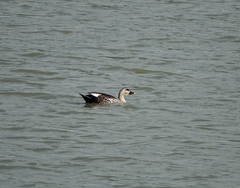
Indian Spot-billed Duck

Indian Spot-billed Duck

Anas poecilorhyncha

Silhouette: Sheatherius · PhyloPic

LCLeast ConcernNTVUENCR
Daily sighting probability <5% · Rare
at Gir National Park

In 3 days ~10% in a week ~30%

9 Verified sightings at Gir National Park From 2019 to 2026
4,594 In all 10 parks
November Best month
🌅 Crepuscular When it's spotted

About the Indian Spot-billed Duck

The Indian spot-billed duck (Anas poecilorhyncha) is a species of large dabbling duck that is a non-migratory breeding duck throughout freshwater wetlands in the Indian subcontinent. The name is derived from the red spot at the base of the bill that is found in the mainland Indian population. When in water it can be recognized from a long distance by the white tertials that form a stripe on the side, and in flight it is distinguished by the green speculum with a broad white band at the base. This species and the eastern spot-billed duck (A. zonorhyncha) were formerly considered conspecific, together called the spot-billed duck (A. poecilorhyncha).

The Indian spot-billed duck was described by the naturalist Johann Reinhold Forster in 1781 under its current binomial name Anas poecilorhyncha. The name of the genus Anas is the Latin word for a duck. The specific epithet poecilorhyncha combines the classical Greek words poikilos meaning "pied" or "spotted" and rhunkhos meaning a "bill".

A molecular phylogenetic study published in 2009 that compared mitochondrial DNA sequences from ducks, geese and swans in the family Anatidae found that the Indian spot-billed duck was a sister... Wikipedia →

Sounds

Call0:08

India · 2011

© Rajgopal Patil · XC571156 · CC BY-NC-SA 4.0

Flight call0:15

India · 2020

© Sreekumar Chirukandoth · XC580929 · CC BY-NC-SA 4.0

Call0:54

India · 1986

© Jelle Scharringa · XC568941 · CC BY-NC-SA 4.0

Global Distribution

Parks Where Found

# Park Country Daily sighting probability
1 Keoladeo National Park 🇮🇳 India
~80%
2 Kaziranga National Park 🇮🇳 India
~70%
3 Bandipur National Park 🇮🇳 India
~20%
4 Nagarhole National Park 🇮🇳 India
~20%
5 Satpura National Park 🇮🇳 India
~20%
6 Mudumalai National Park 🇮🇳 India
~20%
7 Ranthambore National Park 🇮🇳 India
~10%
8 Gir National Park 🇮🇳 India
<5%
9 Kanha National Park 🇮🇳 India
<5%
10 Jim Corbett National Park 🇮🇳 India
<5%

Cities Where Found

# City Country Daily sighting probability
1 Jodhpur 🇮🇳 India
~50%
2 Rajkot 🇮🇳 India
~50%
3 Indore 🇮🇳 India
~50%
4 Coimbatore 🇮🇳 India
~50%
5 Bhopal 🇮🇳 India
~40%
6 Bengaluru 🇮🇳 India
~30%
7 Chennai 🇮🇳 India
~30%
8 Mysuru 🇮🇳 India
~30%
9 Kota 🇮🇳 India
~30%
10 Solapur 🇮🇳 India
~30%

Zoos & Centres Where Found

# Zoo / Centre Country
1 Disney's Animal Kingdom 🇺🇸 United States In captivity
2 SeaWorld Orlando 🇺🇸 United States In captivity
3 Parc des oiseaux 🇫🇷 France In captivity
4 SeaWorld San Antonio 🇺🇸 United States In captivity
5 Tallinn Zoo 🇪🇪 Estonia In captivity
6 Singapore Zoo 🇸🇬 Singapore In captivity
7 Almaty Zoo 🇰🇿 Kazakhstan In captivity
8 VigoNature 🇪🇸 Spain In captivity
9 Staten Island Zoo 🇺🇸 United States In captivity
10 Debrecen Amusement Park 🇭🇺 Hungary In captivity

Before you go

What are the chances of seeing an Indian Spot-billed Duck in Gir National Park?

Rare

Under 5% of wildlife watchers report an Indian Spot-billed Duck sighting in Gir National Park on a given day, based on 9 verified sightings from GBIF citizen-science data from 2019 to 2026. It is the 112th most-seen of the 135 birds we can rate there. Over three days the chance rises to about 10%, and over a week to about 30%, if each day is a fresh chance.

When is the best time to see an Indian Spot-billed Duck in Gir National Park?

November

In that month about 20% of wildlife watchers report an Indian Spot-billed Duck in Gir National Park on a given day, against under 5% in April–May, October and December–February, the lowest months. That is one of Gir National Park's driest months, with about 10 mm of rain against 330 mm in July. July and August have too few records to rate.

What time of day is best to see an Indian Spot-billed Duck?

Between 6 and 9 am

Across all the parks we cover, that three-hour window holds the most Indian Spot-billed Duck sightings with a recorded time, and about half of them come between 6 am and 6 pm: it is most active around dawn and dusk.

Where does the Indian Spot-billed Duck sighting chance come from?

GBIF citizen-science records

It is estimated from how often the Indian Spot-billed Duck is recorded against all the birds logged in Gir National Park (9 verified sightings from 2019 to 2026), calibrated against known sighting rates. Figures are rounded to the nearest 10% because citizen-science data supports honest approximations, not decimals, and months with records from fewer than five people show "—". How it works.

← Back to Gir National Park