Buff-rumped Thornbill

Buff-rumped Thornbill

Acanthiza reguloides

Silhouette: Matt Wilkins (photo by Patrick Kavanagh) · PhyloPic

LCLeast ConcernNTVUENCR Endemic
Daily sighting probability ~10% · With luck
at Grampians National Park

In 3 days ~30% in a week ~60%

101 Verified sightings at Grampians National Park From 2019 to 2026
588 In all 6 parks
October Best month
☀️ Diurnal When it's spotted

About the Buff-rumped Thornbill

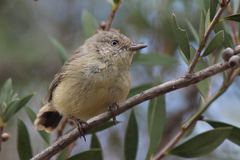
The buff-rumped thornbill (Acanthiza reguloides) is a small passerine bird species belonging to the genus Acanthiza, most of which are endemic to Australia. Measuring 8–10 cm in length, this unassuming thornbill is characterised by its plain greenish brown upperparts and very pale-yellow underparts, with a distinctive buff coloured rump. The tail has a broad, blackish band with a paler tip. Adults possess white irises, whilst juveniles have dark eyes. The buff-rumped thornbill is one of 14 species within the genus Acanthiza genus, which are recognisable by their thin, pointed bill. Species are unique in their plumage and distribution. Despite their shared name, the genus is not related to hummingbirds.

Early classifications of the genus Acanthiza based on plumage and morphology recognised one to three genera with a varying number of species in each. However, recent classifications have recognised one genus containing five species groups or four groups excluding the New Guinean murina.

The taxonomy of the Acanthiza reguloides has undergone significant change and debate since its early classification. Despite marked differences between A. reguloides and A. squamata... Wikipedia →

Sounds

Begging call1:09

Australia · 2024

© Romuald Mikusek · XC1173931 · CC BY-NC-SA 4.0

Call0:33

Australia · 2023

© Peter Boesman · XC859595 · CC BY-NC-ND 4.0

Song0:25

Australia · 2012

© David Edwards · XC521655 · CC BY-NC-ND 4.0

Global Distribution

Parks Where Found

# Park Country Daily sighting probability
1 Kosciuszko National Park 🇦🇺 Australia
~10%
2 Grampians National Park 🇦🇺 Australia
~10%
3 Great Otway National Park 🇦🇺 Australia
~10%
4 Lamington National Park 🇦🇺 Australia
<5%
5 Springbrook National Park 🇦🇺 Australia
<5%
6 Blue Mountains National Park 🇦🇺 Australia
<5%

Cities Where Found

# City Country Daily sighting probability
1 Melbourne 🇦🇺 Australia
<5%

Before you go

What are the chances of seeing a Buff-rumped Thornbill in Grampians National Park?

With luck

About 10% of wildlife watchers report a Buff-rumped Thornbill sighting in Grampians National Park on a given day, based on 101 verified sightings from GBIF citizen-science data from 2019 to 2026. It is the 53rd most-seen of the 145 birds we can rate there. Over three days the chance rises to about 30%, and over a week to about 60%, if each day is a fresh chance.

When is the best time to see a Buff-rumped Thornbill in Grampians National Park?

March, July and October

In those months about 20% of wildlife watchers report a Buff-rumped Thornbill in Grampians National Park on a given day, against under 5% in April, the lowest month.

What time of day is best to see a Buff-rumped Thornbill?

Between 9 am and noon

Across all the parks we cover, that three-hour window holds the most Buff-rumped Thornbill sightings with a recorded time, and nearly all of them come between 6 am and 6 pm: it is a daytime animal.

Is Grampians National Park the best place to see a Buff-rumped Thornbill?

Among the best

Of the 6 parks where we can rate Buff-rumped Thornbill sightings, Grampians National Park ranks 2nd at about 10%, level with the leaders once rounded. The best odds are in Kosciuszko National Park (Australia, about 10%).

Which relatives of the Buff-rumped Thornbill live in Grampians National Park?

Same genus: Acanthiza

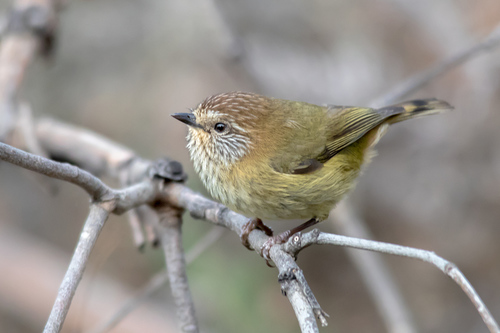
The closest relatives of the Buff-rumped Thornbill that you can see in Grampians National Park (genus Acanthiza, Australasian Thornbills) are Brown Thornbill (about 60%), Striated Thornbill (about 30%) and Yellow-rumped Thornbill (about 20%), with each one's daily chance of a sighting.

Where does the Buff-rumped Thornbill sighting chance come from?

GBIF citizen-science records

It is estimated from how often the Buff-rumped Thornbill is recorded against all the birds logged in Grampians National Park (101 verified sightings from 2019 to 2026), calibrated against known sighting rates. Figures are rounded to the nearest 10% because citizen-science data supports honest approximations, not decimals, and months with records from fewer than five people show "—". How it works.

← Back to Grampians National Park