Canvasback

Canvasback

Aythya valisineria

Silhouette: Gabriela Palomo-Munoz · PhyloPic

LCLeast ConcernNTVUENCR
Daily sighting probability <5% · Rare
at Grand Canyon National Park

In 3 days <5%

10 Verified sightings at Grand Canyon National Park From 2019 to 2026
953 In all 23 parks
February Best month
☀️ Diurnal When it's spotted

About the Canvasback

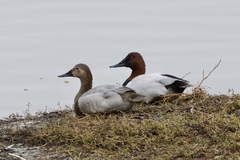
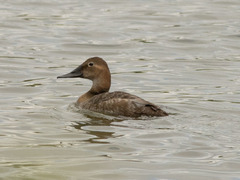
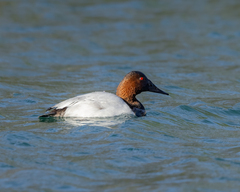
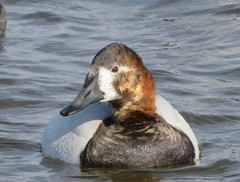
The canvasback (Aythya valisineria) is a species of diving duck, the largest found in North America. Scottish-American naturalist Alexander Wilson described the canvasback in 1814. The genus name is derived from Greek aithuia, an unidentified seabird mentioned by authors, including Hesychius and Aristotle.

The species name valisineria comes from the wild celery Vallisneria americana, whose winter buds and rhizomes are the canvasback's preferred food during the nonbreeding period. The celery genus is itself named for seventeenth century Italian botanist Antonio Vallisneri.

The duck's common name is based on early European inhabitants of North America's assertion that its back was a canvas-like color. In other languages it is just a white-backed duck; for example in French, morillon à dos blanc, or Spanish, pato lomo blanco. In Mexico it is called pato coacoxtle.

It ranges from 48–56 cm (19–22 in) in length and weighs 862–1,588 g (1.900–3.501 lb), with a wingspan of 79–89 cm (31–35 in). It is the largest species in the genus Aythya, and the largest diving duck in North America. Canvasbacks are similar in size to a mallard but with a heavier and more compact... Wikipedia →

Sounds

Call0:04

United States · 2014

© Paul Driver · XC169224 · CC BY-NC-SA 3.0

Global Distribution

Parks Where Found

# Park Country Daily sighting probability
1 Elk Island National Park 🇨🇦 Canada
~10%
2 Riding Mountain National Park 🇨🇦 Canada
~10%
3 Kluane National Park 🇨🇦 Canada
~10%
4 Redwood National Park 🇺🇸 United States
<5%
5 Badlands National Park 🇺🇸 United States
<5%
6 Merritt Island National Wildlife Refuge 🇺🇸 United States
<5%
7 Death Valley National Park 🇺🇸 United States
<5%
8 Yellowstone National Park 🇺🇸 United States
<5%
9 Celestún Biosphere Reserve 🇲🇽 Mexico
<5%
10 Big Bend National Park 🇺🇸 United States
<5%
11 Pacific Rim National Park Reserve 🇨🇦 Canada
<5%
12 Great Bear Rainforest 🇨🇦 Canada
<5%
13 Padre Island National Seashore 🇺🇸 United States
<5%
14 Banff National Park 🇨🇦 Canada
<5%
15 Grand Canyon National Park 🇺🇸 United States
<5%
16 Everglades National Park 🇺🇸 United States
<5%
17 Cumbres de Monterrey National Park 🇲🇽 Mexico
<5%
18 Point Pelee National Park 🇨🇦 Canada
<5%
19 Channel Islands National Park 🇺🇸 United States
<5%
20 Grand Teton National Park 🇺🇸 United States
<5%
21 Shenandoah National Park 🇺🇸 United States
<5%
22 Saguaro National Park 🇺🇸 United States
<5%
23 Rocky Mountain National Park 🇺🇸 United States
<5%

Cities Where Found

# City Country Daily sighting probability
1 Anchorage 🇺🇸 United States
~10%
2 León 🇲🇽 México
~10%
3 Calgary 🇨🇦 Canada
~10%
4 Las Vegas 🇺🇸 United States
~10%
5 San Francisco 🇺🇸 United States
~10%
6 Baltimore 🇺🇸 United States
<5%
7 Seattle 🇺🇸 United States
<5%
8 Denver 🇺🇸 United States
<5%
9 Portland 🇺🇸 United States
<5%
10 Austin 🇺🇸 United States
<5%

Zoos & Centres Where Found

# Zoo / Centre Country
1 Disney's Animal Kingdom 🇺🇸 United States In captivity
2 San Diego Zoo 🇺🇸 United States In captivity
3 National Zoological Park 🇺🇸 United States In captivity
4 Ecomuseum Zoo 🇨🇦 Canada In captivity
5 Columbus Zoo and Aquarium 🇺🇸 United States In captivity
6 Bronx Zoo 🇺🇸 United States In captivity
7 Slimbridge Wetland Centre 🇬🇧 United Kingdom In captivity
8 Saint Louis Zoo 🇺🇸 United States In captivity
9 Franklin Park Zoo 🇺🇸 United States In captivity
10 Cologne Zoological Garden 🇩🇪 Germany In captivity
11 Queens Zoo 🇺🇸 United States In captivity
12 Bramble Park Zoo 🇺🇸 United States In captivity
13 Bird Park Steinen 🇩🇪 Germany In captivity
14 Tracy Aviary 🇺🇸 United States In captivity
15 Florida Aquarium 🇺🇸 United States In captivity
16 Cologne Zoo Aquarium 🇩🇪 Germany In captivity
17 Zooparque Itatiba 🇧🇷 Brazil In captivity

Before you go

What are the chances of seeing a Canvasback in Grand Canyon National Park?

Rare

Under 5% of wildlife watchers report a Canvasback sighting in Grand Canyon National Park on a given day, based on 10 verified sightings from GBIF citizen-science data from 2019 to 2026. It is the 170th most-seen of the 194 birds we can rate there. Over three days the chance rises to under 5%, if each day is a fresh chance.

When is the best time to see a Canvasback in Grand Canyon National Park?

Any time of year

In every month with enough records, under 5% of wildlife watchers report a Canvasback in Grand Canyon National Park on a given day, so our monthly data shows no clear season.

What time of day is best to see a Canvasback?

Between 9 am and noon

Across all the parks we cover, that three-hour window holds the most Canvasback sightings with a recorded time, and about 7 in 10 of them come between 6 am and 6 pm: it is a daytime animal.

Where does the Canvasback sighting chance come from?

GBIF citizen-science records

It is estimated from how often the Canvasback is recorded against all the birds logged in Grand Canyon National Park (10 verified sightings from 2019 to 2026), calibrated against known sighting rates. Figures are rounded to the nearest 10% because citizen-science data supports honest approximations, not decimals, and months with records from fewer than five people show "—". How it works.

← Back to Grand Canyon National Park