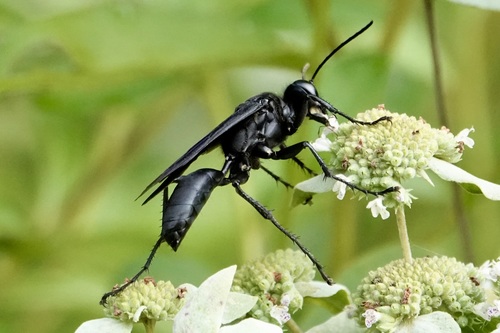
Great Black Digger Wasp

Great Black Digger Wasp

Sphex pensylvanicus

Daily sighting probability <5% · Rare
at Great Smoky Mountains National Park

In 3 days ~10% in a week ~20%

6 Verified sightings at Great Smoky Mountains National Park From 2019 to 2026
42 In all 3 parks
September Best month
☀️ Diurnal When it's spotted

About the Great Black Digger Wasp

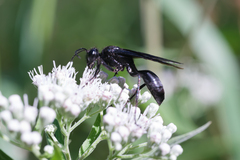
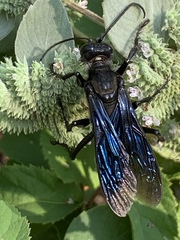
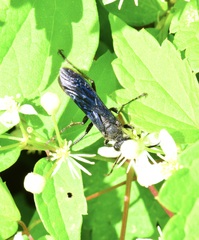
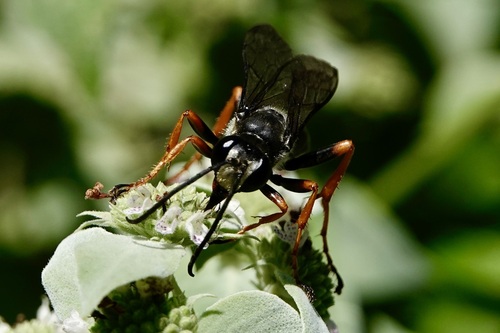
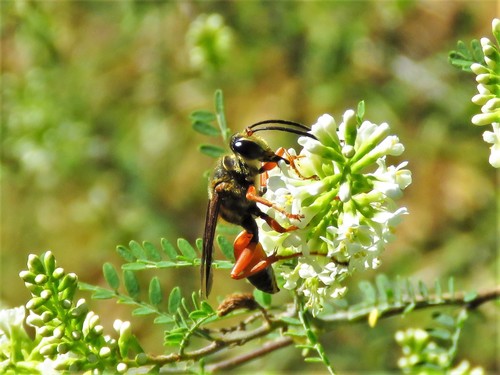
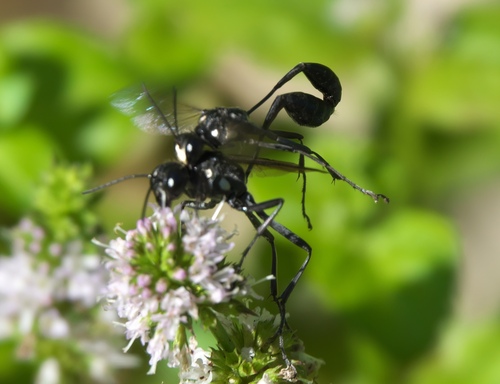
Sphex pensylvanicus, the great black wasp or great black digger wasp, is a species of digger wasp. It lives across most of North America and grows to a size of 20–35 mm (0.8–1.4 in). The larvae feed on living insects that the females paralyze and carry to the underground nest.

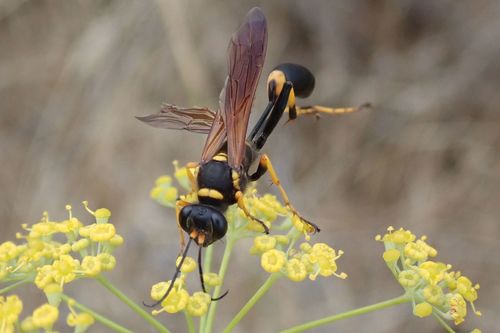
S. pensylvanicus is distributed across most of the contiguous United States and northern Mexico. During the late 20th century, its range expanded north to New York and the Canadian provinces of Quebec and Ontario. Sphex pensylvanicus is a large, black wasp, significantly larger than their congener Sphex ichneumoneus (the great golden digger wasp). Males are smaller than females, at only 19–28 mm (0.7–1.1 in) long compared with typical female sizes of 25–34 mm (1.0–1.3 in). According to John Bartram, "The sting of this Wasp is painful, but does not swell like others". As well as being larger than S. ichneumoneus, they are also darker, with an entirely black body and smoky wings with a blue iridescence, where S. ichneumoneus has yellow wings, red legs, and a partly red abdomen.

Adult females of S. pensylvanicus build an underground nest which they... Wikipedia →
Global Distribution

Parks Where Found

# Park Country Daily sighting probability
1 Acadia National Park 🇺🇸 United States
~10%
2 Shenandoah National Park 🇺🇸 United States
<5%
3 Great Smoky Mountains National Park 🇺🇸 United States
<5%

Cities Where Found

# City Country Daily sighting probability
1 Boston 🇺🇸 United States
~10%
2 Minneapolis [Saint Paul] 🇺🇸 United States
~10%
3 Detroit 🇺🇸 United States
~10%
4 Chicago 🇺🇸 United States
~10%
5 New York City 🇺🇸 United States
~10%
6 Toronto 🇨🇦 Canada
~10%
7 Philadelphia 🇺🇸 United States
~10%
8 Montreal 🇨🇦 Canada
<5%
9 Dallas 🇺🇸 United States
<5%
10 Washington 🇺🇸 United States
<5%

Before you go

What are the chances of seeing a Great Black Digger Wasp in Great Smoky Mountains National Park?

Rare

Under 5% of wildlife watchers report a Great Black Digger Wasp sighting in Great Smoky Mountains National Park on a given day, based on 6 verified sightings from GBIF citizen-science data from 2019 to 2026. It is the 628th most-seen of the 822 insects we can rate there. Over three days the chance rises to about 10%, and over a week to about 20%, if each day is a fresh chance.

When is the best time to see a Great Black Digger Wasp in Great Smoky Mountains National Park?

July and September

In those months about 10% of wildlife watchers report a Great Black Digger Wasp in Great Smoky Mountains National Park on a given day, against under 5% in August and October–June, the lowest months.

What time of day is best to see a Great Black Digger Wasp?

Between 1 and 4 pm

Across all the parks we cover, that three-hour window holds the most Great Black Digger Wasp sightings with a recorded time, and nearly all of them come between 6 am and 6 pm: it is a daytime animal.

Is Great Smoky Mountains National Park the best place to see a Great Black Digger Wasp?

3rd of 3

Of the 3 parks where we can rate Great Black Digger Wasp sightings, Great Smoky Mountains National Park ranks 3rd at under 5%. The best odds are in Acadia National Park (United States, about 10%) and Shenandoah National Park (United States, under 5%).

Which relatives of the Great Black Digger Wasp live in Great Smoky Mountains National Park?

Same genus: Sphex

The closest relatives of the Great Black Digger Wasp that you can see in Great Smoky Mountains National Park (genus Sphex) are Sphex nudus (about 10%) and Great Golden Digger Wasp (about 10%), with each one's daily chance of a sighting.

Where does the Great Black Digger Wasp sighting chance come from?

GBIF citizen-science records

It is estimated from how often the Great Black Digger Wasp is recorded against all the insects logged in Great Smoky Mountains National Park (6 verified sightings from 2019 to 2026), calibrated against known sighting rates. Figures are rounded to the nearest 10% because citizen-science data supports honest approximations, not decimals, and months with records from fewer than five people show "—". How it works.

← Back to Great Smoky Mountains National Park