Pure Green Sweat Bee

Pure Green Sweat Bee

Augochlora pura

Daily sighting probability ~10% · With luck
at Great Smoky Mountains National Park

In 3 days ~20% in a week ~50%

35 Verified sightings at Great Smoky Mountains National Park From 2019 to 2026
56 In all 3 parks
March Best month
☀️ Diurnal When it's spotted

About the Pure Green Sweat Bee

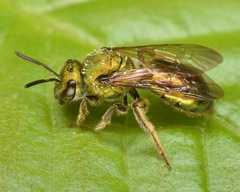
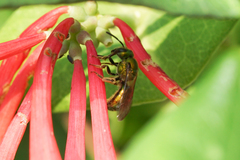
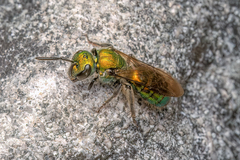
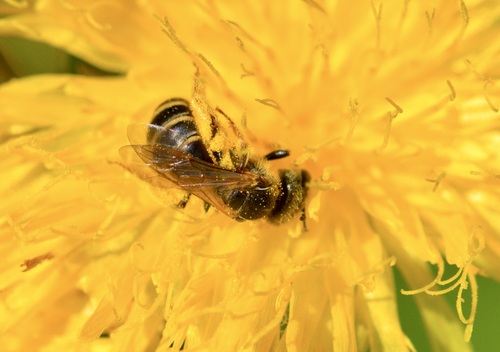
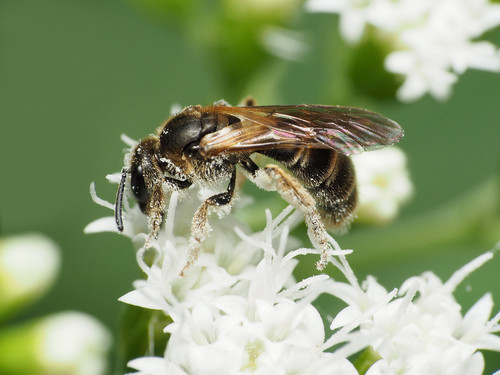
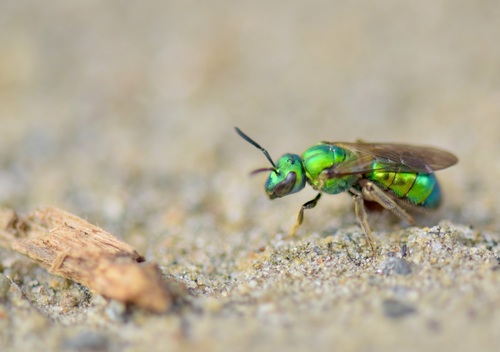
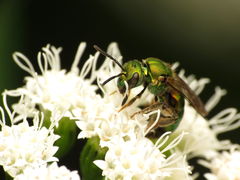
Augochlora pura is a solitary sweat bee found primarily in the Eastern United States. It is known for its bright green color and its tendency to forage on a variety of plants. Inhabiting rotting logs, this bee can produce up to three generations per year. Both males and females have been observed licking sweat from human skin, most likely seeking salt.

Augochlora pura was recently suggested the common name Pure Green Sweat Bee, but about it has been written that "...it does not seem to need one with such a musical scientific designation that means 'pure golden green.'"

Within Halictidae, 4 subfamilies, 81 genera, and over 4,000 species have been defined. About 1,000 of the species in the genera Halictus, Lasioglossum, Augochlora, and Augochlorella, are eusocial. Both males and females are approximately 8 mm long. Over most of the range of the species, their entire bodies are a shiny, bright green, in contrast to many Lasioglossum species such as L. zephyrus, which are a dull metallic green. Male Augochlora pura tend to have darker mandibles and may be slightly more bluish than females, but otherwise, males and females... Wikipedia →
Global Distribution

Parks Where Found

# Park Country Daily sighting probability
1 Great Smoky Mountains National Park 🇺🇸 United States
~10%
2 Shenandoah National Park 🇺🇸 United States
~10%
3 Everglades National Park 🇺🇸 United States
<5%

Cities Where Found

# City Country Daily sighting probability
1 Boston 🇺🇸 United States
~10%
2 New York City 🇺🇸 United States
~10%
3 Washington 🇺🇸 United States
~10%
4 Baltimore 🇺🇸 United States
~10%
5 Montreal 🇨🇦 Canada
<5%
6 Philadelphia 🇺🇸 United States
<5%
7 Toronto 🇨🇦 Canada
<5%
8 Chicago 🇺🇸 United States
<5%
9 Miami 🇺🇸 United States
<5%
10 Minneapolis [Saint Paul] 🇺🇸 United States
<5%

Before you go

What are the chances of seeing a Pure Green Sweat Bee in Great Smoky Mountains National Park?

With luck

About 10% of wildlife watchers report a Pure Green Sweat Bee sighting in Great Smoky Mountains National Park on a given day, based on 35 verified sightings from GBIF citizen-science data from 2019 to 2026. It is the 146th most-seen of the 822 insects we can rate there. Over three days the chance rises to about 20%, and over a week to about 50%, if each day is a fresh chance.

When is the best time to see a Pure Green Sweat Bee in Great Smoky Mountains National Park?

March to November

In those months about 10% of wildlife watchers report a Pure Green Sweat Bee in Great Smoky Mountains National Park on a given day, against under 5% in December to February, the lowest months.

What time of day is best to see a Pure Green Sweat Bee?

Between 1 and 4 pm

Across all the parks we cover, that three-hour window holds the most Pure Green Sweat Bee sightings with a recorded time, and nearly all of them come between 6 am and 6 pm: it is a daytime animal.

Is Great Smoky Mountains National Park the best place to see a Pure Green Sweat Bee?

Yes

Of the 3 parks where we can rate Pure Green Sweat Bee sightings, Great Smoky Mountains National Park has the highest daily chance: about 10%. Next come Shenandoah National Park (United States, about 10%) and Everglades National Park (United States, under 5%).

Where does the Pure Green Sweat Bee sighting chance come from?

GBIF citizen-science records

It is estimated from how often the Pure Green Sweat Bee is recorded against all the insects logged in Great Smoky Mountains National Park (35 verified sightings from 2019 to 2026), calibrated against known sighting rates. Figures are rounded to the nearest 10% because citizen-science data supports honest approximations, not decimals, and months with records from fewer than five people show "—". How it works.

← Back to Great Smoky Mountains National Park