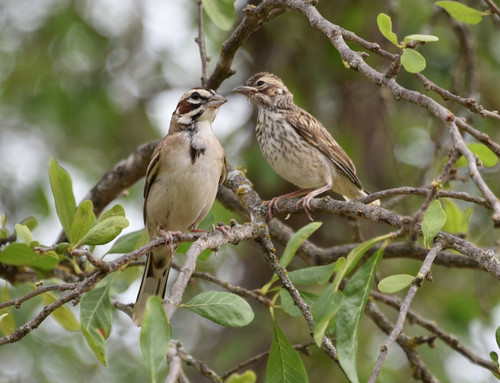
Black-chinned Sparrow

Black-chinned Sparrow

Spizella atrogularis

Silhouette: Andy Wilson · PhyloPic

LCLeast ConcernNTVUENCR
Daily sighting probability ~30% · Possible
at Guadalupe Mountains National Park

In 3 days ~70% in a week ~90%

273 Verified sightings at Guadalupe Mountains National Park From 2019 to 2026
831 In all 8 parks
June Best month
☀️ Diurnal When it's spotted

About the Black-chinned Sparrow

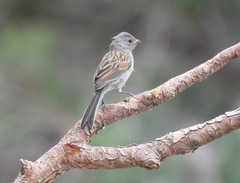
The black-chinned sparrow (Spizella atrogularis) is a small bird in the genus Spizella, in the New World sparrow family Passerellidae. It is found in the southwestern United States and throughout much of Mexico north of the Isthmus of Tehuantepec; most populations in the US migrate south after breeding while those in Mexico are resident. It is a slim, long-tailed bird, primarily gray with a reddish-brown back streaked with black, brown wings and tail, a pink beak, and brownish legs and feet. In the breeding season, the male shows black on his throat, chin, and the front of his face. Females, youngsters and nonbreeding males show little or no black in these areas. An unobtrusive bird, it spends much of its time foraging slowly along the ground, either alone or in small groups, sometimes mixing with other Spizella species. It is an omnivore, feeding primarily on seeds during the winter and insects during the summer. It builds a cup-shaped nest of grasses, rootlets, or plant fibers, into which the female lays 2–5 pale blue eggs. The female does most or all of the egg incubation, but both parents feed the hatched nestlings.

The species was first described by Jean Louis Cabanis in 1851. Four subspecies have been identified: one breeds only in the US, one only in Mexico, and the other two breed in both countries. Most northern populations move south—primarily into Mexico—for the winter. Because of its apparently large population size and very large range, it is considered to be a species of least concern. However, increasing global temperatures could have a significantly negative impact on its numbers. Wikipedia →

Sounds

Song0:25

Mexico · 2024

© Omar Suárez García · XC899379 · CC BY-NC-SA 4.0

Begging call0:31

United States · 2021

© Paul Marvin · XC660557 · CC BY-NC-SA 4.0

Call0:10

United States · 2014

© Micah Riegner · XC170095 · CC BY-NC-SA 3.0

Global Distribution

Parks Where Found

# Park Country Daily sighting probability
1 Guadalupe Mountains National Park 🇺🇸 United States
~30%
2 Big Bend National Park 🇺🇸 United States
~10%
3 Cabo Pulmo National Park 🇲🇽 Mexico
<5%
4 Zion National Park 🇺🇸 United States
<5%
5 Cumbres de Monterrey National Park 🇲🇽 Mexico
<5%
6 Grand Canyon National Park 🇺🇸 United States
<5%
7 Joshua Tree National Park 🇺🇸 United States
<5%
8 Saguaro National Park 🇺🇸 United States
<5%

Cities Where Found

# City Country Daily sighting probability
1 Mexico City 🇲🇽 México
<5%
2 Los Angeles 🇺🇸 United States
<5%

Before you go

What are the chances of seeing a Black-chinned Sparrow in Guadalupe Mountains National Park?

Possible

About 30% of wildlife watchers report a Black-chinned Sparrow sighting in Guadalupe Mountains National Park on a given day, based on 273 verified sightings from GBIF citizen-science data from 2019 to 2026. It is the 23rd most-seen of the 141 birds we can rate there. Over three days the chance rises to about 70%, and over a week to about 90%, if each day is a fresh chance.

When is the best time to see a Black-chinned Sparrow in Guadalupe Mountains National Park?

May and June

In those months about 50% of wildlife watchers report a Black-chinned Sparrow in Guadalupe Mountains National Park on a given day, against about 20% in September and October, the lowest months.

What time of day is best to see a Black-chinned Sparrow?

Between 8 and 11 am

Across all the parks we cover, that three-hour window holds the most Black-chinned Sparrow sightings with a recorded time, and nearly all of them come between 6 am and 6 pm: it is a daytime animal.

Is Guadalupe Mountains National Park the best place to see a Black-chinned Sparrow?

Yes

Of the 8 parks where we can rate Black-chinned Sparrow sightings, Guadalupe Mountains National Park has the highest daily chance: about 30%. Next come Big Bend National Park (United States, about 10%) and Cabo Pulmo National Park (Mexico, under 5%).

Which relatives of the Black-chinned Sparrow live in Guadalupe Mountains National Park?

Same genus: Spizella

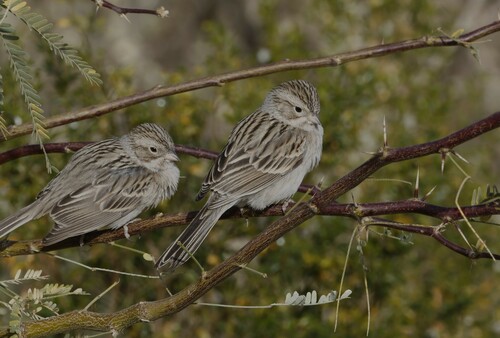
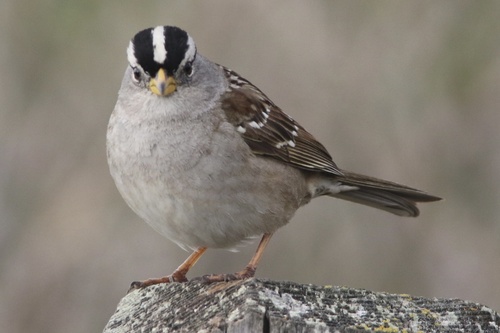
The closest relatives of the Black-chinned Sparrow that you can see in Guadalupe Mountains National Park (genus Spizella, Spizella Sparrows) are Chipping Sparrow (about 60%), Brewer's Sparrow (about 10%) and Clay-colored Sparrow (about 10%), with each one's daily chance of a sighting.

Where does the Black-chinned Sparrow sighting chance come from?

GBIF citizen-science records

It is estimated from how often the Black-chinned Sparrow is recorded against all the birds logged in Guadalupe Mountains National Park (273 verified sightings from 2019 to 2026), calibrated against known sighting rates. Figures are rounded to the nearest 10% because citizen-science data supports honest approximations, not decimals, and months with records from fewer than five people show "—". How it works.

← Back to Guadalupe Mountains National Park