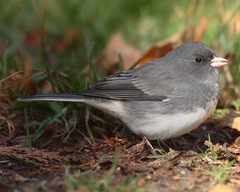
Dark-eyed Junco

Dark-eyed Junco

Junco hyemalis

Silhouette: L. Shyamal · PhyloPic

LCLeast ConcernNTVUENCR
Daily sighting probability ~40% · Likely
at Guadalupe Mountains National Park

In 3 days ~80% in a week >90%

528 Verified sightings at Guadalupe Mountains National Park From 2019 to 2026
56,855 In all 41 parks
November Best month
☀️ Diurnal When it's spotted

About the Dark-eyed Junco

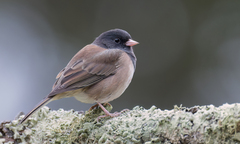
The dark-eyed junco (Junco hyemalis) is a species of junco, a group of small, grayish New World sparrows. The species is common across much of temperate North America and in summer it ranges far into the Arctic. It is a variable species, much like the related fox sparrow (Passerella iliaca), and its systematics are still not completely resolved.

The dark-eyed junco was formally described by the Swedish naturalist Carl Linnaeus in his landmark 1758 10th edition of Systema Naturae as Fringilla hyemalis. The description consisted merely of the laconic remark "F[ringilla] nigra, ventre albo. ("A black 'finch' with white belly") and a statement that it came from America. Linnaeus based his description on the "Snow-Bird" that Mark Catesby had described and illustrated in his 1731 The Natural History of Carolina, Florida and the Bahama Islands.

The Bill of this Bird is white: The Breast and Belly white. All the rest of the Body dark grey; but in some places black, inclining to Lead-color. In Virginia and Carolina they appear only in Winter: and in Snow they appear most. In Summer none are seen. Whether they retire and breed in the North (which is most probable) or where they... Wikipedia →

Sounds

Begging call1:01

United States · 2026

© Greg Irving · XC1186354 · CC BY-NC-SA 4.0

Song0:28

United States · 2026

© Ed Pandolfino · XC1153566 · CC BY-NC-SA 4.0

Call0:04

United States · 2024

© Denis Dujardin · XC1056014 · CC BY-NC-SA 4.0

Global Distribution

Parks Where Found

# Park Country Daily sighting probability
1 Yosemite National Park 🇺🇸 United States
~80%
2 Denali National Park 🇺🇸 United States
~80%
3 Kluane National Park 🇨🇦 Canada
~80%
4 Jasper National Park 🇨🇦 Canada
~70%
5 Sequoia and Kings Canyon National Parks 🇺🇸 United States
~70%
6 Banff National Park 🇨🇦 Canada
~70%
7 Wrangell-St. Elias National Park 🇺🇸 United States
~70%
8 Cape Breton Highlands National Park 🇨🇦 Canada
~60%
9 Rocky Mountain National Park 🇺🇸 United States
~60%
10 Olympic National Park 🇺🇸 United States
~60%
11 Grand Teton National Park 🇺🇸 United States
~50%
12 Grand Canyon National Park 🇺🇸 United States
~50%
13 Glacier National Park 🇺🇸 United States
~50%
14 Yellowstone National Park 🇺🇸 United States
~40%
15 Acadia National Park 🇺🇸 United States
~40%
16 Great Bear Rainforest 🇨🇦 Canada
~40%
17 Riding Mountain National Park 🇨🇦 Canada
~40%
18 Guadalupe Mountains National Park 🇺🇸 United States
~40%
19 Shenandoah National Park 🇺🇸 United States
~40%
20 Great Smoky Mountains National Park 🇺🇸 United States
~30%
21 Gros Morne National Park 🇨🇦 Canada
~30%
22 Zion National Park 🇺🇸 United States
~30%
23 Katmai National Park 🇺🇸 United States
~30%
24 Wood Buffalo National Park 🇨🇦 Canada
~20%
25 Białowieża National Park 🇵🇱 Poland
~20%
26 Redwood National Park 🇺🇸 United States
~20%
27 Pacific Rim National Park Reserve 🇨🇦 Canada
~20%
28 Joshua Tree National Park 🇺🇸 United States
~20%
29 Voyageurs National Park 🇺🇸 United States
~20%
30 Isle Royale National Park 🇺🇸 United States
~10%
31 Kenai Fjords National Park 🇺🇸 United States
~10%
32 Point Pelee National Park 🇨🇦 Canada
~10%
33 Death Valley National Park 🇺🇸 United States
~10%
34 Channel Islands National Park 🇺🇸 United States
~10%
35 Big Bend National Park 🇺🇸 United States
~10%
36 Elk Island National Park 🇨🇦 Canada
~10%
37 Everglades National Park 🇺🇸 United States
<5%
38 Congaree National Park 🇺🇸 United States
<5%
39 Badlands National Park 🇺🇸 United States
<5%
40 Saguaro National Park 🇺🇸 United States
<5%
41 Cumbres de Monterrey National Park 🇲🇽 Mexico
<5%

Cities Where Found

# City Country Daily sighting probability
1 Seattle 🇺🇸 United States
~80%
2 Portland 🇺🇸 United States
~70%
3 Vancouver 🇨🇦 Canada
~50%
4 San Francisco 🇺🇸 United States
~50%
5 Edmonton 🇨🇦 Canada
~40%
6 Montreal 🇨🇦 Canada
~40%
7 Salt Lake City 🇺🇸 United States
~40%
8 Toronto 🇨🇦 Canada
~30%
9 Anchorage 🇺🇸 United States
~30%
10 Detroit 🇺🇸 United States
~30%

Before you go

What are the chances of seeing a Dark-eyed Junco in Guadalupe Mountains National Park?

Likely

About 40% of wildlife watchers report a Dark-eyed Junco sighting in Guadalupe Mountains National Park on a given day, based on 528 verified sightings from GBIF citizen-science data from 2019 to 2026. It is the 14th most-seen of the 141 birds we can rate there. Over three days the chance rises to about 80%, and over a week to over 90%, if each day is a fresh chance.

When is the best time to see a Dark-eyed Junco in Guadalupe Mountains National Park?

November and December

In those months about 80% of wildlife watchers report a Dark-eyed Junco in Guadalupe Mountains National Park on a given day, against about 10% in April and July, the lowest months.

What time of day is best to see a Dark-eyed Junco?

Between 9 am and noon

Across all the parks we cover, that three-hour window holds the most Dark-eyed Junco sightings with a recorded time, and about 9 in 10 of them come between 6 am and 6 pm: it is a daytime animal.

Is Guadalupe Mountains National Park the best place to see a Dark-eyed Junco?

18th of 41

Of the 41 parks where we can rate Dark-eyed Junco sightings, Guadalupe Mountains National Park ranks 18th at about 40%. The best odds are in Yosemite National Park (United States, about 80%), Denali National Park (United States, about 80%) and Kluane National Park (Canada, about 80%). All parks ranked.

Which relatives of the Dark-eyed Junco live in Guadalupe Mountains National Park?

Same family: Passerellidae

The closest relatives of the Dark-eyed Junco that you can see in Guadalupe Mountains National Park (family Passerellidae, New World Sparrows) are Spotted Towhee (about 70%), Chipping Sparrow (about 60%) and Canyon Towhee (about 60%), with each one's daily chance of a sighting.

Where does the Dark-eyed Junco sighting chance come from?

GBIF citizen-science records

It is estimated from how often the Dark-eyed Junco is recorded against all the birds logged in Guadalupe Mountains National Park (528 verified sightings from 2019 to 2026), calibrated against known sighting rates. Figures are rounded to the nearest 10% because citizen-science data supports honest approximations, not decimals, and months with records from fewer than five people show "—". How it works.

← Back to Guadalupe Mountains National Park